This post was originally published on June 24th, 2013. It has been slightly edited and updated for your edification and enjoyment.
Fans of the late John Lennon might bristle at my adulteration of the title of a famous song by the iconic musician and peace activist, but a "nursing class hero" is certainly something to be.
Career advice -- and commentary on current healthcare news and trends for savvy 21st-century nurses and healthcare providers -- from holistic nurse career coach Keith Carlson, RN, BSN, NC-BC. Since 2005.
Showing posts with label nurses' image. Show all posts
Monday, April 10, 2017
The "Nursing Class Hero"
Labels:
health care,
healthcare delivery,
medical care,
medicine,
nurse,
nurse careers,
nurse education,
nurse identity,
nurse practitioners,
nurse professionalism,
nurses,
nurses' image,
nursing,
nursing practice
Monday, April 03, 2017
Explaining What Nurses Do
This post about what nurses do and how nursing is perceived by the general public was originally posted in 2012. It's been updated and republished for your enjoyment and edification.
When I tell people that I'm a nurse, they will often innocently ask, "So, how many hours do you work at the hospital?" While such questions are well-meaning, they belie the fact that so many people make wild assumptions about nurses and nursing, and most everyone has little idea what nurses actually do. I've expounded on this topic before, and will no doubt do so again.
If we're put in boxes by others, do we also unthinkingly put ourselves in boxes, as well?
When I tell people that I'm a nurse, they will often innocently ask, "So, how many hours do you work at the hospital?" While such questions are well-meaning, they belie the fact that so many people make wild assumptions about nurses and nursing, and most everyone has little idea what nurses actually do. I've expounded on this topic before, and will no doubt do so again.
If we're put in boxes by others, do we also unthinkingly put ourselves in boxes, as well?
Labels:
nurse,
nurse bloggers,
nurse coaching,
nurse entrepreneurs,
nurse entrepreneurship,
Nurse Keith Coaching,
nurse-patient relationships,
nurses' image,
nursing,
nursing identity,
nursing practice,
nursing roles
Tuesday, January 31, 2012
Internet Radio for Nurses Takes Off!
Our newly birthed internet radio station for nurses---RN.FM Radio---is maturing into a reliable weekly source of inspiration, encouragement, interviews and nursing news that many nurses are flocking to every Monday evening at 9pm EST.
Tuesday, December 27, 2011
Nursing and Transformation in the New Year
As the dawn of 2012 beckons, I hold a new vision for the nursing profession.
Along with the rest of large segments of humanity, nurses are waking up. Nurses are realizing that the old paradigms no longer apply, and that the vestiges of Old World thinking (when it comes to nursing and medicine) are dying as we speak. Health care must be transformed, and since nurses are the largest segment of the American health care industry (and perhaps in the world), we nurses could indeed "occupy" health care in a way that could potentially turn the entire industry on its head. The political will of nurses will be tested, and I am encouraged by the rumblings that I hear as I put my ear to the virtual tracks.
Contrary to popular images propagated by the media (in Hollywood, television, the news, and other sources), nurses are not handmaidens to doctors, sex kittens in white uniforms, or background characters who simply serve as foils to George Clooney and other TV doctors. (Although we may notice on close inspection that only actors who play doctors on shows such as "ER" ever seem to move into the limelight.) Nurses are more than this, whether the media wish to portray us realistically or not.
As usual, nurses have ranked as the most trusted professionals in the United States yet again in the most recent Gallup poll. This is the 12th time out of 13 years that nurses have earned this honor from the American people. The only occasion when nurses were not the number one most trusted professionals was in 2001 when firefighters earned that top spot following their heroic efforts in the aftermath of the September 11th terrorist attacks.
From my own perspective, one way for nurses to be more effective is to be more vigilant in their own self care. That's why I have decided to offer my own coaching services for nurses to assist them in living the healthiest and most satisfying lives possible. Nurses can impact the health care industry when they are healthy and balanced. Thus, preventing burnout and adopting a healthy lifestyle can have a far reaching impact on patients, fellow nurses, other colleagues, and beyond.
I am proud to be a nurse, and I can see that the nursing industry is still in it infancy when it comes to embracing change, championing that change, and subverting the dominant paradigms that keep nurses and nursing care relegated to the past rather than focused on the future. Still, I'm hopeful, optimistic and looking forward to the ways in which nursing---and the world at large---will transform in 2012. These are momentous times, and we have only seen the tip of the iceberg as Americans---and people all over the world---wake up to the many disparities that are crying out for transformation. Nurses can lead the way in health care, and I hope to be part of the actions and conversations that bring that transformation into being.
Along with the rest of large segments of humanity, nurses are waking up. Nurses are realizing that the old paradigms no longer apply, and that the vestiges of Old World thinking (when it comes to nursing and medicine) are dying as we speak. Health care must be transformed, and since nurses are the largest segment of the American health care industry (and perhaps in the world), we nurses could indeed "occupy" health care in a way that could potentially turn the entire industry on its head. The political will of nurses will be tested, and I am encouraged by the rumblings that I hear as I put my ear to the virtual tracks.
Contrary to popular images propagated by the media (in Hollywood, television, the news, and other sources), nurses are not handmaidens to doctors, sex kittens in white uniforms, or background characters who simply serve as foils to George Clooney and other TV doctors. (Although we may notice on close inspection that only actors who play doctors on shows such as "ER" ever seem to move into the limelight.) Nurses are more than this, whether the media wish to portray us realistically or not.
As usual, nurses have ranked as the most trusted professionals in the United States yet again in the most recent Gallup poll. This is the 12th time out of 13 years that nurses have earned this honor from the American people. The only occasion when nurses were not the number one most trusted professionals was in 2001 when firefighters earned that top spot following their heroic efforts in the aftermath of the September 11th terrorist attacks.
From my own perspective, one way for nurses to be more effective is to be more vigilant in their own self care. That's why I have decided to offer my own coaching services for nurses to assist them in living the healthiest and most satisfying lives possible. Nurses can impact the health care industry when they are healthy and balanced. Thus, preventing burnout and adopting a healthy lifestyle can have a far reaching impact on patients, fellow nurses, other colleagues, and beyond.
I am proud to be a nurse, and I can see that the nursing industry is still in it infancy when it comes to embracing change, championing that change, and subverting the dominant paradigms that keep nurses and nursing care relegated to the past rather than focused on the future. Still, I'm hopeful, optimistic and looking forward to the ways in which nursing---and the world at large---will transform in 2012. These are momentous times, and we have only seen the tip of the iceberg as Americans---and people all over the world---wake up to the many disparities that are crying out for transformation. Nurses can lead the way in health care, and I hope to be part of the actions and conversations that bring that transformation into being.
Friday, December 16, 2011
Nurses' Voice, Nurses' Image: Nurses' Power
Since it feels timely to do so, I am choosing to republish a previous blog post from 2009 that I feel is still poignant and worthy of discussion. Here is the post in its entirety, originally published under the auspices of the nurse blogger scholarship which I received from Value Care, Value Nurses, the nursing arm of the Service Employees International Union (SEIU).
----------
I have recently been re-reading From Silence to Voice: What Nurses Know and Must Communicate to the Public, by Bernice Buresh and Suzanne Gordon. What I am most struck by is that nurses still have not necessarily found their collective voice, and despite the media attention given to the global nursing shortage, I still believe that Buresh and Gordon's thesis still holds true: the public still does not fully understand what nurses do, and until that day comes, nurses' real value as clinicians will not be common knowledge.
Buresh and Gordon touch on many themes and areas of interest vis-a-vis nurses and their relation to the public, to doctors, and to one another. While I will not provide a review of the book---nor a comprehensive enumerating of its content---there are certain area which pique my interest, and I encourage curious readers to order a copy of the book and explore some of these issues for themselves.
Doctors Cure, Nurses Care
When I first heard this phrase, I was moderately disturbed by it for several reasons. Doctors, by and large, receive the lion's share of praise and gratitude when a sick patient is cured of an illness. Granted, doctors undergo a great deal of training and education in order to offer curative treatments for a variety of diseases, yet all too often, the work of nurses is grossly overlooked when it comes to successful treatment. While nurses do indeed carry out many orders originated from doctors, nurses use their own brand of critical thinking and autonomous action in order to perform specialized patient care. The public may not be aware of this fact, but many actions taken by nurses are initiated by nurses themselves, and the professional clinical assessments performed by nurses will often lead to changes in treatment and greater overall success.
Sure, nurses care, and nursing is seen by the public as a "caring" profession. However, nurses utilize scientific methods, skilled observation, and keen assessment skills to monitor patients' progress. Nurses are not just "the caring eyes and ears of doctors"---nurses are skilled professionals fully involved in patient care---and patient cures.
The Nurse as Angel, Teddy-Bear, and Child
In their book, Buresh and Gordon make one thing clear: nurses' self-presentation says a great deal to the public, and images of nurses that instill themselves in the societal zeitgeist are difficult to dispel.
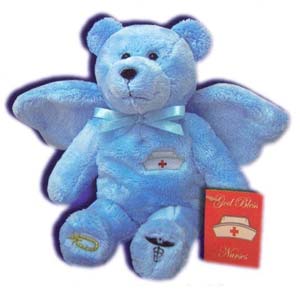
Somewhere along the line, the "angels of mercy" moniker became attached to nurses as a group. Granted, in the early days of nursing, nurses' ability to act autonomously was extremely limited, and we were, by and large, the handmaidens of deified doctors. However, as much as that regrettable history has largely changed, the image of the nurse as angel unfortunately persists quite widely in our culture and websites galore promote gifts and baubles that continue to diminish nurses' professionalism. Images such as this one drive home the point: nurses are childlike individuals with starched white hats who love teddy-bears. Adding insult to injury, nurses can actually be depicted as winged angel/teddy-bears, further enforcing the infantilization (and deprofessionalization) of our profession. Would doctors allow themselves to be thus represented to the public?
Rather than being perceived as cherubic angels and childlike creatures, this writer feels that being perceived as the valuable and skilled professionals who we truly are would allow the public to have a much more accurate perception of what we do, and our importance to the care of millions.
The Clothes on Our Back
Nurses' uniforms have certainly changed over the years, and as scrubs have become the norm for nurses in most clinical settings, many companies have capitalized on the popularity of such utilitarian clothing. Now, designer scrubs covered with angels, teddy-bears (there they are again!), and any number of cartoon-like images adorn the hard-working bodies of nurses around the world. If nurses want to be taken seriously by the public---and by doctors and other professionals---how does the wearing of such (in my opinion) unprofessional clothing help our cause?
Picture this: a team meeting occurs midday to discuss a patient on the adult oncology floor. Present at the meeting: a medical resident, a medical student, the attending doctor, the oncologist, two unit nurses, a social worker and a respiratory therapist. Of all of the professionals in the room, who would possibly be wearing pink scrubs covered with teddy-bears and hearts, and a pin on her chest saying "Doctors Cure, Nurses Care"? And what message does this convey about the nurse's self-image and how the other professionals present in the meeting should perceive him or her?
What's in a Name?
In From Silence to Voice, Buresh and Gordon make their case that nurses being addressed by first name only is also a major image problem when it comes to the public's perception of us a collective whole.
When doctors introduce themselves to patients or other professionals, they always do so by using the title "Doctor" before their name. This practice immediately creates an impression that the doctor is a professional, that he or she has a name that should be remembered, and a hierarchy of power and authority is clearly established from the start.
Conversely, we nurses almost ubiquitously introduce ourselves by first name only, ostensibly to break down the barriers between patients and nurses, assisting the patient in overcoming fears and anxieties related to their treatment. While this tactic may have some limited benefit, Buresh and Gordon argue that "if nurses introduce themselves by their first names only, they are asking to be regarded as nonprofessionals because that is the conventional way that nonprofessionals present themselves."
The "first-name only convention", as the authors have named it, makes it significantly more difficult for individual nurses to receive recognition for their work when only their first names are known. It also creates a hierarchical structure in which the doctor stands alone as a figure of authority, towering above the patient and nurse with (patriarchal or matriarchal) power and authority.
Interestingly, many nurses will argue that introducing ourselves as "Nurse Smith" or "Nurse Cadmus" is awkward at best, but also brings to mind the infamous "Nurse Ratched" from "One Flew Over the Cuckoo's Nest". Granted, Nurse Ratched is a mythic and hated figure in the pantheon of film and modern literature, yet do we see doctors eschewing their well-earned title due to historical figures such as Dr. Kevorkian or Dr. Mengele (of Auschwitz fame)? Absolutely not. Doctors use their title so commonly and so frequently that the word "doctor" simply holds too much cultural power to be diminished by one literary (or real-life) character who used that title for ill.
As for "naming practices" between doctors and nurses themselves, further examples of an unequal playing field emerge, with nurses almost continually subjugated to a diminished status by always being addressed by first name by both patients and doctors, whereas doctors maintain their professionalism and authority through the use of their title and last name.
Taking Credit Where Credit is Due
All too often, the work of nurses is diminished by nurses themselves. When thanked for their work, nurses will frequently say, "Oh, I didn't do much. The doctors really did the hard part." Or when a nurse is asked what he or she does, the answer will often be, "I'm just a nurse." This diminution of nurses' worth does little to cement in the public's collective mind the utter importance---the crucial presence---of nurses in the healthcare system. The "just a nurse" phrase---used all too painfully often---hurts nurses' cultural standing and diminishes the profession in the public's eye.
Nurses need to stand up and take credit for the work that they do. Buresh and Gordon urge nurses to say "You're welcome" when they are thanked. "I am so glad that I could assist you in learning so much about your diabetes, Mr. Smith" or "It was my pleasure to provide your post-operative nursing care, Mrs. Jones"---these are statements that take credit for nurses' actions, acknowledge patients' gratitude, and accept responsibility for providing crucial nursing care that directly impacts patients' recovery and health.
Nurses' Agency
Buresh and Gordon recommend that nurses discover their "voice of agency". According the authors, "the voice of agency is the voice that says: 'I helped the patient to walk after surgery so that she wouldn't get blood clots in her legs' or 'I taught the patient how to take his medications so that they would be effective and produce fewer side effects.' The authors further illustrate their point by reminding us that "the voice of agency is the voice that conveys the message, 'I'm here. I am doing something important.' "
For nurses to develop their own agency---their own power---nurses must first claim and recognize the importance of what they do. As Buresh and Gordon elucidate so clearly in their book, patients do not learn self-care skills in a vacuum. Someone must teach them those skills, and it is nurses who bring their knowledge and education directly to patient care. When recovering from surgery, it isn't doctors who monitor patients every fifteen minutes, using a lifetime's worth of learning to perform important expert assessments. Nurses use a wide variety of skills---often on an autonomous basis---to provide patients with the care and attention they need for optimal health.
While nurses are indeed held in very high esteem by the general public in surveys and polls, most members of that adoring public would be hard pressed to actually describe what it is that nurses do. As Bernice Buresh and Suzanne Gordon make so abundantly clear, it is up to nurses to claim their rightful place of importance in the care provided to patients in a variety of settings. Nurses need to proudly speak of their work with a voice of agency and power, and communicate clearly---to the public, the media, their families, their friends, and their colleagues---that nursing is important, that it is meaningful, and that what nurses do contributes to successful patient care and positive outcomes. We must forgo the teddy-bears, the hearts, the flowers, the useless diminutive statements and self-deprecation, and claim our professionalism for our own.
Nursing's voice must be heard, and Buresh and Gordon feel that the time for that voice to be clearly heard is now.
----------
I have recently been re-reading From Silence to Voice: What Nurses Know and Must Communicate to the Public, by Bernice Buresh and Suzanne Gordon. What I am most struck by is that nurses still have not necessarily found their collective voice, and despite the media attention given to the global nursing shortage, I still believe that Buresh and Gordon's thesis still holds true: the public still does not fully understand what nurses do, and until that day comes, nurses' real value as clinicians will not be common knowledge.
Buresh and Gordon touch on many themes and areas of interest vis-a-vis nurses and their relation to the public, to doctors, and to one another. While I will not provide a review of the book---nor a comprehensive enumerating of its content---there are certain area which pique my interest, and I encourage curious readers to order a copy of the book and explore some of these issues for themselves.
Doctors Cure, Nurses Care
When I first heard this phrase, I was moderately disturbed by it for several reasons. Doctors, by and large, receive the lion's share of praise and gratitude when a sick patient is cured of an illness. Granted, doctors undergo a great deal of training and education in order to offer curative treatments for a variety of diseases, yet all too often, the work of nurses is grossly overlooked when it comes to successful treatment. While nurses do indeed carry out many orders originated from doctors, nurses use their own brand of critical thinking and autonomous action in order to perform specialized patient care. The public may not be aware of this fact, but many actions taken by nurses are initiated by nurses themselves, and the professional clinical assessments performed by nurses will often lead to changes in treatment and greater overall success.
Sure, nurses care, and nursing is seen by the public as a "caring" profession. However, nurses utilize scientific methods, skilled observation, and keen assessment skills to monitor patients' progress. Nurses are not just "the caring eyes and ears of doctors"---nurses are skilled professionals fully involved in patient care---and patient cures.
The Nurse as Angel, Teddy-Bear, and Child
In their book, Buresh and Gordon make one thing clear: nurses' self-presentation says a great deal to the public, and images of nurses that instill themselves in the societal zeitgeist are difficult to dispel.
Somewhere along the line, the "angels of mercy" moniker became attached to nurses as a group. Granted, in the early days of nursing, nurses' ability to act autonomously was extremely limited, and we were, by and large, the handmaidens of deified doctors. However, as much as that regrettable history has largely changed, the image of the nurse as angel unfortunately persists quite widely in our culture and websites galore promote gifts and baubles that continue to diminish nurses' professionalism. Images such as this one drive home the point: nurses are childlike individuals with starched white hats who love teddy-bears. Adding insult to injury, nurses can actually be depicted as winged angel/teddy-bears, further enforcing the infantilization (and deprofessionalization) of our profession. Would doctors allow themselves to be thus represented to the public?
Rather than being perceived as cherubic angels and childlike creatures, this writer feels that being perceived as the valuable and skilled professionals who we truly are would allow the public to have a much more accurate perception of what we do, and our importance to the care of millions.
The Clothes on Our Back
Nurses' uniforms have certainly changed over the years, and as scrubs have become the norm for nurses in most clinical settings, many companies have capitalized on the popularity of such utilitarian clothing. Now, designer scrubs covered with angels, teddy-bears (there they are again!), and any number of cartoon-like images adorn the hard-working bodies of nurses around the world. If nurses want to be taken seriously by the public---and by doctors and other professionals---how does the wearing of such (in my opinion) unprofessional clothing help our cause?
Picture this: a team meeting occurs midday to discuss a patient on the adult oncology floor. Present at the meeting: a medical resident, a medical student, the attending doctor, the oncologist, two unit nurses, a social worker and a respiratory therapist. Of all of the professionals in the room, who would possibly be wearing pink scrubs covered with teddy-bears and hearts, and a pin on her chest saying "Doctors Cure, Nurses Care"? And what message does this convey about the nurse's self-image and how the other professionals present in the meeting should perceive him or her?
What's in a Name?
In From Silence to Voice, Buresh and Gordon make their case that nurses being addressed by first name only is also a major image problem when it comes to the public's perception of us a collective whole.
When doctors introduce themselves to patients or other professionals, they always do so by using the title "Doctor" before their name. This practice immediately creates an impression that the doctor is a professional, that he or she has a name that should be remembered, and a hierarchy of power and authority is clearly established from the start.
Conversely, we nurses almost ubiquitously introduce ourselves by first name only, ostensibly to break down the barriers between patients and nurses, assisting the patient in overcoming fears and anxieties related to their treatment. While this tactic may have some limited benefit, Buresh and Gordon argue that "if nurses introduce themselves by their first names only, they are asking to be regarded as nonprofessionals because that is the conventional way that nonprofessionals present themselves."
The "first-name only convention", as the authors have named it, makes it significantly more difficult for individual nurses to receive recognition for their work when only their first names are known. It also creates a hierarchical structure in which the doctor stands alone as a figure of authority, towering above the patient and nurse with (patriarchal or matriarchal) power and authority.
Interestingly, many nurses will argue that introducing ourselves as "Nurse Smith" or "Nurse Cadmus" is awkward at best, but also brings to mind the infamous "Nurse Ratched" from "One Flew Over the Cuckoo's Nest". Granted, Nurse Ratched is a mythic and hated figure in the pantheon of film and modern literature, yet do we see doctors eschewing their well-earned title due to historical figures such as Dr. Kevorkian or Dr. Mengele (of Auschwitz fame)? Absolutely not. Doctors use their title so commonly and so frequently that the word "doctor" simply holds too much cultural power to be diminished by one literary (or real-life) character who used that title for ill.
As for "naming practices" between doctors and nurses themselves, further examples of an unequal playing field emerge, with nurses almost continually subjugated to a diminished status by always being addressed by first name by both patients and doctors, whereas doctors maintain their professionalism and authority through the use of their title and last name.
Taking Credit Where Credit is Due
All too often, the work of nurses is diminished by nurses themselves. When thanked for their work, nurses will frequently say, "Oh, I didn't do much. The doctors really did the hard part." Or when a nurse is asked what he or she does, the answer will often be, "I'm just a nurse." This diminution of nurses' worth does little to cement in the public's collective mind the utter importance---the crucial presence---of nurses in the healthcare system. The "just a nurse" phrase---used all too painfully often---hurts nurses' cultural standing and diminishes the profession in the public's eye.
Nurses need to stand up and take credit for the work that they do. Buresh and Gordon urge nurses to say "You're welcome" when they are thanked. "I am so glad that I could assist you in learning so much about your diabetes, Mr. Smith" or "It was my pleasure to provide your post-operative nursing care, Mrs. Jones"---these are statements that take credit for nurses' actions, acknowledge patients' gratitude, and accept responsibility for providing crucial nursing care that directly impacts patients' recovery and health.
Nurses' Agency
Buresh and Gordon recommend that nurses discover their "voice of agency". According the authors, "the voice of agency is the voice that says: 'I helped the patient to walk after surgery so that she wouldn't get blood clots in her legs' or 'I taught the patient how to take his medications so that they would be effective and produce fewer side effects.' The authors further illustrate their point by reminding us that "the voice of agency is the voice that conveys the message, 'I'm here. I am doing something important.' "
For nurses to develop their own agency---their own power---nurses must first claim and recognize the importance of what they do. As Buresh and Gordon elucidate so clearly in their book, patients do not learn self-care skills in a vacuum. Someone must teach them those skills, and it is nurses who bring their knowledge and education directly to patient care. When recovering from surgery, it isn't doctors who monitor patients every fifteen minutes, using a lifetime's worth of learning to perform important expert assessments. Nurses use a wide variety of skills---often on an autonomous basis---to provide patients with the care and attention they need for optimal health.
While nurses are indeed held in very high esteem by the general public in surveys and polls, most members of that adoring public would be hard pressed to actually describe what it is that nurses do. As Bernice Buresh and Suzanne Gordon make so abundantly clear, it is up to nurses to claim their rightful place of importance in the care provided to patients in a variety of settings. Nurses need to proudly speak of their work with a voice of agency and power, and communicate clearly---to the public, the media, their families, their friends, and their colleagues---that nursing is important, that it is meaningful, and that what nurses do contributes to successful patient care and positive outcomes. We must forgo the teddy-bears, the hearts, the flowers, the useless diminutive statements and self-deprecation, and claim our professionalism for our own.
Nursing's voice must be heard, and Buresh and Gordon feel that the time for that voice to be clearly heard is now.
Saturday, February 27, 2010
Suzanne Gordon Offers A New Book for Nurses
Suzanne Gordon, an esteemed author previously discussed on this blog (click here and here for two of those posts), has now published a new book about nursing that will certainly be required reading for anyone desirous of a realistic view of issues facing nurses in the 21st century.
"When Chicken Soup Isn't Enough: Stories of Nurses Standing Up for Themselves, Their Patients, and Their Profession", is a response to the soft and sentimental genre of feel-good books which have been published, according to Gordon, to lift the spirits of overworked and unappreciated nurses without thought of empowerment or a true representation of what nurses actually do. Gordon says on her website:
"The problem is, in this heavily sentimental genre, the real-world context of long hours, increased patient loads, and chronic understaffing quickly fades into the background. In the foreground we see traditional images of nurses as people (generally women) who “make a difference” through their touch–always gentle–and niceness. Rarely are their abilities or technical knowledge–represented in a true-to-life setting–the subjects of the story…"
I for one greatly appreciate Gordon's response to what I see as an insipid "Chicken Soup" book culture that uses platitudes and niceties to gloss over the true reality behind the myth of nurses as angels of mercy who simply need a pat on the back and an inspirational story in order to continue working double shifts and mandatory overtime without complaint.
Gordon continues on her website:
"No wonder the public clings to this sentimentalized vision of nurses and texts that are produced to inspire nurses deliver up story after saccharine story that reinforce traditional stereotypes of nursing and women’s work. Nurses are plied from every direction with a narrative that depicts them as modern angels endowed with extraordinary powers of empathy and compassion–qualities that are never depicted as the products of education or experience on the job."
The "angel of mercy" image of nurses---long a myth brought forward since the time of Florence Nightingale---has indeed secured a place in the modern view of nurses, and it is authors like Suzanne Gordon who seek to shatter that image and paint a picture of nurses' challenges and true professionalism with realistic hues.
I sincerely hope that I myself have not inadvertently contributed to this widespread sentimentalism about nurses and nursing through my own writings in print and online, but as a nurse on the front lines since the mid-90's, I hope I have indeed written enough about the vicissitudes of nursing over the years to make up for any notions of sentimentality on my part.
Suzanne Gordon's consistent championing of the cause of 21st-century nursing is heartening and encouraging. Gordon brings a sober journalist's eye to a subject that, according to her keen observation, has been watered down and delivered without consideration regarding how to move nurses from sentimental caricature to real life. Gordon believes that nurses need "crucial tools" such as negotiation and conflict resolution in order to have a true seat at the health care table, and the "inspirational narratives" so often published about nurses focus too much on feeling and not enough on the nitty gritty action that portrays nurses in a true light.
I greatly look forward to reading Gordon's new book, and applaud her for her advocacy and courage as a writer and journalist. Gordon has done a great deal for nurses through her work as an author, and I'm certain that this new collection will only add to the canon of literature that truly defines the reality of modern-day nursing.
"When Chicken Soup Isn't Enough: Stories of Nurses Standing Up for Themselves, Their Patients, and Their Profession", is a response to the soft and sentimental genre of feel-good books which have been published, according to Gordon, to lift the spirits of overworked and unappreciated nurses without thought of empowerment or a true representation of what nurses actually do. Gordon says on her website:
"The problem is, in this heavily sentimental genre, the real-world context of long hours, increased patient loads, and chronic understaffing quickly fades into the background. In the foreground we see traditional images of nurses as people (generally women) who “make a difference” through their touch–always gentle–and niceness. Rarely are their abilities or technical knowledge–represented in a true-to-life setting–the subjects of the story…"
I for one greatly appreciate Gordon's response to what I see as an insipid "Chicken Soup" book culture that uses platitudes and niceties to gloss over the true reality behind the myth of nurses as angels of mercy who simply need a pat on the back and an inspirational story in order to continue working double shifts and mandatory overtime without complaint.
Gordon continues on her website:
"No wonder the public clings to this sentimentalized vision of nurses and texts that are produced to inspire nurses deliver up story after saccharine story that reinforce traditional stereotypes of nursing and women’s work. Nurses are plied from every direction with a narrative that depicts them as modern angels endowed with extraordinary powers of empathy and compassion–qualities that are never depicted as the products of education or experience on the job."
The "angel of mercy" image of nurses---long a myth brought forward since the time of Florence Nightingale---has indeed secured a place in the modern view of nurses, and it is authors like Suzanne Gordon who seek to shatter that image and paint a picture of nurses' challenges and true professionalism with realistic hues.
I sincerely hope that I myself have not inadvertently contributed to this widespread sentimentalism about nurses and nursing through my own writings in print and online, but as a nurse on the front lines since the mid-90's, I hope I have indeed written enough about the vicissitudes of nursing over the years to make up for any notions of sentimentality on my part.
Suzanne Gordon's consistent championing of the cause of 21st-century nursing is heartening and encouraging. Gordon brings a sober journalist's eye to a subject that, according to her keen observation, has been watered down and delivered without consideration regarding how to move nurses from sentimental caricature to real life. Gordon believes that nurses need "crucial tools" such as negotiation and conflict resolution in order to have a true seat at the health care table, and the "inspirational narratives" so often published about nurses focus too much on feeling and not enough on the nitty gritty action that portrays nurses in a true light.
I greatly look forward to reading Gordon's new book, and applaud her for her advocacy and courage as a writer and journalist. Gordon has done a great deal for nurses through her work as an author, and I'm certain that this new collection will only add to the canon of literature that truly defines the reality of modern-day nursing.
Friday, May 29, 2009
"Nurse Jackie" Disappoints and Demeans
So, I just finished watching the first episode of "Nurse Jackie", the new Showtime television show about a nurse on the front lines.
What is so disappointing about "Nurse Jackie" is that, in the first five minutes of the premier, this insipid "dramedy" depicts the lead character snorting narcotics while on the clock, forging a dead patient's signature on an organ donor card, lying to said patient's family about the organ donor status of their loved one, and engaging in illicit sex with a coworker while her husband's at home caring for her two young children. Meanwhile, a 1st year nursing student pegs our heroine (or anti-heroine, if you will) as a saint, a designation that Jackie appears to aspire to, "but just not yet".
Now, I'm not so naive as to think that there aren't nurses out there who divert medications, have affairs with coworkers, and engage in all manner of improper behavior. But I take issue with the fact that even though nurses are the most trusted professionals in the United States on survey after survey, the media continues to portray nurses in derogatory ways that undermine our credibility and image in the eyes of the public.
While Florence Nightingale may indeed be the most famous nurse in history, Nurse Ratched of "One Flew Over the Cuckoo's Nest" is probably a close second. Sadly, the premier of "Nurse Jackie" does nothing to advance the cause of nursing in the eyes of the television audience, relying instead on gallows humor, sexual intrigue and drug diversion to add spice to a lackluster premier that demeans nurses and diverts the public's attention from the real story of nursing that is ultimately more compelling than any faux "dramedy" could ever be.
What is so disappointing about "Nurse Jackie" is that, in the first five minutes of the premier, this insipid "dramedy" depicts the lead character snorting narcotics while on the clock, forging a dead patient's signature on an organ donor card, lying to said patient's family about the organ donor status of their loved one, and engaging in illicit sex with a coworker while her husband's at home caring for her two young children. Meanwhile, a 1st year nursing student pegs our heroine (or anti-heroine, if you will) as a saint, a designation that Jackie appears to aspire to, "but just not yet".
Now, I'm not so naive as to think that there aren't nurses out there who divert medications, have affairs with coworkers, and engage in all manner of improper behavior. But I take issue with the fact that even though nurses are the most trusted professionals in the United States on survey after survey, the media continues to portray nurses in derogatory ways that undermine our credibility and image in the eyes of the public.
While Florence Nightingale may indeed be the most famous nurse in history, Nurse Ratched of "One Flew Over the Cuckoo's Nest" is probably a close second. Sadly, the premier of "Nurse Jackie" does nothing to advance the cause of nursing in the eyes of the television audience, relying instead on gallows humor, sexual intrigue and drug diversion to add spice to a lackluster premier that demeans nurses and diverts the public's attention from the real story of nursing that is ultimately more compelling than any faux "dramedy" could ever be.
Monday, March 02, 2009
Nursing: Surviving the Storm With Trust as the Key
A blogger friend of mine recently posted an article about the nursing profession's "unbreakable" standing despite these challenging economic times. Several of her points are very well taken, and I wanted to take this opportunity to weigh in and expand upon some of her most salient ideas.
According to the 2008 Gallup Honesty/Ethics Poll, nurses are once again in the #1 spot, and have been for the past seven years. In fact, 24% of respondents rated nurses' ethics as "very high", whereas 60% rated nurses' ethics as "high", with only 1% rating nurses as "low" on the ethics scale. Not surprisingly, bankers did not fare so well, along with stockbrokers, people who sell cars, lobbyists, and telemarketers.
My blogger friend points out in her article that the general public adheres to a "nurses are angels" ethos wherein nurses are still regarded as angelic and selfless individuals who serve others due to their higher-than-normal moral standing and ceaseless desire to give. While this "nurse as angel" motif is indeed quite vexing to those of us who would like nursing to eschew it in favor of simple professionalism, the public's consistent habit of equating nurses with the angelic realm has certainly cemented our status as a trustworthy source of care for the infirm. Now, if we could trade in those angel-nurse statuettes for higher salaries, I'd be delighted.
Setting those ridiculous and maddening nurse angel images aside, nurses are indeed a very trusted group of people in many societies, and here in the U.S., it seems that Americans hold us nurses in very high esteem. Personally, I'm happy to be a member of a profession that is so revered. Taking that into consideration, I feel strongly that the nursing profession should more aggressively utilize this trust as a means to, 1) recruit more people into the profession, 2) gain further recognition as a true profession (not just a "calling") with its own code of ethics and standards, 3) advance recognition of nursing research, 4) parlay that trust and recognition into higher pay and better benefits, 5) demand government support for those wishing to enter the profession, and 6) pressure the President to create an Office of the National Nurse that would be on equal footing with the Surgeon General in terms of public health and national health policy.
Nurses have earned the trust of millions of Americans, and it is my point of view that the nursing profession should intelligently and wisely parlay this trust into an acceptance of an agenda of greater professional recognition and increased earning potential.
Speaking of earning potential, here is a conundrum that is especially troubling to this nurse who has actually seen his salary decline over the last few years. If lobbyists, lawyers, bankers, stockbrokers, business executives, and members of Congress rank so low on the public's list of trusted professionals, why do those groups earn so much more than nurses? If nurses are so revered by our society, why are we not paid on a scale that matches the importance of the service which we provide? And why don't pharmacists (the second most trusted professionals) and high school teachers (the third most trusted) receive remuneration equal to their societal value and level of public esteem? As corporate CEOs walk away with multimillion dollar severance packages and bonuses at a time of economic implosion across the board, why aren't the professionals who have actually earned the trust of the American people rewarded for that trust?
Nurses have served the public in myriad capacities for many centuries, and like physicians, nurses frequently hold lives (and troubled hearts) in their capable hands. It is an honor to be a nurse, to know that I am a member of a profession held in such esteem, and I honestly and consciously work to earn that esteem as I execute my professional duties.
My blogger friend feels that nursing is a "unbreakable" profession, trusted and needed by all who interface with the health care system. Yes, we are unbreakable, and as a profession we use integrity, competence and character to garner the trust that is so freely given to us by an appreciative public. Integrity, competence and character are truly a great foundation, and that strong foundation is what will continue to carry us through the difficult times ahead.
According to the 2008 Gallup Honesty/Ethics Poll, nurses are once again in the #1 spot, and have been for the past seven years. In fact, 24% of respondents rated nurses' ethics as "very high", whereas 60% rated nurses' ethics as "high", with only 1% rating nurses as "low" on the ethics scale. Not surprisingly, bankers did not fare so well, along with stockbrokers, people who sell cars, lobbyists, and telemarketers.
My blogger friend points out in her article that the general public adheres to a "nurses are angels" ethos wherein nurses are still regarded as angelic and selfless individuals who serve others due to their higher-than-normal moral standing and ceaseless desire to give. While this "nurse as angel" motif is indeed quite vexing to those of us who would like nursing to eschew it in favor of simple professionalism, the public's consistent habit of equating nurses with the angelic realm has certainly cemented our status as a trustworthy source of care for the infirm. Now, if we could trade in those angel-nurse statuettes for higher salaries, I'd be delighted.
Setting those ridiculous and maddening nurse angel images aside, nurses are indeed a very trusted group of people in many societies, and here in the U.S., it seems that Americans hold us nurses in very high esteem. Personally, I'm happy to be a member of a profession that is so revered. Taking that into consideration, I feel strongly that the nursing profession should more aggressively utilize this trust as a means to, 1) recruit more people into the profession, 2) gain further recognition as a true profession (not just a "calling") with its own code of ethics and standards, 3) advance recognition of nursing research, 4) parlay that trust and recognition into higher pay and better benefits, 5) demand government support for those wishing to enter the profession, and 6) pressure the President to create an Office of the National Nurse that would be on equal footing with the Surgeon General in terms of public health and national health policy.
Nurses have earned the trust of millions of Americans, and it is my point of view that the nursing profession should intelligently and wisely parlay this trust into an acceptance of an agenda of greater professional recognition and increased earning potential.
Speaking of earning potential, here is a conundrum that is especially troubling to this nurse who has actually seen his salary decline over the last few years. If lobbyists, lawyers, bankers, stockbrokers, business executives, and members of Congress rank so low on the public's list of trusted professionals, why do those groups earn so much more than nurses? If nurses are so revered by our society, why are we not paid on a scale that matches the importance of the service which we provide? And why don't pharmacists (the second most trusted professionals) and high school teachers (the third most trusted) receive remuneration equal to their societal value and level of public esteem? As corporate CEOs walk away with multimillion dollar severance packages and bonuses at a time of economic implosion across the board, why aren't the professionals who have actually earned the trust of the American people rewarded for that trust?
Nurses have served the public in myriad capacities for many centuries, and like physicians, nurses frequently hold lives (and troubled hearts) in their capable hands. It is an honor to be a nurse, to know that I am a member of a profession held in such esteem, and I honestly and consciously work to earn that esteem as I execute my professional duties.
My blogger friend feels that nursing is a "unbreakable" profession, trusted and needed by all who interface with the health care system. Yes, we are unbreakable, and as a profession we use integrity, competence and character to garner the trust that is so freely given to us by an appreciative public. Integrity, competence and character are truly a great foundation, and that strong foundation is what will continue to carry us through the difficult times ahead.
Friday, September 12, 2008
Nurses' Voices, Nurses' Image: Nurses' Power
(Note: This is my sixth post under the auspices of the nurse blogger scholarship which I recently received from Value Care, Value Nurses.)
I have recently been re-reading From Silence to Voice: What Nurses Know and Must Communicate to the Public, by Bernice Buresh and Suzanne Gordon. What I am most struck by is that nurses still have not necessarily found their collective voice, and despite the media attention given to the global nursing shortage, I still believe that Buresh and Gordon's thesis still holds true: the public still does not fully understand what nurses do, and until that day comes, nurses' real value as clinicians will not be common knowledge.
Buresh and Gordon touch on many themes and areas of interest vis-a-vis nurses and their relation to the public, to doctors, and to one another. While I will not provide a review of the book---nor a comprehensive enumerating of its content---there are certain area which pique my interest, and I encourage curious readers to order a copy of the book and explore some of these issues for themselves.
Doctors Cure, Nurses Care
When I first heard this phrase, I was moderately disturbed by it for several reasons. Doctors, by and large, receive the lion's share of praise and gratitude when a sick patient is cured of an illness. Granted, doctors undergo a great deal of training and education in order to offer curative treatments for a variety of diseases, yet all too often, the work of nurses is grossly overlooked when it comes to successful treatment. While nurses do indeed carry out many orders originated from doctors, nurses use their own brand of critical thinking and autonomous action in order to perform specialized patient care. The public may not be aware of this fact, but many actions taken by nurses are initiated by nurses themselves, and the professional clinical assessments performed by nurses will often lead to changes in treatment and greater overall success.
Sure, nurses care, and nursing is seen by the public as a "caring" profession. However, nurses utilize scientific methods, skilled observation, and keen assessment skills to monitor patients' progress. Nurses are not just "the caring eyes and ears of doctors"---nurses are skilled professionals fully involved in patient care---and patient cures.
The Nurse as Angel, Teddy-Bear, and Child
In their book, Buresh and Gordon make one thing clear: nurses' self-presentation says a great deal to the public, and images of nurses that instill themselves in the societal zeitgeist are difficult to dispel.
Somewhere along the line, the "angels of mercy" moniker became attached to nurses as a group. Granted, in the early days of nursing, nurses' ability to act autonomously was extremely limited, and we were, by and large, the handmaidens of deified doctors. However, as much as that regrettable history has largely changed, the image of the nurse as angel unfortunately persists quite widely in our culture and websites galore promote gifts and baubles that continue to diminish nurses' professionalism. Images such as this one drive home the point: nurses are childlike individuals with starched white hats who love teddy-bears. Adding insult to injury, nurses can actually be depicted as winged angel/teddy-bears, further enforcing the infantilization (and deprofessionalization) of our profession. Would doctors allow themselves to be thus represented to the public?
Rather than being perceived as cherubic angels and childlike creatures, this writer feels that being perceived as the valuable and skilled professionals who we truly are would allow the public to have a much more accurate perception of what we do, and our importance to the care of millions.
The Clothes on Our BackNurses' uniforms have certainly changed over the years, and as scrubs have become the norm for nurses in most clinical settings, many companies have capitalized on the popularity of such utilitarian clothing. Now, designer scrubs covered with angels, teddy-bears (there they are again!), and any number of cartoon-like images adorn the hard-working bodies of nurses around the world. If nurses want to be taken seriously by the public---and by doctors and other professionals---how does the wearing of such (in my opinion) unprofessional clothing help our cause?
Picture this: a team meeting occurs midday to discuss a patient on the adult oncology floor. Present at the meeting: a medical resident, a medical student, the attending doctor, the oncologist, two unit nurses, a social worker and a respiratory therapist. Of all of the professionals in the room, who would possibly be wearing pink scrubs covered with teddy-bears and hearts, and a pin on her chest saying "Doctors Cure, Nurses Care"? And what message does this convey about the nurse's self-image and how the other professionals present in the meeting should perceive him or her?
What's in a Name?
In From Silence to Voice, Buresh and Gordon make their case that nurses being addressed by first name only is also a major image problem when it comes to the public's perception of us a collective whole.
When doctors introduce themselves to patients or other professionals, they always do so by using the title "Doctor" before their name. This practice immediately creates an impression that the doctor is a professional, that he or she has a name that should be remembered, and a hierarchy of power and authority is clearly established from the start.
Conversely, we nurses almost ubiquitously introduce ourselves by first name only, ostensibly to break down the barriers between patients and nurses, assisting the patient in overcoming fears and anxieties related to their treatment. While this tactic may have some limited benefit, Buresh and Gordon argue that "if nurses introduce themselves by their first names only, they are asking to be regarded as nonprofessionals because that is the conventional way that nonprofessionals present themselves."
The "first-name only convention", as the authors have named it, makes it significantly more difficult for individual nurses to receive recognition for their work when only their first names are known. It also creates a hierarchical structure in which the doctor stands alone as a figure of authority, towering above the patient and nurse with (patriarchal or matriarchal) power and authority.
Interestingly, many nurses will argue that introducing ourselves as "Nurse Smith" or "Nurse Cadmus" is awkward at best, but also brings to mind the infamous "Nurse Ratched" from "One Flew Over the Cuckoo's Nest". Granted, Nurse Ratched is a mythic and hated figure in the pantheon of film and modern literature, yet do we see doctors eschewing their well-earned title due to historical figures such as Dr. Kevorkian or Dr. Mengele (of Auschwitz fame)? Absolutely not. Doctors use their title so commonly and so frequently that the word "doctor" simply holds too much cultural power to be diminished by one literary (or real-life) character who used that title for ill.
As for "naming practices" between doctors and nurses themselves, further examples of an unequal playing field emerge, with nurses almost continually subjugated to a diminished status by always being addressed by first name by both patients and doctors, whereas doctors maintain their professionalism and authority through the use of their title and last name.
Taking Credit Where Credit is Due
All too often, the work of nurses is diminished by nurses themselves. When thanked for their work, nurses will frequently say, "Oh, I didn't do much. The doctors really did the hard part." Or when a nurse is asked what he or she does, the answer will often be, "I'm just a nurse." This diminution of nurses' worth does little to cement in the public's collective mind the utter importance---the crucial presence---of nurses in the healthcare system. The "just a nurse" phrase---used all too painfully often---hurts nurses' cultural standing and diminishes the profession in the public's eye.
Nurses need to stand up and take credit for the work that they do. Buresh and Gordon urge nurses to say "You're welcome" when they are thanked. "I am so glad that I could assist you in learning so much about your diabetes, Mr. Smith" or "It was my pleasure to provide your post-operative nursing care, Mrs. Jones"---these are statements that take credit for nurses' actions, acknowledge patients' gratitude, and accept responsibility for providing crucial nursing care that directly impacts patients' recovery and health.
Nurses' Agency
Buresh and Gordon recommend that nurses discover their "voice of agency". According the authors, "the voice of agency is the voice that says: 'I helped the patient to walk after surgery so that she wouldn't get blood clots in her legs' or 'I taught the patient how to take his medications so that they would be effective and produce fewer side effects.' The authors further illustrate their point by reminding us that "the voice of agency is the voice that conveys the message, 'I'm here. I am doing something important.' "
For nurses to develop their own agency---their own power---nurses must first claim and recognize the importance of what they do. As Buresh and Gordon elucidate so clearly in their book, patients do not learn self-care skills in a vacuum. Someone must teach them those skills, and it is nurses who bring their knowledge and education directly to patient care. When recovering from surgery, it isn't doctors who monitor patients every fifteen minutes, using a lifetime's worth of learning to perform important expert assessments. Nurses use a wide variety of skills---often on an autonomous basis---to provide patients with the care and attention they need for optimal health.
While nurses are indeed held in very high esteem by the general public in surveys and polls, most members of that adoring public would be hard pressed to actually describe what it is that nurses do. As Bernice Buresh and Suzanne Gordon make so abundantly clear, it is up to nurses to claim their rightful place of importance in the care provided to patients in a variety of settings. Nurses need to proudly speak of their work with a voice of agency and power, and communicate clearly---to the public, the media, their families, their friends, and their colleagues---that nursing is important, that it is meaningful, and that what nurses do contributes to successful patient care and positive outcomes. We must forgo the teddy-bears, the hearts, the flowers, the useless diminutive statements and self-deprecation, and claim our professionalism for our own.
Nursing's voice must be heard, and Buresh and Gordon feel that the time for that voice to be clearly heard is now.
I have recently been re-reading From Silence to Voice: What Nurses Know and Must Communicate to the Public, by Bernice Buresh and Suzanne Gordon. What I am most struck by is that nurses still have not necessarily found their collective voice, and despite the media attention given to the global nursing shortage, I still believe that Buresh and Gordon's thesis still holds true: the public still does not fully understand what nurses do, and until that day comes, nurses' real value as clinicians will not be common knowledge.
Buresh and Gordon touch on many themes and areas of interest vis-a-vis nurses and their relation to the public, to doctors, and to one another. While I will not provide a review of the book---nor a comprehensive enumerating of its content---there are certain area which pique my interest, and I encourage curious readers to order a copy of the book and explore some of these issues for themselves.
Doctors Cure, Nurses Care
When I first heard this phrase, I was moderately disturbed by it for several reasons. Doctors, by and large, receive the lion's share of praise and gratitude when a sick patient is cured of an illness. Granted, doctors undergo a great deal of training and education in order to offer curative treatments for a variety of diseases, yet all too often, the work of nurses is grossly overlooked when it comes to successful treatment. While nurses do indeed carry out many orders originated from doctors, nurses use their own brand of critical thinking and autonomous action in order to perform specialized patient care. The public may not be aware of this fact, but many actions taken by nurses are initiated by nurses themselves, and the professional clinical assessments performed by nurses will often lead to changes in treatment and greater overall success.
Sure, nurses care, and nursing is seen by the public as a "caring" profession. However, nurses utilize scientific methods, skilled observation, and keen assessment skills to monitor patients' progress. Nurses are not just "the caring eyes and ears of doctors"---nurses are skilled professionals fully involved in patient care---and patient cures.
The Nurse as Angel, Teddy-Bear, and Child
In their book, Buresh and Gordon make one thing clear: nurses' self-presentation says a great deal to the public, and images of nurses that instill themselves in the societal zeitgeist are difficult to dispel.
Somewhere along the line, the "angels of mercy" moniker became attached to nurses as a group. Granted, in the early days of nursing, nurses' ability to act autonomously was extremely limited, and we were, by and large, the handmaidens of deified doctors. However, as much as that regrettable history has largely changed, the image of the nurse as angel unfortunately persists quite widely in our culture and websites galore promote gifts and baubles that continue to diminish nurses' professionalism. Images such as this one drive home the point: nurses are childlike individuals with starched white hats who love teddy-bears. Adding insult to injury, nurses can actually be depicted as winged angel/teddy-bears, further enforcing the infantilization (and deprofessionalization) of our profession. Would doctors allow themselves to be thus represented to the public?
Rather than being perceived as cherubic angels and childlike creatures, this writer feels that being perceived as the valuable and skilled professionals who we truly are would allow the public to have a much more accurate perception of what we do, and our importance to the care of millions.
The Clothes on Our BackNurses' uniforms have certainly changed over the years, and as scrubs have become the norm for nurses in most clinical settings, many companies have capitalized on the popularity of such utilitarian clothing. Now, designer scrubs covered with angels, teddy-bears (there they are again!), and any number of cartoon-like images adorn the hard-working bodies of nurses around the world. If nurses want to be taken seriously by the public---and by doctors and other professionals---how does the wearing of such (in my opinion) unprofessional clothing help our cause?
Picture this: a team meeting occurs midday to discuss a patient on the adult oncology floor. Present at the meeting: a medical resident, a medical student, the attending doctor, the oncologist, two unit nurses, a social worker and a respiratory therapist. Of all of the professionals in the room, who would possibly be wearing pink scrubs covered with teddy-bears and hearts, and a pin on her chest saying "Doctors Cure, Nurses Care"? And what message does this convey about the nurse's self-image and how the other professionals present in the meeting should perceive him or her?
What's in a Name?
In From Silence to Voice, Buresh and Gordon make their case that nurses being addressed by first name only is also a major image problem when it comes to the public's perception of us a collective whole.
When doctors introduce themselves to patients or other professionals, they always do so by using the title "Doctor" before their name. This practice immediately creates an impression that the doctor is a professional, that he or she has a name that should be remembered, and a hierarchy of power and authority is clearly established from the start.
Conversely, we nurses almost ubiquitously introduce ourselves by first name only, ostensibly to break down the barriers between patients and nurses, assisting the patient in overcoming fears and anxieties related to their treatment. While this tactic may have some limited benefit, Buresh and Gordon argue that "if nurses introduce themselves by their first names only, they are asking to be regarded as nonprofessionals because that is the conventional way that nonprofessionals present themselves."
The "first-name only convention", as the authors have named it, makes it significantly more difficult for individual nurses to receive recognition for their work when only their first names are known. It also creates a hierarchical structure in which the doctor stands alone as a figure of authority, towering above the patient and nurse with (patriarchal or matriarchal) power and authority.
Interestingly, many nurses will argue that introducing ourselves as "Nurse Smith" or "Nurse Cadmus" is awkward at best, but also brings to mind the infamous "Nurse Ratched" from "One Flew Over the Cuckoo's Nest". Granted, Nurse Ratched is a mythic and hated figure in the pantheon of film and modern literature, yet do we see doctors eschewing their well-earned title due to historical figures such as Dr. Kevorkian or Dr. Mengele (of Auschwitz fame)? Absolutely not. Doctors use their title so commonly and so frequently that the word "doctor" simply holds too much cultural power to be diminished by one literary (or real-life) character who used that title for ill.
As for "naming practices" between doctors and nurses themselves, further examples of an unequal playing field emerge, with nurses almost continually subjugated to a diminished status by always being addressed by first name by both patients and doctors, whereas doctors maintain their professionalism and authority through the use of their title and last name.
Taking Credit Where Credit is Due
All too often, the work of nurses is diminished by nurses themselves. When thanked for their work, nurses will frequently say, "Oh, I didn't do much. The doctors really did the hard part." Or when a nurse is asked what he or she does, the answer will often be, "I'm just a nurse." This diminution of nurses' worth does little to cement in the public's collective mind the utter importance---the crucial presence---of nurses in the healthcare system. The "just a nurse" phrase---used all too painfully often---hurts nurses' cultural standing and diminishes the profession in the public's eye.
Nurses need to stand up and take credit for the work that they do. Buresh and Gordon urge nurses to say "You're welcome" when they are thanked. "I am so glad that I could assist you in learning so much about your diabetes, Mr. Smith" or "It was my pleasure to provide your post-operative nursing care, Mrs. Jones"---these are statements that take credit for nurses' actions, acknowledge patients' gratitude, and accept responsibility for providing crucial nursing care that directly impacts patients' recovery and health.
Nurses' Agency
Buresh and Gordon recommend that nurses discover their "voice of agency". According the authors, "the voice of agency is the voice that says: 'I helped the patient to walk after surgery so that she wouldn't get blood clots in her legs' or 'I taught the patient how to take his medications so that they would be effective and produce fewer side effects.' The authors further illustrate their point by reminding us that "the voice of agency is the voice that conveys the message, 'I'm here. I am doing something important.' "
For nurses to develop their own agency---their own power---nurses must first claim and recognize the importance of what they do. As Buresh and Gordon elucidate so clearly in their book, patients do not learn self-care skills in a vacuum. Someone must teach them those skills, and it is nurses who bring their knowledge and education directly to patient care. When recovering from surgery, it isn't doctors who monitor patients every fifteen minutes, using a lifetime's worth of learning to perform important expert assessments. Nurses use a wide variety of skills---often on an autonomous basis---to provide patients with the care and attention they need for optimal health.
While nurses are indeed held in very high esteem by the general public in surveys and polls, most members of that adoring public would be hard pressed to actually describe what it is that nurses do. As Bernice Buresh and Suzanne Gordon make so abundantly clear, it is up to nurses to claim their rightful place of importance in the care provided to patients in a variety of settings. Nurses need to proudly speak of their work with a voice of agency and power, and communicate clearly---to the public, the media, their families, their friends, and their colleagues---that nursing is important, that it is meaningful, and that what nurses do contributes to successful patient care and positive outcomes. We must forgo the teddy-bears, the hearts, the flowers, the useless diminutive statements and self-deprecation, and claim our professionalism for our own.
Nursing's voice must be heard, and Buresh and Gordon feel that the time for that voice to be clearly heard is now.
Subscribe to:
Posts (Atom)