Sunday, January 15, 2012

NurseFriendly on RN.FM Radio!


Just a reminder that tomorrow, January 16th, 2012, Andrew Lopez of Nursefriendly.com will be our guest on RN.FM Radio. Andrew is the consummate connector and promoter of nurses, and we look forward to his appearance on RN.FM Radio! Tune in or listen to the archived show afterwards.

Also, please take a peek at our new RN.FM Radio website! It's growing by the day!

"See" you there! 


Wednesday, January 11, 2012

Book Review: "Confident Voices" by Beth Boynton

A note to the reader: As always, I have received no remuneration for posting this book review. As a point of disclosure, I did, however, receive a free copy of the book from the author in order to facilitate the review process.
--------------

"Confident Voices: The Nurse's Guide to Improving Communication and Creating Positive Workplaces", was published in 2009 by Beth Boynton, RN, MS and edited by Bonnie Kerrick, RN, BSN.

Summary

In Confident Voices, Boynton strives to give nurses the understanding and skills to navigate the workplace in a way that fosters improved communication, healthier workplaces and a more supportive and safe environment for them and their colleagues. Boynton achieves her goal, and delivers information that is useful, well-organized, easy to digest, and potentially possible to put into practice immediately.

The book walks the reader through three distinct sections covering various topics of interest to the nurse who wishes to work in an environment that supports positive relationships and respectful communication.

Part I addresses workplace dynamics, and identifies the characteristics of toxic workplaces, and delves into theories that explain human behavior, especially in the context of the workplace. Organizational culture is explained and dissected, and workplace violence---be it physical, verbal or emotional---is also addressed.

Part II is focused on "building assertiveness and respectful listening skills" and explores "strategies for creating organizational cultures where effective communication and respectful relationships can thrive".

Part III integrates the theories, insights and skills covered in Parts I and II in the context of nurses' experiences which were gleaned from interviews with nurses in the field. Common toxic behaviors are described and various revisions of the encounters in question are offered as examples of improved communication and healthier outcomes for all involved.

Discussion

Toxicity in the workplace is an important subject rarely given its due, and Boynton succeeds in communicating her mission clearly in this very useful book. We all know that the health care system is suffering from various forms of overload and dysfunction, and the result for nurses is that we often feel powerless in the face of old patriarchal systems of organization, entrenched methods of communication, and hierarchical relationships that apparently strip us of our power and leave us literally speechless in the face of workplace violence, bullying, top-down management, and organizational failure.

Boynton gives nurses concrete examples of common situations wherein nurses can practice their assertiveness and respectful communication skills. She also provides practical tools for nurses within a theoretical framework that takes into consideration the characteristics of toxic workplaces, the ways in which workplace violence impacts nurses, and how effective communication can cut through the static to a place of greater clarity, personal empowerment, and professional satisfaction.

In a future edition of "Confident Voices",  I would like to see the author make use of a more diverse selection of real-life scenarios in order to address potential gender and power issues that her examples fail to take into consideration.

Suggestions

The nurse interviews used in the book to illustrate Boynton's thesis all feature female nurses who are interacting with male physicians in the hospital setting. While this gender dynamic may be common (and may be a deeply and culturally embedded knee-jerk reaction when we think of "nurse and doctor") there are now a plethora of female physicians working alongside male nurses, and male nurses working alongside male physicians.

Additionally, it would be interesting to explore workplace dynamics when we consider male and female nurses working together, as well as combinations of male nurses alongside male nurses, and female nurses collaborating with female doctors. It could also be enlightening to explore the dynamics of workplace violence, bullying and communication when considering comparisons between male and female supervisors and administrators, and the ways in which gender differences impact communication in health care. Several books have been written about the effects of feminism on the nursing profession, most notably "Daring to Care: American Nursing and Second-Wave Feminism" by Susan Gelfand Malka. Perhaps an exploration combining the effects of feminism on nursing and changes in communication would be an interesting follow up to "Confident Voices".

Within "Confident Voices", Boynton also does not address cultural, ethnic and racial differences in communication that could greatly impact nurses and those who work in health care institutions. Asians, Native Americans, Hispanics and other groups may have cultural practices and norms vis-a-vis communication that differ widely from white American culture. From eye contact to body language, communication in the workplace also needs to take these differences into consideration.

My Recommendation

Overall, I would highly recommend "Confident Voices" to any nurse who wishes to improve his or her own communication skills, share those skills with colleagues, and attempt to understand organizational culture with an eye towards creating positive workplaces for all concerned.

On the Radio

Beth Boynton will be appearing as a guest on RN.FM Radio: Nursing Unleashed on March 12th, 2012 at 9pm EST. Please tune in and you will be able to call into the show and ask Beth questions about her work as a nurse, writer, and workplace communication expert.


Monday, January 09, 2012

RN.FM Radio Launches Today!

Today, on Monday the 9th of January, 2012 at 9pm EST, RN.FM Radio will launch its inaugural broadcast on Blog Talk Radio. RN.FM Radio is the newest voice to emerge vis-a-vis the cutting edge of the nursing profession, and RN.FM Radio will bring to the airwaves the most diverse mix of entrepreneurs, bloggers, coaches, writers and thought leaders within the nursing community.

The show will be hosted by myself, as well as Anna Morrison of I Coach Nurses, and Kevin Ross of Innovative Nurse. As nurse entrepreneurs, our mission is to forge a new vision of nursing and what it means to be a nurse in the 21st century.

Upcoming guests will include: 

*Andrew Lopez of NurseFriendly.com on January 16th

*Laurel Lewis, Hospice Nurse and host of Death and Dying Dinner Parties in the Los Angeles area   on January 23rd

*Annette Tersigni, The Yoga Nurse on January 30th


........and many more thought-provoking and inspiring nurses!

Please tune in tonight, January 9th at 9pm EST on Blog Talk Radio, or listen to the archived shows afterwards. All shows will include the opportunity for listeners to call in and offer questions or comments, or participate in live chats with other listeners.

Please watch for the launch of our website, RNFMRadio.com, and you can also connect with us on Facebook and Twitter

RN.FM Radio is the new voice of nursing. Join us as we forge a new vision of nursing in the 21st century!


Tuesday, January 03, 2012

National Nurse Act of 2011 Signatory Letter


The following letter is being sent to all members of Congress to enlist their support of The National Nurse Act of 2011. If you would like to be a signatory to this letter, please contact Terri Mills, President of the National Nursing Network Organization, whose contact information is listed below. 
-----
To The Members of the United States Congress:
We, the undersigned, urge you to support HR 3679 The National Nurse Act of 2011. This legislation would designate the Chief Nurse Officer of the U.S. Public Health Services as the "National Nurse for Public Health" to elevate the authority and visibility of this position. Chronic conditions such as diabetes, asthma, obesity, and others pose the single greatest threat to the health of Americans and our nation's economy. Nurses provide key services for the prevention and management of these conditions and this legislation is necessary to support further work needed to promote prevention, improve outcomes, and guide national, state and local efforts in addressing the nation's health.
This is the ideal time to make a National Nurse for Public Health a reality. The current administration and Congress have a clear commitment to wellness promotion and illness prevention. There is convincing evidence that the health of our country can be dramatically advanced by deploying our greatest and most trusted national health resource, America's nurses. Establishing a National Nurse for Public Health would be a practical step forward in publicly acknowledging the need for a focus on wellness and prevention. This legislation would provide the nation with a trusted professional representative from nursing to kickoff the move to prevention in whatever form of health-care system our lawmakers deliver.  
The National Nurse for Public Health would provide a visible nurse leader to advocate for enhanced prevention efforts for all communities. Further, we recognize the potential of having the National Nurse for Public Health as a representative who would meet with health care leaders to determine ways to address continued health disparities and poor health literacy.
We, as organizations and individuals, support this legislation as a means to achieve the goals of better health, decreased health disparity and improved health literacy and look forward to working with you on this important issue. We applaud your efforts in highlighting the important contribution of nurses and in your advocacy of improvement of the nation’s health. We strongly urge your support of The National Nurse Act of 2011.
Thank you for your consideration and please call upon us if we can be of further support as this bill moves forward.
Teri Mills MS, RN, CNE
President National Nursing Network Organization
503-320-2385

Monday, January 02, 2012

What We Leave at the Door

As nurses, when we are preparing to walk into an exam room, a hospital room, or a patient's home, we bring with us a veritable toolbox of skills, ranging from biopsychosocial analysis to keen physical assessment skills. We are trained to look at the whole patient, the family system, and the multifaceted aspects of patients' lives.

However, we can also walk through that door with judgments, suspicions, preconceived beliefs, fears, projections, and a host of other "baggage" that may or may not serve the therapeutic relationship---nor our patient's chances of healing.

In my own work, I have witnessed patients and their families engaged in drug addiction, prostitution, child neglect, elder abuse, financial exploitation, and numerous other social conditions or actions that could often make my skin crawl. I also witnessed patients simply making poor choices, living in squalid conditions, refusing treatment, and otherwise choosing chaos over order, illness over health, and hell over healing.

When possible and necessary, I would intervene, and sometimes that meant calling the police or the local protective service organization. Sometimes it meant just listening and trying to get to the root of the behavior. At others, it was a call to a therapist, a psychiatrist, or a drug counselor.

No matter the situation, we health care providers bring to the situation our own life experiences, our own traumas, and a unique personal history. In this line of work, transference and projection are not just quaint vocabulary terms memorized during a requisite Psych 101 class, and if you're a nurse and you can't tell me what projection and transference are, then it's time to do some brushing up. (Perhaps that Psych 101 textbook is still in your garage somewhere.)

No matter where you are in the course of your career, you are subject to the same psychological forces as a novice nurse, and at times it is exactly our experience as seasoned nurses that can harm us the most. Cynicism, jadedness, and a sense of "I've seen it all before" can actually get in the way of our seeing the patient for who they are in the first place, so looking beyond our experience with fresh eyes and an open heart can work wonders for actually "seeing" the patient or situation in front of our very noses.

Before you walk in that door, think about what it is that you bring to the therapeutic relationship and the situaton at hand. What is the baggage that might get in the way? What are the stresses and worries from outside of work that need to be set aside? And once you're in that room, keep a sharp eye out for those projections, that sneaky transference, and the judgments that undermine your ability to be objective and most clinically effective.

And remember to ask yourself: What am I bringing to this encounter? What are the skills that I most need to activate at this time? And what do I need to leave outside that door


Saturday, December 31, 2011

Nurse Keith Coaching is Born!

In the last few days, my new website and coaching venture was officially birthed! Nurse Keith Coaching is now live, and the process of making it a reality has paid off! There has been a great deal of support from my community of friends, family and colleagues. Now the task is spreading the word that I am now available to provide professional coaching for nurses and nursing students who want more out of their lives and their careers.

As I say on my website:

As nurses, we spend a great deal of time caring for others and precious little time caring for ourselves. Our work can be all consuming, and in that process we can easily lose touch with our own health, happiness, and sense of balance. Toxic workplaces, heavy workloads, stressful work conditions, mandatory overtime and unhappy, cynical colleagues can all leave us feeling undermined in our attempts to be healthy and happy in our work and at home. 

Nurses are caregivers, but we can only provide the best care when we are also taking care of ourselves properly. Exercise, nutrition, weight loss, stress management, leisure and fun, work-life balance, spirituality, financial prudence, relationships—all of these aspects of our lives impact our ability to be at our best when we engage in our work. 


My skills allow me to hold space for where you currently are in your life, but also to challenge you to dig deeper and find the places where you still want to grow. 

So, please stop by NurseKeith.com, visit and "Like" my Facebook page, and let me know how I might be of service to you. 


Tuesday, December 27, 2011

Nursing and Transformation in the New Year

As the dawn of 2012 beckons, I hold a new vision for the nursing profession.

Along with the rest of large segments of humanity, nurses are waking up. Nurses are realizing that the old paradigms no longer apply, and that the vestiges of Old World thinking (when it comes to nursing and medicine) are dying as we speak. Health care must be transformed, and since nurses are the largest segment of the American health care industry (and perhaps in the world), we nurses could indeed "occupy" health care in a way that could potentially turn the entire industry on its head. The political will of nurses will be tested, and I am encouraged by the rumblings that I hear as I put my ear to the virtual tracks.

Contrary to popular images propagated by the media (in Hollywood, television, the news, and other sources), nurses are not handmaidens to doctors, sex kittens in white uniforms, or background characters who simply serve as foils to George Clooney and other TV doctors. (Although we may notice on close inspection that only actors who play doctors on shows such as "ER" ever seem to move into the limelight.)  Nurses are more than this, whether the media wish to portray us realistically or not.

As usual, nurses have ranked as the most trusted professionals in the United States yet again in the most recent Gallup poll. This is the 12th time out of 13 years that nurses have earned this honor from the American people. The only occasion when nurses were not the number one most trusted professionals was in 2001 when firefighters earned that top spot following their heroic efforts in the aftermath of the September 11th terrorist attacks.

From my own perspective, one way for nurses to be more effective is to be more vigilant in their own self care. That's why I have decided to offer my own coaching services for nurses to assist them in living the healthiest and most satisfying lives possible. Nurses can impact the health care industry when they are healthy and balanced. Thus, preventing burnout and adopting a healthy lifestyle can have a far reaching impact on patients, fellow nurses, other colleagues, and beyond.

I am proud to be a nurse, and I can see that the nursing industry is still in it infancy when it comes to embracing change, championing that change, and subverting the dominant paradigms that keep nurses and nursing care relegated to the past rather than focused on the future. Still, I'm hopeful, optimistic and looking forward to the ways in which nursing---and the world at large---will transform in 2012. These are momentous times, and we have only seen the tip of the iceberg as Americans---and people all over the world---wake up to the many disparities that are crying out for transformation. Nurses can lead the way in health care, and I hope to be part of the actions and conversations that bring that transformation into being.

Wednesday, December 21, 2011

RN.FM Radio is Coming!

On January 9th, 2012, several esteemed nurse entrepreneurs and I will officially launch RN.FM Radio: Nursing Unleashed, a new internet radio station on Blog Talk Radio!
Our mission is to shake up the nursing profession and blow the roof off of the idea of a nurse as just a humble bedside servant. We're here to prove that you can be a nurse, be ultra-savvy and innovative, make a huge difference in patients' and other healthcare providers' lives, and improve your own life and experience of the profession of nursing, all at the same time.

We want to support bedside nurses in re-engaging their creativity and innovation to generate solutions to today's complex healthcare challenges, thereby improving patient and healthcare provider experience, while also elevating their own status, well-being and income as business owners and entrepreneurs.

RN.FM Radio will be hosted by Kevin Ross of Innovative Nurse, Anna Morrison of I Coach Nurses, and yours truly. I am so lucky to be collaborating with these two nurse entrepreneur and blogger powerhouses! 

Our inaugural broadcast will air at 9pm EST on Monday, January 12th, 2012 and every Monday thereafter. We plan to feature engaging and lively interviews with prominent nurse entrepreneurs, bloggers, writers, researchers, activists and thought leaders from the nursing world.

You can find us on Facebook, follow us on Twitter, or join us on Monday evenings (or listen to our podcasts and archived shows) beginning January 9th as we forge a new vision of the future of nursing! See you there!


Saturday, December 17, 2011

National Nurse Act of 2011 Introduced

PRESS RELEASE

Washington, DC – (Friday, December 16) – Yesterday, Congresswoman Eddie Bernice Johnson (D-TX) introduced the National Nurse Act of 2011, HR 3679. The bill, co-led by Congressman Peter King (R-NY), has garnered eighteen original co-sponsors. It would designate the Chief Nurse Officer of the U.S. Public Health Service as the “National Nurse for Public Health.”
The National Nurse would function alongside the Surgeon General and focus on health promotion, improving health literacy, and decreasing health disparities.
“The National Nurse Act of 2011 is an important piece of legislation that would establish a focal point for promoting health and disease prevention. There are currently 3.4 million nurses, making the demographic the largest sector of healthcare workers in the United States.
“As the first registered nurse in Congress, I believe that having a National Nurse focused on prevention activities will help reduce illnesses and decrease the costs for care and services,” said Congresswoman Johnson.
The National Nurse Act of 2011 is currently endorsed by dozens of prominent nursing organizations and key stakeholders.

Friday, December 16, 2011

Nurses' Voice, Nurses' Image: Nurses' Power

Since it feels timely to do so, I am choosing to republish a previous blog post from 2009 that I feel is still poignant and worthy of discussion. Here is the post in its entirety, originally published  under the auspices of the nurse blogger scholarship which I received from Value Care, Value Nurses, the nursing arm of the Service Employees International Union (SEIU).

----------

I have recently been re-reading From Silence to Voice: What Nurses Know and Must Communicate to the Public, by Bernice Buresh and Suzanne Gordon. What I am most struck by is that nurses still have not necessarily found their collective voice, and despite the media attention given to the global nursing shortage, I still believe that Buresh and Gordon's thesis still holds true: the public still does not fully understand what nurses do, and until that day comes, nurses' real value as clinicians will not be common knowledge.

Buresh and Gordon touch on many themes and areas of interest vis-a-vis nurses and their relation to the public, to doctors, and to one another. While I will not provide a review of the book---nor a comprehensive enumerating of its content---there are certain area which pique my interest, and I encourage curious readers to order a copy of the book and explore some of these issues for themselves.

Doctors Cure, Nurses Care

When I first heard this phrase, I was moderately disturbed by it for several reasons. Doctors, by and large, receive the lion's share of praise and gratitude when a sick patient is cured of an illness. Granted, doctors undergo a great deal of training and education in order to offer curative treatments for a variety of diseases, yet all too often, the work of nurses is grossly overlooked when it comes to successful treatment. While nurses do indeed carry out many orders originated from doctors, nurses use their own brand of critical thinking and autonomous action in order to perform specialized patient care. The public may not be aware of this fact, but many actions taken by nurses are initiated by nurses themselves, and the professional clinical assessments performed by nurses will often lead to changes in treatment and greater overall success.

Sure, nurses care, and nursing is seen by the public as a "caring" profession. However, nurses utilize scientific methods, skilled observation, and keen assessment skills to monitor patients' progress. Nurses are not just "the caring eyes and ears of doctors"---nurses are skilled professionals fully involved in patient care---and patient cures.

The Nurse as Angel, Teddy-Bear, and Child

In their book, Buresh and Gordon make one thing clear: nurses' self-presentation says a great deal to the public, and images of nurses that instill themselves in the societal zeitgeist are difficult to dispel.

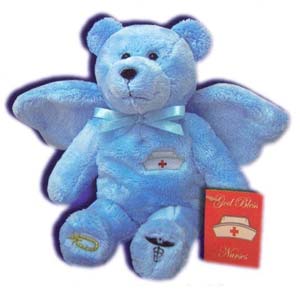
Somewhere along the line, the "angels of mercy" moniker became attached to nurses as a group. Granted, in the early days of nursing, nurses' ability to act autonomously was extremely limited, and we were, by and large, the handmaidens of deified doctors. However, as much as that regrettable history has largely changed, the image of the nurse as angel unfortunately persists quite widely in our culture and websites galore promote gifts and baubles that continue to diminish nurses' professionalism. Images such as this one drive home the point: nurses are childlike individuals with starched white hats who love teddy-bears. Adding insult to injury, nurses can actually be depicted as winged angel/teddy-bears, further enforcing the infantilization (and deprofessionalization) of our profession. Would doctors allow themselves to be thus represented to the public?

Rather than being perceived as cherubic angels and childlike creatures, this writer feels that being perceived as the valuable and skilled professionals who we truly are would allow the public to have a much more accurate perception of what we do, and our importance to the care of millions.

The Clothes on Our Back


Nurses' uniforms have certainly changed over the years, and as scrubs have become the norm for nurses in most clinical settings, many companies have capitalized on the popularity of such utilitarian clothing. Now, designer scrubs covered with angels, teddy-bears (there they are again!), and any number of cartoon-like images adorn the hard-working bodies of nurses around the world. If nurses want to be taken seriously by the public---and by doctors and other professionals---how does the wearing of such (in my opinion) unprofessional clothing help our cause?

Picture this: a team meeting occurs midday to discuss a patient on the adult oncology floor. Present at the meeting: a medical resident, a medical student, the attending doctor, the oncologist, two unit nurses, a social worker and a respiratory therapist. Of all of the professionals in the room, who would possibly be wearing pink scrubs covered with teddy-bears and hearts, and a pin on her chest saying "Doctors Cure, Nurses Care"? And what message does this convey about the nurse's self-image and how the other professionals present in the meeting should perceive him or her?

What's in a Name?

In From Silence to Voice, Buresh and Gordon make their case that nurses being addressed by first name only is also a major image problem when it comes to the public's perception of us a collective whole.

When doctors introduce themselves to patients or other professionals, they always do so by using the title "Doctor" before their name. This practice immediately creates an impression that the doctor is a professional, that he or she has a name that should be remembered, and a hierarchy of power and authority is clearly established from the start.

Conversely, we nurses almost ubiquitously introduce ourselves by first name only, ostensibly to break down the barriers between patients and nurses, assisting the patient in overcoming fears and anxieties related to their treatment. While this tactic may have some limited benefit, Buresh and Gordon argue that "if nurses introduce themselves by their first names only, they are asking to be regarded as nonprofessionals because that is the conventional way that nonprofessionals present themselves."

The "first-name only convention", as the authors have named it, makes it significantly more difficult for individual nurses to receive recognition for their work when only their first names are known. It also creates a hierarchical structure in which the doctor stands alone as a figure of authority, towering above the patient and nurse with (patriarchal or matriarchal) power and authority.

Interestingly, many nurses will argue that introducing ourselves as "Nurse Smith" or "Nurse Cadmus" is awkward at best, but also brings to mind the infamous "Nurse Ratched" from "One Flew Over the Cuckoo's Nest". Granted, Nurse Ratched is a mythic and hated figure in the pantheon of film and modern literature, yet do we see doctors eschewing their well-earned title due to historical figures such as Dr. Kevorkian or Dr. Mengele (of Auschwitz fame)? Absolutely not. Doctors use their title so commonly and so frequently that the word "doctor" simply holds too much cultural power to be diminished by one literary (or real-life) character who used that title for ill.

As for "naming practices" between doctors and nurses themselves, further examples of an unequal playing field emerge, with nurses almost continually subjugated to a diminished status by always being addressed by first name by both patients and doctors, whereas doctors maintain their professionalism and authority through the use of their title and last name.

Taking Credit Where Credit is Due

All too often, the work of nurses is diminished by nurses themselves. When thanked for their work, nurses will frequently say, "Oh, I didn't do much. The doctors really did the hard part." Or when a nurse is asked what he or she does, the answer will often be, "I'm just a nurse." This diminution of nurses' worth does little to cement in the public's collective mind the utter importance---the crucial presence---of nurses in the healthcare system. The "just a nurse" phrase---used all too painfully often---hurts nurses' cultural standing and diminishes the profession in the public's eye.

Nurses need to stand up and take credit for the work that they do. Buresh and Gordon urge nurses to say "You're welcome" when they are thanked. "I am so glad that I could assist you in learning so much about your diabetes, Mr. Smith" or "It was my pleasure to provide your post-operative nursing care, Mrs. Jones"---these are statements that take credit for nurses' actions, acknowledge patients' gratitude, and accept responsibility for providing crucial nursing care that directly impacts patients' recovery and health.

Nurses' Agency

Buresh and Gordon recommend that nurses discover their "voice of agency". According the authors, "the voice of agency is the voice that says: 'I helped the patient to walk after surgery so that she wouldn't get blood clots in her legs' or 'I taught the patient how to take his medications so that they would be effective and produce fewer side effects.' The authors further illustrate their point by reminding us that "the voice of agency is the voice that conveys the message, 'I'm here. I am doing something important.' "

For nurses to develop their own agency---their own power---nurses must first claim and recognize the importance of what they do. As Buresh and Gordon elucidate so clearly in their book, patients do not learn self-care skills in a vacuum. Someone must teach them those skills, and it is nurses who bring their knowledge and education directly to patient care. When recovering from surgery, it isn't doctors who monitor patients every fifteen minutes, using a lifetime's worth of learning to perform important expert assessments. Nurses use a wide variety of skills---often on an autonomous basis---to provide patients with the care and attention they need for optimal health.

While nurses are indeed held in very high esteem by the general public in surveys and polls, most members of that adoring public would be hard pressed to actually describe what it is that nurses do. As Bernice Buresh and Suzanne Gordon make so abundantly clear, it is up to nurses to claim their rightful place of importance in the care provided to patients in a variety of settings. Nurses need to proudly speak of their work with a voice of agency and power, and communicate clearly---to the public, the media, their families, their friends, and their colleagues---that nursing is important, that it is meaningful, and that what nurses do contributes to successful patient care and positive outcomes. We must forgo the teddy-bears, the hearts, the flowers, the useless diminutive statements and self-deprecation, and claim our professionalism for our own.

Nursing's voice must be heard, and Buresh and Gordon feel that the time for that voice to be clearly heard is now.

Tuesday, December 13, 2011

Why Coaching For Nurses?


When I speak with people about my newly launching coaching practice for nurses (which will shortly be live at NurseKeithCoaching.com and NurseKeith.com), they often ask why nurses might need coaching. There are many reasons that nurses can benefit from coaching, and when you take into consideration the fact that nurses are responsible for the care of millions of people worldwide, it makes sense that nurses should be healthy, balanced and happy at home and at work so that they can perform at their best.
As nurses, we spend a great deal of time caring for others and precious little time caring for ourselves. Our work can be all consuming, and in that process we can easily lose touch with our own health, happiness, and sense of balance.
Coaching with me is meant to be all about you. It’s about rediscovering the things that you love about your work. It’s about reconnecting with what’s underneath your desire to be a nurse. It’s also about finding balance in your life, and making your own health, happiness, relationships and life satisfaction the focus.
Nurses are caregivers, but we can only provide the best care when we're also taking care of ourselves properly. Exercise, nutrition, weight loss, stress management, leisure and fun, work-life balance, spirituality, relationships---all of these aspects of our lives impact our ability to be at our best when we engage in our work. And when our lives are out of balance, we suffer on multiple levels. 
My intention is to provide coaching that lifts nurses' spirits, assists them in identifying their goals, their strengths and their areas of challenge, and creating a life that more clearly resonates with their spirit and their vision of the best possible life. 
If nurses are the backbone of the health care industry, then that backbone needs the support to be the strongest and healthiest it can be. Nursing should be something you do, not just something that does you in!

Friday, December 09, 2011

Nurse Keith Coaching Is On The Way!

Happy holidays, readers of Digital Doorway! I hope this finds you well and happy!

The purpose of this post is to inform you that the nature of my private coaching practice is changing, and I have decided to focus completely on the coaching of nurses. As an experienced nurse and coach, I feel that my coaching skills can serve in their greatest capacity by helping nurses to live the most satisfying and healthy lives possible. I plan to offer services ranging from health and wellness, weight loss and stress management to burnout prevention, burnout recovery and work-life balance, and I am already in discussion with others in the industry to create exciting partnerships and joint ventures to add even more value and power to my offerings.

As nurses, we spend a great deal of time caring for others and precious little time caring for ourselves. Our work can be all consuming, and in that process we can easily lose touch with our own health, happiness, and sense of balance.
Coaching with me is all about you. It’s about rediscovering the things that you love about your work. It’s about reconnecting with what’s underneath your desire to be a nurse. It’s also about finding balance in your life, and making your own health, happiness, relationships and life satisfaction the focus.
Nurses are caregivers, but we can only provide the best care when we are also taking care of ourselves properly. Exercise, nutrition, weight loss, stress management, leisure and fun, spirituality, relationships---all of these aspects of our health impact our ability to be at our best when we engage in our work. And when our lives are out of balance, we suffer on multiple levels.
You can work with me to improve your work-life balance, get your health on track, set personal and professional goals, and make nursing something that you do and love, not something that does you in!
My new website---currently under construction---will be located at NurseKeithCoaching.com and also linked at NurseKeith.com. There will be a frequently updated Facebook page, as well as my continued presence on Twitter (as NurseKeith). My plan is also to eventually offer free downloads, audio podcasts, and perhaps branch into webinars, internet radio and live workshops here in Santa Fe. 
At this point, I am requesting that you hold this endeavor in your heart, knowing that I am creating this coaching practice so that more nurses can be healthier, happier, and more successful and satisfied clinicians. I am so excited about the coming birth of Nurse Keith Coaching, and I will post a formal announcement as soon as the website is live! 
Gratefully, 
NurseKeith

Friday, December 02, 2011

Pathways in Nursing Infographic

The good folks over at NursingLicenseMap.com have created an interesting infographic on the various pathways of a nursing career, including average salaries and other data. It is well worth perusing, and I include a copy of the infographic here for your enjoyment and edification.
Brought to you by Nursing License Map and Nursing@Georgetown.

Wednesday, November 30, 2011

Book Review: The Millionaire Nurse

A note to the reader: As always, I have received no remuneration for posting this book review. As a point of disclosure, I did, however, receive a free copy of the book from the author in order to facilitate the review process. 

------------

Dr. Dean Burke, MD is a successful OB/GYN and author who has branded himself as a champion of nurses' financial freedom. Married to a nurse, Dean has an intimate understanding of the challenges and vicissitudes of the nursing profession, and he encourage nurses to leverage his knowledge and advice in the interest of their own financial well-being. Since nurses are so good at caring for others, Dean contends that they should also be just as good at managing their own lives, financially and otherwise. 

The Millionaire Nurse is a book and companion website that walk nurses through the basics of financial management, using simple language and understandable examples to illustrate the subject at hand. Dean offers practical advice on a variety of subjects, relating the issues generally to nurses' lives, nurses' income levels, and the challenges that he knows many nurses face in the real world. While money management is foremost in Dean's writings, time management and the enjoyment of life also figure largely in Dean's world of wealth and financial freedom. Dean's writing leans towards the casual, with pithy puns and down-to-earth language not usually found in books about money.

The subjects covered in The Millionaire Nurse include calculating net worth, debt management, homeownership (including buying and selling), budgeting, salaries and benefits, insurance, saving money at home, saving and paying for college, retirement and investing. And while a great deal of this information could be gleaned from any number of books, websites or magazines about finance, none of those sources are written specifically for the nurse, using real-life examples from nurses' lives and data that reflect the reality of those lives.

Dean states in his introduction: "My plan in The Millionaire Nurse is to help you to prioritize and rearrange your financial dreams into reasonable and reachable goals. I also feel it is my duty to give back to you, the nurses who have saved my rear-end more than once." 

Whether your financial situation is in need of intensive care, outpatient surgery or emergency resuscitation, Dr. Dean offers no-nonsense advice that I believe is sound, understandable, digestible, and practical. His free downloadable e-book, "Emergency Money Resuscitation", is a very helpful volume, as is his regular email newsletter that is sent periodically to subscribers.

Dean on investing: "Emotional decisions are the enemy of good investing. Just as when you're faced with an extremely ill patient, panicking never helps---especially the patient."

Dean on debt: "One of the most difficult aspects of retiring your debt is taking the ego out of your decisions."

Dean on setting financial goals: "Goals are necessary. In the long run, you'll begin to look forward to setting goals for yourself, not the least because they not only give you direction, they also act as self-fulfilling prophecies."

I recommend "The Millionaire Nurse", whether you plan to be a millionaire or not. We nurses work hard, serve the greater good, and many of us struggle financially like so many others, whether we live here in the United States or abroad. Dr. Dean offers a readable and user-friendly plan that can be shared with friends and family members alike. We should all be committed to our own financial well-being and freedom, and I'm grateful to Dean for caring enough about nurses to create products specifically geared towards our noble and valuable profession.

Tuesday, November 22, 2011

Book Review: Nursing 2012 Drug Handbook

I will begin this review with the disclosure that Publisher Wolters Kluwer contacted me through a marketing agent and requested that I post a review of their new Nursing 2012 Drug Handbook here on Digital Doorway. I did not receive financial compensation of any kind for this review, but did receive a free copy of the guide in order to facilitate the review process. 

Upon first glance, the new Nursing2012 Drug Handbook looks like any other drug handbook I have encountered in the past. However, on further inspection I was pleased to see several aspects of this book that are both useful and user-friendly.

Traditionally, nursing drug handbooks utilize a simple alphabetical listing of drugs that allows a nurse to easily use the book as an easy and quick reference tool. This book follows the same format, including new FDA-approved drugs, black box warnings, and other information that a prudent nurse would require and expect.

There are several aspects of this guide that I find especially useful and worthy of notice, and these include:

A color photo guide to "396 tablets and capsules, representing the most commonly prescribed generic and trade name drugs." These are listed alphabetically by generic name, and the photos are shown in actual size and color, with cross-referencing to drug information in other portions of the book.

Each drug entry includes a small table with route, onset, peak duation, and half-life clearly listed.

Overdose information is listed in red.

Look-alike and sound-alike warnings are given for appropriate medications.

The useful appendices include:
  • Pregnancy risk categories
  • Controlled substance schedules
  • Quick guide to combination drugs
  • Common combination drugs
  • Vaccines and toxoids: indications and dosages
  • Vitamins and minerals: indications and dosages
  • Therapeutic drug monitoring guidelines
  • Cytochrome P-450 enzymes and common drug interactions
  • Drugs that prolong QT intervals
  • Dialyzable drugs
  • Abbreviations to avoid
  • Herbal supplements
  • Drugs that shouldn't be crushed or chewed
  • Avoiding common drug errors: best practices and prevention
  • Pediatric drugs commonly involved in drug errors
  • Elder care medication tips
  • Additional new drugs: indications and dosages
The purchase of the book also provides the owner with a one-year subscription to Lippincott's online Nursing Drug Advisor, a site that provides online access to monographs of every medication in the text. This access also includes an online toolkit, with a dosage calculator, English-to-Spanish drug phrase translator, tables of equivalents and conversions, and discounted CE programs.

Overall, I am very impressed by the layout of the book, the appendices, and the online content.

Through the publisher, I have several offers to elucidate at this juncture.
  • The first nurse who leaves a comment on this post will receive a free copy of the book directly from the publisher. (The winner will need to provide me with their mailing address.)
  • Other nurses who wish to purchase the book can do so via this link, receiving an instant 20% discount as a reader of Digital Doorway. (I receive no remuneration for these purchases, and I am simply passing on these savings to my readers based on an offer from the publisher.)
This book is a worthwhile investment, and I am happy to have my own copy, as well as access to the very useful and user-friendly online resources. 


Thursday, November 10, 2011

My Newest Blog Is Live

I am grateful to the good people at  LPNtoBSNonline for inviting me to be their new resident "expert blogger". The blog is now live, and you can visit the blog by clicking here. The posts are generally geared towards nurses---both seasoned and novice---and those who wish to enter the field.

Please stop by regularly since there will be two new posts every week!

Tuesday, November 08, 2011

"So, Which Hospital Do You Work In?"


Whenever I tell someone that I’m a nurse, the inevitable question follows: “So, which hospital do you work in?”
While I have nothing against hospitals (well, maybe I do!) or nurses who work in them, I have chosen to forge a nursing career utterly free of the hospital environment. Although many colleagues assured me that it was professional suicide to do so, I chose to eschew the one or two years of Med-Surg that most nurses undergo after graduation, and I entered directly into community nursing and never looked back.
My History
Over the last 15 years, I’ve worked as a nurse in two urban community health centers that served low-income Latinos, held a position as a Nurse Care Manager for several cutting-edge case management programs in the same low-income urban neighborhoods, worked as a visiting nurse, a hospice nurse (inpatient and outpatient), as well as a stint as a nursing professor and as the sole Public Health Nurse for a New England town of 25,000 people. Meanwhile, I’ve maintained a popular nursing blog, have contributed chapters to several books about nursing, been interviewed on radio and internet radio, and been published on a variety of nursing websites as a regular contributor.
Despite my lack of hospital experience, I have never felt encumbered by a less-than-interesting career or by the sense that something is missing from that career. Needless to say, if I was to seek a position in a hospital-based program or unit, I might have to first spend a year or so in Med-Surg, and that would be fine. Meanwhile, my career is wholly satisfying and I have never lacked for interesting and remunerative work.
The Public’s Perception
When someone reflexively asks me what hospital I work in, I am immediately reminded that the public simply has no real idea what nurses do and simply base their image of nursing on images from television and the movies.
If you ask the average American what their image of a nurse is, they will most likely describe a nurse in scrubs working in a hospital, or an older American just might conjure up the image of a nurse in starched whites with a little cap on her head. Those images indeed still persist, despite the efforts of some in the nursing community to counter that outdated stereotype.
Sadly for us, Nurse Ratched (of “One Flew Over the Cuckoo’s Nest” fame), is probably the most famous nurse in the American zeitgeist after Florence Nightingale, so many Americans may either see nurses as crazed sadists armed with arm-length needles or angels of mercy who serve as a doctor’s handmaiden amidst the horrors of war and disease.
What Does It All Mean, Anyway?
The public has a particular perception of nurses that is skewed by television and the media’s ability to create cultural icons that are difficult to overcome. It is the mission of many nurses to change that perception by providing a new paradigm in which nurses are perceived as trained and competent professionals that work in a variety of clinical settings.
From a personal point of view, I feel it is equally important for both nurses and the public to understand that, while hospital nursing is a crucial aspect of the profession, there are scores of nurses who choose to work in community-based positions that do not involve employment by a hospital. While some hospital nurses may see non-hospital nurses as somehow inferior (an erroneous perception that I have personally encountered during my career), non-hospital based nurses contribute a great deal to society and to the nursing profession as a whole.
Whose Responsibility Is It?
Nursing has changed a great deal, especially over the last 100 years, and I believe that it is in the collective interest of all nurses to take responsibility to mold and recreate the public’s perception of who we are and what we do, not to mention our own self-perception of the profession.
So, when someone asks me what hospital I work in rather than simply asking me what kind of nursing I do, I see it as my personal mission to educate that individual regarding the myriad functions a nurse can perform and the many environments where that can occur.
Public perception of nurses does not necessarily negate our efficacy or our importance, but it can indeed impact our self-esteem, our profession’s standing, as well as the cultural and societal significance of our work. It’s up to us to educate those around us that nurses are not akin to the nurses portrayed on television. We are real people doing real work. Nurses make a difference in people’s lives. We always have, and we always will.

My Recent Articles on WorkingNurse.com

Here are links to my most recent articles published by WorkingNurse.com. My thanks to my editor at Working Nurse for her continued support and positive feedback!

My Specialty: Telemetry Nursing

My Specialty: Emergency Nursing

My Specialty: Nursing Educator

My Specialty: Hospice Nursing


Wednesday, November 02, 2011

In Stitches: A Memoir by Anthony Youn, MD

Periodically, I receive unsolicited requests by publishers and media agencies to review books here on Digital Doorway. In return for my services, I receive a copy---or several copies---of said tome, and the satisfaction of thinking---and writing---like a critic. There have been a few books that I've decided to not review after having read them since I don't want to hurt the author's feelings, and there are several that have been equally a pleasure to read and to write about.

That said, a number of months ago, I received a request to review "In Stitches: A Memoir" by Dr. Anthony Youn, M.D., one of the most famous cosmetic surgeons in the United States. I did not peruse Youn's many websites until after finishing the book, although based on the personality communicated through the book, I was not surprised to find the sites ranging from significantly tacky to unsurprisingly tacky. The book, co-written with Allan Eisenstock, strives to rise above the glamorous veneer exuded by the websites, and manages to do so from time to time in its more sober moments, but the book is, in the end, a disappointment on many fronts.

In his memoir, Dr. Youn paints a portrait of a young, second-generation Korean-American who grows up in a household ruled by a nearly tryannical father (a successful OB-GYN) who Youn, along with his brother, both fear, respect and obey almost unquestioningly throughout their lives. Developing a jaw deformity as a teenager, Youn undergoes a series of surgeries that we are led to believe have an eventual impact on his decision to become a cosmetic surgeon. Sadly, although he briefly tells the story of his father's family, Youn's parents remain two-dimensional characters, as do most of the other individuals portrayed throughout the book (including his wife-to-be).

Unfortunately, Youn spends dozens of pages reminiscing over his sexual failures and inadequacies in the world of dating and women, and we are treated to multiple stories of the exploits---or lack thereof---of Youn and his adolescent and college-aged friends. This aspect of the book is most painful and tedious, and I found myself sighing in impatient consternation when faced with yet another anecdote about his hopes as a wannabe Romeo being dashed once again.

Youn makes it explicit that his Asian background and cultural heritage account largely for his feelings of being an outsider in a majority caucasian world. To his credit, he often uses self-deprecating humor to his advantage, and he clearly describes a moment in his life when his judgment and derision of another outsider (a gay roommate), causes him great shame and regret.

Still, although Youn rhapsodizes about realizing the errors of his ways and tells us how he has grown as a person through his many trials and tribulations, within this book he manages to propagate and give further power to many misguided notions regarding beauty and outward appearance. And while Youn clarifies that he has become a doctor---specifically a plastic surgeon---because he wants to "fix people", it is no surprise that he has become the "plastic surgeon to the stars", nipping and tucking his way into American living rooms via numerous television appearances.

Just as Dr. Youn refers consistently to women he wants to date as "knockouts" or "Penthouse hot", he demonstrates his judgmental attitudes regarding beauty and "otherness" by referring to an elderly professor as "an old witch" and a neighbor in his college dorm as a "mountain range of hairless flab". Youn could have taken the road less traveled, sharing tea and sympathy with other outcasts and societal rejects, but instead he takes the easy way out and utilizes cliche and occasional self-deprecation as a tool to elicit sympathy for himself while simultaneously attempting to elicit loathing by the reader for those less handsome, less rich, less successful than he wanted to be (and eventually became).

When he is serious and earnest, the author is at his best, as in this passage where, while in gross anatomy lab, he sees the humanity within the cadaverous body parts populating various plastic tubs:

"I drift over to the bodies that we will study, some under tarps, some lying naked, their innards exposed, and certain details that I'd never noticed jump out---tattoos, dental fillings, scars---and I feel lightheaded. I am in awe of these people. Most of all, instead of feeling detached from them, as I assume most doctors do, I feel attached to them. Committed to them. 


"I can't say that I feel this way constantly, every second of anatomy class, every moment of medical school. I will often lose this feeling of reverence toward these bodies, especially when I'm grinding through my notes, preparing for an exam. But I'm able to bring myself back, to locate the humanity easily. 


"Especially when I look into the bin of hands."

It is in moments like these that Youn's compassion shines through, as when he holds a crying baby all night or convinces a man who feels unloved to have a life-saving surgery.

Youn also uses humor well in certain passages, painting hilarious portraits/caricatures of medical residents, interns, doctors and surgeons that many in the medical field will most likely find highly entertaining and evocative of some of their own experiences.

Over all, Youn's book is a chatty, breezy and lightweight read with a modicum of entertainment value. He offers rather pedestrian and less than insightful advice about medical school, and apparently fails to grasp or elucidate the depths to which he could have plumbed the role of outsider and societal outcast that he managed to only hint at throughout its pages.

As an Asian American from a hardworking upper-middle class family with a father who works as a successful doctor, Youn is not exactly a kid from the other side of the tracks. Still, his theme of being an outsider---a theme driven home ad nauseum in the first half of the book----falls flat based on the life that Youn describes and the relative privilege that he enjoys. Sure, he once had a Thanksgiving meal from a convenience store, but there is no doubt that Youn had his sights set high and managed to achieve his goals, perhaps beyond his wildest dreams. I applaud the author's professional tenacity and his ability to create the life he always wanted, but Youn's attempt at a memoir offers too little in terms of moving passages describing humanity's many frailties, and too much of his sentimental and simplistic summing up of the world according to Anthony Youn.

This memoir is one to read, for example, when waiting in an airport during a long layover, and then leave on the seat for the next weary traveler who needs an unchallenging and moderately entertaining ---yet forgettable---memoir to pass the time.

Tuesday, October 25, 2011

The "Occupy" Movement and Healthcare

For the last several months, I have been actively supporting the now worldwide "Occupy" movement that has swept the world following the initiation of the famous "Occupy Wall Street" action in New York City. Here in Santa Fe, New Mexico, my wife and I have taken part in marches, rallies, protests and teach-ins, and the "Occupy Santa Fe" encampment continues near downtown.

Although the issues broached by "Occupiers" throughout the country are seemingly disparate and multifaceted, I believe it is only through the communication of these different voices and concerns that central themes (and possible demands) can eventually be distilled.

As a nurse and healthcare professional, I have seen the face of the healthcare system up close, and it is (still) quite broken. With innumerable for-profit insurance companies dictating what doctors can and cannot do, and tens of millions of Americans living completely without health insurance, the system eschews the notion of universal coverage and leaves millions in the proverbial dust. And since almost every industrialized country in the world has some form of universal coverage, the United States lags far behind, not only in this respect, but also in infant mortality and other important markers of health and well-being of the citizenry at large. It is a shameful state of affairs.

Just today on National Public Radio, I heard a report quoting Republican candidate Ron Paul as he railed against the notion of universal coverage. When asked if an uninsured 30-year-old with a catastrophic illness should receive expensive care in order to save his life, Paul intimated that there are other ways for these sorts of people to be cared for (such as churches and neighbors). He stated, "That's what freedom is all about---taking your own risks." Although he wouldn't directly say that society should just allow this individual to die, some members of the audience loudly proclaimed that, indeed, this uninsured American's care should not be paid for and he should be allowed to meet his (uninsured) fate. A shocking notion, especially since doctors (and Ron Paul is himself an M.D.) take an oath to "do no harm". (I have always wondered about the relative similarity between the words "Hippocratic" and "hypocritical".)

When it comes to the "Occupy" movement, my sense is that a more fair distribution of wealth, corporate responsibility (in terms of taxes, etc), economic justice (an admittedly broad and relatively ill-defined phrase), jobs, the end of war, and the initiation of broader protections (such as universal health coverage) are some of the mainstays of the movement's demands.

As autocracies around the world crumble before our eyes, it was only a matter of time until such a popular people's movement erupted from its latent slumber here in the U.S.. People can only take so much, and when the number of uninsured Americans topped 52 million just last year (40% higher than in 2001), there was no reason for Americans to not decide to speak out and demand change. And if you couple the nationwide jobless numbers with the numbers of uninsured citizens (let alone the list of companies---like Wal-Mart---who are jettisoning their healthcare coverage), the recipe for popular unrest only grows.

Rates of obesity, diabetes and heart disease are ballooning in this country, and childhood obesity and chronic illness are equally on the rise. As Americans get sicker and fatter, the nation's largest employers are cutting their healthcare coverage and leaving millions of American workers (and their families) in the lurch.

Meanwhile, the American right proclaims that "Occupiers" are dirty hippies, unemployed and looking for a handout. From my perspective, this is both unenlightened thinking and plain ignorant hyperbole. I have marched and rallied with retired schoolteachers, nurses, housepainters, unemployed laborers, and gainfully employed citizens from multiple sectors of society. Yes, some "Occupiers" are unemployed, but every unemployed protester I have spoken with simply wants a job and benefits for them and their family, and they're willing to pay taxes to get what they want. (They just want wealthy Americans and American corporations to pay their fair share.)

The noise and perceived "inconvenience" of massive protests will, in my opinion, continue as the movement galvanizes a broader spectrum of Americans and gains clarity as it works internally to crystallize its main messages. And as the protests continue, those 50 million Americans still languish without health insurance, millions more look for work that cannot be found, and the corporate and political powers that be bide their time in hopes that the restless citizenry will fall back into a television-induced slumber. Aside from a nationwide campaign to taint drinking water with Ambien or Lunesta in hopes of a sleepier and more ignorant nation, the chances of this movement simply being lulled into complacency is more remote than Wal-Mart offering its workers the benefits they deserve.


Sunday, October 16, 2011

Food: A Rumination for Blog Action Day


On several occasions, I have participated in Blog Action Day, an annual event wherein bloggers from around the world post simultaneously about a chosen topic of global importance. This year, food is the topic of concern, and thousands of bloggers from more than 80 countries are posting about the subject food on this day, the 16th of October, 2011. The following is my own rumination about food, from the personal to the global and back again. You can read more entries at the Blog Action Day website and blog.
 ^^^^^^^^^
Throughout my adult life, I have generally tended to view food as being medicinal in nature, and this tendency has only grown as I have entered middle age. While food represents many things to many people---including culture, pleasure, sustenance, survival, identity, a sense of belonging---my connection with food remains solidly in the categories of health and well-being, with a generous helping of pleasure. 
Being from a family with a Jewish heritage reaching as far back as the genealogy can see, one would think that Jewish cultural foods would figure strongly in my predilections and preferences. While my mother did indeed make matzo ball soup and other Jewish foods when I was a child, that Jewish identity never really took hold, especially since we were raised, ironically, with all of the Christian holidays, albeit celebrated in a thoroughly assimilationist and secular manner.  So, with no real cultural identity per se, I was unleashed into the world to find my own gastronomic way, and, for the majority of my adult life, that road has been paved with health food.
The term “health food” is somewhat of a misnomer, since many foods can be readily associated with health, even as more and more foods have had the health literally stripped out of them in the processing plant. Still, health food conjures images of bins of granola, honey, fresh fruits and vegetables, tofu, and any number of items that can be easily lumped into that broad category. “Whole foods” is, in my view, a much more apt definition of the way in which I like to eat, but a very large health food corporation (which shall not remain altogether nameless in this case) has now trademarked that name for its own. Thus, telling someone that you eat a “whole foods” diet will only bring sneers and a chuckle, and perhaps a sense from the listener that you spend so much money on groceries that you probably have to give up other things like cars, gasoline, and a telephone. (They don’t call the aforementioned store “Whole Paycheck” for nothing.) Still, “whole foods” explains one’s dietary preferences much more aptly than “health food”, but we’ll leave the name issue for someone else to tease out.
For my wife and me, food is where the rubber meets the road in terms of our health, and we have generally opted in our two decades together to spend more on good healthy food rather than put our money elsewhere. While other families eschew organic produce due to its relatively high cost, we would much rather cancel our cable or cut back on other expenses rather than buy the mainstream non-organic alternative. We recognize that organic can be more costly, and we understand which foods are most important to purchase organically and which are safe to buy that are conventionally grown. We also recognize that many people simply cannot afford organic food, and as a health coach and nurse, I would far prefer that a client purchase non-organic produce, wash it well and enjoy it, rather than processed foods with little redeeming qualities. And in areas that are known as “food deserts”, many people simply have no access to fresh produce or even a supermarket, relying on fast food and highly processed foods from convenience stores.
Amazingly, the organic movement has grown (Wal-Mart is now one of the largest vendors of organic produce in the United States), and as demand has risen, prices have come within reach of more and more Americans. And as more Americans wake up to the fact that genetically modified foods grown with petroleum-based fertilizers on corporate farms are not in their best interest---or the country’s best interest, for that matter---demand will only continue to rise.
In a world where food insecurity is increasing, famine is spreading across portions of Africa, and topsoil erosion and access to water are increasingly problematic, the issue of food is central to our very survival. With free trade agreements decimating certain farmers’ ability to sell their crops at a profit, family farms being foreclosed in record numbers, and corporate agribusiness growing at an alarming rate, we are at a moment in history when the security, quantity and quality of our food supply is in jeopardy. It’s all well and good to espouse the benefits of a healthy diet, proper hydration and plenty of aerobic exercise, but there is no getting around the fact that millions of people around the world---many of whom live in your home town---go hungry every day, or simply don’t have the security of knowing where their next meal is coming from.
Food is a loaded issue, and it carries a great deal of baggage for all of us. My memories of my mother’s matzo ball soup may linger in my cellular memory until the day that I die, and meanwhile I have the economic privilege of buying just about anything I want at the grocery store (within reason), never personally knowing the stresses and concerns of those who cannot even afford to adequately  feed their children each morning. I can rail against Monsanto for genetically modifying corn and depleting the topsoil through poor farming practices in favor of profits and high yields, yet I also need to remember that some unknown neighbor of mine just down the street doesn’t have enough cash flow to stock the fridge as his children clamor for the sugary and marginally nutritious cereals they see happy people eating on television. 
Yes, food consumes us just as we consume it, and it is the future of food itself that should truly consume us day and night. “Give us this day our daily bread” should be our rallying cry, and if our collective moral compass was not somehow askew in this world out of balance, we would have already figured out how to feed every person on the planet.
In the optimism that I have cultivated---or discovered---in this second half of my life, I know in my heart that change is indeed coming. The “Occupy Wall Street” movement is only one example of how the world is changing as people individually and collectively wake up to the many stark realities that we face on a global scale.
In my small world, it can feel like a crisis if I can’t find the item I’m seeking when I walk the aisles of the health food store or I forget something important during a shopping trip. But my personal crises hold no water in the larger scheme of things. Proportionality is the operative word of the day, and the proportion of hungry people in this world must be contended with, lowered, and eventually brought under control. As we mine the human genome and monitor the universe for signs of intelligent life, we continue to demonstrate that we have the collective intelligence and technology to solve the food crisis for ourselves.
What we need now is a collective will to feed the world, and to transform this crisis into an opportunity. We can indeed feed the world, and if we decide to do so, there is no force on earth that can stop us from moving unequivocally towards that goal. Be it “whole foods”, “health food”, or just simply “food”, the name is not as important as the intention. We know how to grow healthy foods, we know how to produce foods that are less processed, more nutritious, and more affordable, and we know that we have the ability to do so if we truly desire to. So we say again, “give us this day our daily bread”, and when we say “us”, we realize that we truly understand the meaning of that word.
#bad11

Tuesday, October 04, 2011

Living, Loving and Dying

A few months ago, I shared here on Digital Doorway that my mother had died suddenly from a massive and unexpected stroke which occurred while she was giving a piano recital with some of her music students. Five weeks prior, my father-in-law suffered a major heart attack, dying in his easy chair after enjoying dinner with his beloved wife and a few friends on the Cinco de Mayo. Their deaths reverberate in our lives still.

In the weeks between those two significant losses, my wife lost an uncle and a cousin, and not long ago my step-son lost his step-brother on his father's side. Just yesterday, we learned that a dear friend with whom we had lost touch was diagnosed with stage four liver cancer on a Thursday this past August and died the following Monday, surrounded by family. Meanwhile, one of our very dearest and oldest friends is struggling in her eighteenth month of ovarian cancer and we're not sure we'll ever see her again---in this life, anyway.

Losing loved ones and watching others grieve as they mourn their losses puts life into perspective and allows for a different view of one's personal priorities. As a nurse, I have walked many patients through their own illnesses and the process of facing their own mortality, and there are those whose faces are as clear in my mind now as they were when I was providing their care.

In the course of our lifetime, we see dozens, if not hundreds, of deaths acted out in movies and television shows in the name of entertainment, some quite realistically. Meanwhile, the news media graphically report famine, war, disease, natural disasters and violent deaths, and this regular diet of death can at times inure us to the reality and potential tragedy of lives lost. Film and television depictions of death can move us to tears, and can at times even help us to process our own personal losses through the artifice of cinematic drama.

Still, there is nothing more realistic than holding the hand of a dying person and looking in their eyes as they face the great unknown. Five years ago, we were all at the side of my step-father as he died in his own home from pancreatic cancer, and it was an honor to be his midwife in that very beautiful and graceful process.

As a father and husband, I occasionally experience fear regarding the loss of my wife, son or daughter-in-law, and I know that I will likely one day face the death of my father, my mother-in-law, and perhaps even my siblings or other family members. At the time of a death of a loved one, it has often seemed that I simply could not walk through the passage of grief that had opened up before my very eyes. When a dear friend of ours was murdered in 2001, it seemed as if our lives had ended, and indeed our lives as we knew them certainly had come to a resounding close.

However, even in the midst of terrible grief and loss, the urge to survive---and even to thrive---persists, and we somehow manage to renew ourselves again and again. I am personally on that path of renewal, and while I have no doubt that death will make its presence known at some point in the future, there's nothing else to do but focus on love, acceptance, and the knowledge that strength will come from a powerful wellspring, whatever one may choose to call it or however one might acknowledge it.

My own death holds no fear for me, but the great mystery of that passage and its ultimate meaning is strong. For now, I focus on the meaning that death and loss have given to my life, and the relative unimportance of the myriad trivial issues that clamor for space in my mind.

We the living can continue to live, and the dead want nothing more than our happiness. I choose to embrace my life and my happiness, remembering the saying that living well is the best revenge. I am not a vengeful person, but we can all take revenge on the violence, fear and panic that seem to so often encircle our world so vehemently. We can resist the fear. Our loved ones who have passed on want this for us, and while we can't live for them, we can live with them---in our minds, in our thoughts, and in our hearts.


Thursday, September 08, 2011

Nursing: Beyond the Books

The good people over at Online Nursing Degrees recently decided to conduct several in-depth interviews with nine nurse bloggers from various professional backgrounds in the nursing world. I am honored to have been chosen as one of the interviewees, and want to provide a link to curious readers to this smorgasbord of nurse opinion and story. The thoughtful interviewer obviously read through our nine blogs very carefully, posing interesting and thought-provoking queries well beyond the usual cookie-cutter interview questions so frequently bandied about.

The series, entitled Nursing: Beyond the Books, consists of nine interviews, with one interview posting each day for nine days until all nine are published. My interview---the third in the series---posts today, September 8th, and can be found by clicking here. The entire series will be available once the nine day roll-out is complete.

Thanks to Martin at Online Nursing Degrees for his interest and diligence in making this wonderful online event a reality!

Tuesday, August 02, 2011

Fresh Air Fund Still Seeks Host Families

Many regular readers of Digital Doorway will remember that I have supported The Fresh Air Fund for several years. The Fresh Air Fund has provided opportunities for inner-city children in the New York area to experience summer vacation in the homes of host families in the Northeastern United States and Canada since 1877.

In 2010, Fresh Air Fund host families provided such opportunities for over 5,000 children between the ages of 6 and 18, and more than 65% of children are invited to visit their host families in subsequent years.

This year, there are still 200 mostly low-income inner-city children waiting to be placed with a host family before the end of the summer. If you or someone you know would like to host a Fresh Air child this summer (or next summer, for that matter), please visit the host family website page.

Monday, August 01, 2011

Johnson and Johnson Nursing Notes

My thanks to Johnson and Johnson for featuring me in their recent "Nursing Notes" newsletter about nurse entrepreneurs. If you want to read the issue, click here and scroll to the bottom for my brief interview.