For the last several months, I have been actively supporting the now worldwide "Occupy" movement that has swept the world following the initiation of the famous "Occupy Wall Street" action in New York City. Here in Santa Fe, New Mexico, my wife and I have taken part in marches, rallies, protests and teach-ins, and the "Occupy Santa Fe" encampment continues near downtown.
Although the issues broached by "Occupiers" throughout the country are seemingly disparate and multifaceted, I believe it is only through the communication of these different voices and concerns that central themes (and possible demands) can eventually be distilled.
As a nurse and healthcare professional, I have seen the face of the healthcare system up close, and it is (still) quite broken. With innumerable for-profit insurance companies dictating what doctors can and cannot do, and tens of millions of Americans living completely without health insurance, the system eschews the notion of universal coverage and leaves millions in the proverbial dust. And since almost every industrialized country in the world has some form of universal coverage, the United States lags far behind, not only in this respect, but also in infant mortality and other important markers of health and well-being of the citizenry at large. It is a shameful state of affairs.
Just today on National Public Radio, I heard a report quoting Republican candidate Ron Paul as he railed against the notion of universal coverage. When asked if an uninsured 30-year-old with a catastrophic illness should receive expensive care in order to save his life, Paul intimated that there are other ways for these sorts of people to be cared for (such as churches and neighbors). He stated, "That's what freedom is all about---taking your own risks." Although he wouldn't directly say that society should just allow this individual to die, some members of the audience loudly proclaimed that, indeed, this uninsured American's care should not be paid for and he should be allowed to meet his (uninsured) fate. A shocking notion, especially since doctors (and Ron Paul is himself an M.D.) take an oath to "do no harm". (I have always wondered about the relative similarity between the words "Hippocratic" and "hypocritical".)
When it comes to the "Occupy" movement, my sense is that a more fair distribution of wealth, corporate responsibility (in terms of taxes, etc), economic justice (an admittedly broad and relatively ill-defined phrase), jobs, the end of war, and the initiation of broader protections (such as universal health coverage) are some of the mainstays of the movement's demands.
As autocracies around the world crumble before our eyes, it was only a matter of time until such a popular people's movement erupted from its latent slumber here in the U.S.. People can only take so much, and when the number of uninsured Americans topped 52 million just last year (40% higher than in 2001), there was no reason for Americans to not decide to speak out and demand change. And if you couple the nationwide jobless numbers with the numbers of uninsured citizens (let alone the list of companies---like Wal-Mart---who are jettisoning their healthcare coverage), the recipe for popular unrest only grows.
Rates of obesity, diabetes and heart disease are ballooning in this country, and childhood obesity and chronic illness are equally on the rise. As Americans get sicker and fatter, the nation's largest employers are cutting their healthcare coverage and leaving millions of American workers (and their families) in the lurch.
Meanwhile, the American right proclaims that "Occupiers" are dirty hippies, unemployed and looking for a handout. From my perspective, this is both unenlightened thinking and plain ignorant hyperbole. I have marched and rallied with retired schoolteachers, nurses, housepainters, unemployed laborers, and gainfully employed citizens from multiple sectors of society. Yes, some "Occupiers" are unemployed, but every unemployed protester I have spoken with simply wants a job and benefits for them and their family, and they're willing to pay taxes to get what they want. (They just want wealthy Americans and American corporations to pay their fair share.)
The noise and perceived "inconvenience" of massive protests will, in my opinion, continue as the movement galvanizes a broader spectrum of Americans and gains clarity as it works internally to crystallize its main messages. And as the protests continue, those 50 million Americans still languish without health insurance, millions more look for work that cannot be found, and the corporate and political powers that be bide their time in hopes that the restless citizenry will fall back into a television-induced slumber. Aside from a nationwide campaign to taint drinking water with Ambien or Lunesta in hopes of a sleepier and more ignorant nation, the chances of this movement simply being lulled into complacency is more remote than Wal-Mart offering its workers the benefits they deserve.
Tuesday, October 25, 2011


Sunday, October 16, 2011
Food: A Rumination for Blog Action Day
On several occasions, I have participated in Blog Action Day, an annual event wherein bloggers from around the world post simultaneously about a chosen topic of global importance. This year, food is the topic of concern, and thousands of bloggers from more than 80 countries are posting about the subject food on this day, the 16th of October, 2011. The following is my own rumination about food, from the personal to the global and back again. You can read more entries at the Blog Action Day website and blog.
^^^^^^^^^
Throughout my adult life, I have generally tended to view
food as being medicinal in nature, and this tendency has only grown as I have
entered middle age. While food represents many things to many
people---including culture, pleasure, sustenance, survival, identity, a sense
of belonging---my connection with food remains solidly in the categories of
health and well-being, with a generous helping of pleasure.
Being from a family with a Jewish heritage reaching as far
back as the genealogy can see, one would think that Jewish cultural foods would
figure strongly in my predilections and preferences. While my mother did indeed
make matzo ball soup and other Jewish foods when I was a child, that Jewish
identity never really took hold, especially since we were raised, ironically,
with all of the Christian holidays, albeit celebrated in a thoroughly
assimilationist and secular manner.
So, with no real cultural identity per se, I was unleashed into the
world to find my own gastronomic way, and, for the majority of my adult life,
that road has been paved with health food.
The term “health food” is somewhat of a misnomer, since many
foods can be readily associated with health, even as more and more foods have
had the health literally stripped out of them in the processing plant. Still,
health food conjures images of bins of granola, honey, fresh fruits and
vegetables, tofu, and any number of items that can be easily lumped into that
broad category. “Whole foods” is, in my view, a much more apt definition of the
way in which I like to eat, but a very large health food corporation (which
shall not remain altogether nameless in this case) has now trademarked that
name for its own. Thus, telling someone that you eat a “whole foods” diet will
only bring sneers and a chuckle, and perhaps a sense from the listener that you
spend so much money on groceries that you probably have to give up other things
like cars, gasoline, and a telephone. (They don’t call the aforementioned store
“Whole Paycheck” for nothing.) Still,
“whole foods” explains one’s dietary preferences much more aptly than “health
food”, but we’ll leave the name issue for someone else to tease out.
For my wife and me, food is where the rubber meets the road
in terms of our health, and we have generally opted in our two decades together
to spend more on good healthy food rather than put our money elsewhere. While
other families eschew organic produce due to its relatively high cost, we would
much rather cancel our cable or cut back on other expenses rather than buy the
mainstream non-organic alternative. We recognize that organic can be more
costly, and we understand which foods are most important to purchase
organically and which are safe to buy that are conventionally grown. We also
recognize that many people simply cannot afford organic food, and as a health
coach and nurse, I would far prefer that a client purchase non-organic produce,
wash it well and enjoy it, rather than processed foods with little redeeming
qualities. And in areas that are known as “food deserts”, many people simply
have no access to fresh produce or even a supermarket, relying on fast food and
highly processed foods from convenience stores.
Amazingly, the organic movement has grown (Wal-Mart is now
one of the largest vendors of organic produce in the United States), and as
demand has risen, prices have come within reach of more and more Americans. And
as more Americans wake up to the fact that genetically modified foods grown
with petroleum-based fertilizers on corporate farms are not in their best
interest---or the country’s best interest, for that matter---demand will only
continue to rise.
In a world where food insecurity is increasing, famine is
spreading across portions of Africa, and topsoil erosion and access to water
are increasingly problematic, the issue of food is central to our very
survival. With free trade agreements decimating certain farmers’ ability to
sell their crops at a profit, family farms being foreclosed in record numbers,
and corporate agribusiness growing at an alarming rate, we are at a moment in
history when the security, quantity and quality of our food supply is in
jeopardy. It’s all well and good to espouse the benefits of a healthy diet,
proper hydration and plenty of aerobic exercise, but there is no getting around
the fact that millions of people around the world---many of whom live in your
home town---go hungry every day, or simply don’t have the security of knowing
where their next meal is coming from.
Food is a loaded issue, and it carries a great deal of baggage
for all of us. My memories of my mother’s matzo ball soup may linger in my
cellular memory until the day that I die, and meanwhile I have the economic
privilege of buying just about anything I want at the grocery store (within
reason), never personally knowing the stresses and concerns of those who
cannot even afford to adequately feed their children each morning.
I can rail against Monsanto for genetically modifying corn and depleting the
topsoil through poor farming practices in favor of profits and high yields, yet
I also need to remember that some unknown neighbor of mine just down the street
doesn’t have enough cash flow to stock the fridge as his children clamor for
the sugary and marginally nutritious cereals they see happy people eating on television.
Yes, food consumes us just as we consume it, and it is the
future of food itself that should truly consume us day and night. “Give us this day our daily bread” should
be our rallying cry, and if our collective moral compass was not somehow askew
in this world out of balance, we would have already figured out how to feed
every person on the planet.
In the optimism that I have cultivated---or discovered---in
this second half of my life, I know in my heart that change is indeed coming.
The “Occupy Wall Street” movement is
only one example of how the world is changing as people individually and
collectively wake up to the many stark realities that we face on a global
scale.
In my small world, it can feel like a crisis if I can’t find
the item I’m seeking when I walk the aisles of the health food store or I
forget something important during a shopping trip. But my personal crises hold
no water in the larger scheme of things. Proportionality is the operative word
of the day, and the proportion of hungry people in this world must be contended
with, lowered, and eventually brought under control. As we mine the human
genome and monitor the universe for signs of intelligent life, we continue to
demonstrate that we have the collective intelligence and technology to solve
the food crisis for ourselves.
What we need now is a collective will to feed the world, and
to transform this crisis into an opportunity. We can indeed feed the world, and
if we decide to do so, there is no force on earth that can stop us from moving
unequivocally towards that goal. Be it “whole foods”, “health food”, or just
simply “food”, the name is not as important as the intention. We know how to
grow healthy foods, we know how to produce foods that are less processed, more
nutritious, and more affordable, and we know that we have the ability to do so
if we truly desire to. So we say again, “give
us this day our daily bread”, and when we say “us”, we realize that we truly understand the meaning of that word.
#bad11
Tuesday, October 04, 2011
Living, Loving and Dying
A few months ago, I shared here on Digital Doorway that my mother had died suddenly from a massive and unexpected stroke which occurred while she was giving a piano recital with some of her music students. Five weeks prior, my father-in-law suffered a major heart attack, dying in his easy chair after enjoying dinner with his beloved wife and a few friends on the Cinco de Mayo. Their deaths reverberate in our lives still.
In the weeks between those two significant losses, my wife lost an uncle and a cousin, and not long ago my step-son lost his step-brother on his father's side. Just yesterday, we learned that a dear friend with whom we had lost touch was diagnosed with stage four liver cancer on a Thursday this past August and died the following Monday, surrounded by family. Meanwhile, one of our very dearest and oldest friends is struggling in her eighteenth month of ovarian cancer and we're not sure we'll ever see her again---in this life, anyway.
Losing loved ones and watching others grieve as they mourn their losses puts life into perspective and allows for a different view of one's personal priorities. As a nurse, I have walked many patients through their own illnesses and the process of facing their own mortality, and there are those whose faces are as clear in my mind now as they were when I was providing their care.
In the course of our lifetime, we see dozens, if not hundreds, of deaths acted out in movies and television shows in the name of entertainment, some quite realistically. Meanwhile, the news media graphically report famine, war, disease, natural disasters and violent deaths, and this regular diet of death can at times inure us to the reality and potential tragedy of lives lost. Film and television depictions of death can move us to tears, and can at times even help us to process our own personal losses through the artifice of cinematic drama.
Still, there is nothing more realistic than holding the hand of a dying person and looking in their eyes as they face the great unknown. Five years ago, we were all at the side of my step-father as he died in his own home from pancreatic cancer, and it was an honor to be his midwife in that very beautiful and graceful process.
As a father and husband, I occasionally experience fear regarding the loss of my wife, son or daughter-in-law, and I know that I will likely one day face the death of my father, my mother-in-law, and perhaps even my siblings or other family members. At the time of a death of a loved one, it has often seemed that I simply could not walk through the passage of grief that had opened up before my very eyes. When a dear friend of ours was murdered in 2001, it seemed as if our lives had ended, and indeed our lives as we knew them certainly had come to a resounding close.
However, even in the midst of terrible grief and loss, the urge to survive---and even to thrive---persists, and we somehow manage to renew ourselves again and again. I am personally on that path of renewal, and while I have no doubt that death will make its presence known at some point in the future, there's nothing else to do but focus on love, acceptance, and the knowledge that strength will come from a powerful wellspring, whatever one may choose to call it or however one might acknowledge it.
My own death holds no fear for me, but the great mystery of that passage and its ultimate meaning is strong. For now, I focus on the meaning that death and loss have given to my life, and the relative unimportance of the myriad trivial issues that clamor for space in my mind.
We the living can continue to live, and the dead want nothing more than our happiness. I choose to embrace my life and my happiness, remembering the saying that living well is the best revenge. I am not a vengeful person, but we can all take revenge on the violence, fear and panic that seem to so often encircle our world so vehemently. We can resist the fear. Our loved ones who have passed on want this for us, and while we can't live for them, we can live with them---in our minds, in our thoughts, and in our hearts.
In the weeks between those two significant losses, my wife lost an uncle and a cousin, and not long ago my step-son lost his step-brother on his father's side. Just yesterday, we learned that a dear friend with whom we had lost touch was diagnosed with stage four liver cancer on a Thursday this past August and died the following Monday, surrounded by family. Meanwhile, one of our very dearest and oldest friends is struggling in her eighteenth month of ovarian cancer and we're not sure we'll ever see her again---in this life, anyway.
Losing loved ones and watching others grieve as they mourn their losses puts life into perspective and allows for a different view of one's personal priorities. As a nurse, I have walked many patients through their own illnesses and the process of facing their own mortality, and there are those whose faces are as clear in my mind now as they were when I was providing their care.
In the course of our lifetime, we see dozens, if not hundreds, of deaths acted out in movies and television shows in the name of entertainment, some quite realistically. Meanwhile, the news media graphically report famine, war, disease, natural disasters and violent deaths, and this regular diet of death can at times inure us to the reality and potential tragedy of lives lost. Film and television depictions of death can move us to tears, and can at times even help us to process our own personal losses through the artifice of cinematic drama.
Still, there is nothing more realistic than holding the hand of a dying person and looking in their eyes as they face the great unknown. Five years ago, we were all at the side of my step-father as he died in his own home from pancreatic cancer, and it was an honor to be his midwife in that very beautiful and graceful process.
As a father and husband, I occasionally experience fear regarding the loss of my wife, son or daughter-in-law, and I know that I will likely one day face the death of my father, my mother-in-law, and perhaps even my siblings or other family members. At the time of a death of a loved one, it has often seemed that I simply could not walk through the passage of grief that had opened up before my very eyes. When a dear friend of ours was murdered in 2001, it seemed as if our lives had ended, and indeed our lives as we knew them certainly had come to a resounding close.
However, even in the midst of terrible grief and loss, the urge to survive---and even to thrive---persists, and we somehow manage to renew ourselves again and again. I am personally on that path of renewal, and while I have no doubt that death will make its presence known at some point in the future, there's nothing else to do but focus on love, acceptance, and the knowledge that strength will come from a powerful wellspring, whatever one may choose to call it or however one might acknowledge it.
My own death holds no fear for me, but the great mystery of that passage and its ultimate meaning is strong. For now, I focus on the meaning that death and loss have given to my life, and the relative unimportance of the myriad trivial issues that clamor for space in my mind.
We the living can continue to live, and the dead want nothing more than our happiness. I choose to embrace my life and my happiness, remembering the saying that living well is the best revenge. I am not a vengeful person, but we can all take revenge on the violence, fear and panic that seem to so often encircle our world so vehemently. We can resist the fear. Our loved ones who have passed on want this for us, and while we can't live for them, we can live with them---in our minds, in our thoughts, and in our hearts.
Thursday, September 08, 2011
Nursing: Beyond the Books
The good people over at Online Nursing Degrees recently decided to conduct several in-depth interviews with nine nurse bloggers from various professional backgrounds in the nursing world. I am honored to have been chosen as one of the interviewees, and want to provide a link to curious readers to this smorgasbord of nurse opinion and story. The thoughtful interviewer obviously read through our nine blogs very carefully, posing interesting and thought-provoking queries well beyond the usual cookie-cutter interview questions so frequently bandied about.
The series, entitled Nursing: Beyond the Books, consists of nine interviews, with one interview posting each day for nine days until all nine are published. My interview---the third in the series---posts today, September 8th, and can be found by clicking here. The entire series will be available once the nine day roll-out is complete.
Thanks to Martin at Online Nursing Degrees for his interest and diligence in making this wonderful online event a reality!
The series, entitled Nursing: Beyond the Books, consists of nine interviews, with one interview posting each day for nine days until all nine are published. My interview---the third in the series---posts today, September 8th, and can be found by clicking here. The entire series will be available once the nine day roll-out is complete.
Thanks to Martin at Online Nursing Degrees for his interest and diligence in making this wonderful online event a reality!
Tuesday, August 02, 2011
Fresh Air Fund Still Seeks Host Families
Many regular readers of Digital Doorway will remember that I have supported The Fresh Air Fund for several years. The Fresh Air Fund has provided opportunities for inner-city children in the New York area to experience summer vacation in the homes of host families in the Northeastern United States and Canada since 1877.
In 2010, Fresh Air Fund host families provided such opportunities for over 5,000 children between the ages of 6 and 18, and more than 65% of children are invited to visit their host families in subsequent years.
This year, there are still 200 mostly low-income inner-city children waiting to be placed with a host family before the end of the summer. If you or someone you know would like to host a Fresh Air child this summer (or next summer, for that matter), please visit the host family website page.

In 2010, Fresh Air Fund host families provided such opportunities for over 5,000 children between the ages of 6 and 18, and more than 65% of children are invited to visit their host families in subsequent years.
This year, there are still 200 mostly low-income inner-city children waiting to be placed with a host family before the end of the summer. If you or someone you know would like to host a Fresh Air child this summer (or next summer, for that matter), please visit the host family website page.
Monday, August 01, 2011
Johnson and Johnson Nursing Notes
My thanks to Johnson and Johnson for featuring me in their recent "Nursing Notes" newsletter about nurse entrepreneurs. If you want to read the issue, click here and scroll to the bottom for my brief interview.
Wednesday, July 20, 2011
Book Review: Critical Care by Theresa Brown
“Critical Care: A New Nurse Faces Death, Life, and Everything in Between” by Theresa Brown (Harper Collins, 2010), is a deeply personal book that details the transformation of an English professor into a oncology nurse. Honest and self-disclosing, Brown describes her decision to leave the cozy world of academia behind in search of more meaning in her professional life, embracing the mantle of “nurse”, her academic colleagues watching in disbelief as she abandons tenure for a stethoscope and scrubs.

Channeling her love of writing through the filter of her first year as a nurse on the oncology floor, Brown relates to the reader the challenges and joys of being a nurse and a writer, two identities with which I deeply resonate.
“People will say that being a nurse-writer is an odd choice, and I’ve even taken to calling myself a hybrid. But the combination works really well for me. Writing about nursing helps me to understand the intricacies of the job better than I would otherwise. Being a nurse who writes means that I pay attention at work in a more intense way than I used to.”
Brown uses her command of prose and her keen insight to paint a picture of nursing in all its glory and gore:
“Working as a floor nurse is messy and stressful, but I wouldn’t exchange it for a dream classroom full of well-read, hardworking, intellectually curious college students---not in a million years, not ever. For where else can I go to sample daily the richness of life in all its profound chaos? Where else can I comfort a cheeky eleven-year-old boy who has to confront his own mortality earlier than any of us ever should?”
And when confronted with the frightening novelty of life as a new nurse, Brown writes lines that could send a chill through the spine of any potential hospital patient:
“My challenge was figuring out what U didn’t know and how I could most efficiently learn it within the confines of a system so byzantine and idiosyncractic that at moments I really would have liked to bang my head on a wall in frustration, except that I never had time.”
Far from glamorizing the work of a floor nurse in a hospital, Brown makes it glaringly clear that doctors, patients, other nurses, and the medical system itself can often work against a novice nurse who simply wants to perform his or her job and learn what it is he or she is supposed to do in the course of a day. Whether facing a hemorrhaging patient or an inexperienced doctor equally fumbling through the novelty of a new career, Brown relates clearly how simultaneously maddening and sublime her work can be.
“When I first started as a nurse, the hospital seemed like the least ‘normal’ place I had ever been. We stick tubes in every possible human orifice, slice people open to save their lives, fill their veins with poison, measure their urine, count their bowel movements. The craziness is normal, and the only thing’s that’s really normal is the fundamental humanness that unites us all. Sometimes a patient needs his bum wiped twelve times in half as many hours, and sometimes he needs a Bible. Soup to nuts; shit to death---we’re all on the same continuum.”
Frustration abounds in Brown’s interactions with the medical and nursing worlds, and she minces no words about the nurses and doctors who eat their young.
“Like people from low-status groups everywhere, some nurses take their frustrations out on other nurses rather than trying to improve their own position. It’s not surprising that it happens, but it’s especially poignant that people in a caring profession sometimes have such a hard time caring for one another.”
But when it comes down to brass tacks, Brown’s nursing career is about her patients, her respect for them, and her desire to make things right even amidst a system that lets her down.
“I do not have time to chatter with rage, and no one else would have time to listen, but I have felt my eyes get hot and angry when my patients are not treated as I would like, and I will fight to make things better.”
When writing about death, Brown is unequivocal in her bafflement and her awe. She writes, “When you see a corpse, you learn what it means for something to really end.” Writing further about death, she adds:
“Death is the final stage (in that process), since in death the person’s body remains, but her spirit, or soul, the force that animated her and made her who she was, is gone forever. Perhaps if our bodies vanished when we died, death would be easier; part of the puzzlement of death is that the body stays, but the person we knew and loved will never come back.”
Brown uses her love of language and her love of nursing equally well in this book that spans just under 200 pages. While a novice or wannabe nurse may be taken aback by Brown’s raw honesty about her first year of nursing experience on the front lines, her forthright descriptions of what it takes to be a nurse and what’s wrong with the system at large are important lessons to hear.
This author describes the work and wisdom of nursing so eloquently, verbalizing clearly the caring, the science, and the humanity of her work. Her book is a gift to the nursing profession and those who respect it.
“At times this caring will ask so much of you that being devoted to the job is the only thing that will enable you to keep doing it….Each patient comes to us a blank canvas or a solid block of stone, and at first we will make only the simplest of brushstrokes, the most obvious chisels…….My masterpieces are all internal: ease given to a suffering human heart.”
The 25 Best Nursing Blogs
Thank you to the website QI Exam Prep for including Digital Doorway on it's list of the 25 best nursing blogs on the Internet. I am humbled to be included in such stellar blogging company.


Tuesday, June 28, 2011
My Mother: Rest in Peace

On May 26th, just over one month ago, I posted a blog post entitled The Ride of a Lifetime in which I ruminated about life, death, mortality, and my own coming of age as an elder. In that post, I paid homage to my recently deceased father-in-law, my newly widowed mother-in-law, and my deceased step-father, whose ashes sit in a makeshift urn on my mother's kitchen counter.
Not sixteen days later, I received a phone call from my sister that my mother, a relatively healthy 78-year-old woman with several well-controlled chronic health conditions, had suffered a serious stroke. A Juilliard-trained classical pianist, my mother was giving a recital with some of her students that afternoon, and in keeping with her desire to "die while playing the piano" (as she had often wished), she continued to play with her right hand as she lost all control of her left. Rushed to the hospital, she lost consciousness in the ambulance and was declared brain-dead by early evening, a ventilator maintaining oxygenation of her vital organs while our family made some important decisions. My sister and brother-in-law held vigil at her bedside for almost 12 hours, friends coming and going, bringing food and offering solace and prayers.
Arriving to Atlanta from Albuquerque at 2am, I arrived to the hospital to join my sister and her husband at the bedside, and we made the mutual decision to disconnect her from life support. We held her hands as her heart slowly stopped beating, and the life force left her body completely at 5:15am. Knowing that she would never have wanted to remain "alive" artificially, this decision was relatively easy to make.
I stroked her hand for some time in those early morning hours, marveling at the smoothness of her skin and remembering with my fingers all of those arthritic knobs that never seemed to compromise her musicianship. She was a consummate musician, and she would be thrilled to know that her final act on this earth was playing the piano as she encouraged young musicians to pursue their dreams and develop their talents.
Losing one's mother is a loss like no other, and I'm still digesting the fact that she's gone. Writing is not easy for me right now, and thus my output here on Digital Doorway (and elsewhere) has slowed to a crawl. Meanwhile, my grief comes in waves, and while I rejoice for her freedom, I recognize and honor the loss that I and my other family members have suffered.
Here is a copy of the eulogy that I read at her memorial service on June 15th in Atlanta, Georgia. Rest in peace, Mom. I love you.
It will come as no surprise to anyone in attendance today that our childhood had a soundtrack. From Gershwin’s “Rhapsody in Blue” to Beethoven or our mother’s original compositions, the music flowed throughout our lives. Whether we were attending one of mom’s many concert performances, serving as her ersatz “bodyguards” at Jersey Shore nightclubs, or listening to her practice as we did our homework, the pervasive soundtrack continued as a constant reminder of both our mother’s musical genius and her passionate vocation.
But in as much as my mother’s life was informed by music (and our lives by extension), the other parallel soundtrack was one of love, kindness, and unconditional support. Especially in my adult years, it became ever more apparent how my mother accepted my many incarnations with unperturbed aplomb. Whether I was announcing my desire to study yoga, travel to Europe, marry a single mother, or attend nursing school, she and Tulane both reacted with similar equanimity and words of support and enthusiasm. (But I must admit the one-way ticket to London at age 21 was likely the most difficult thing for her to accept, let alone my 11-month absence long before the days of cell phones and email, not that my mom ever mastered the use of a computer!)
Nonetheless, support and caring were indeed the ingredients that were essentially my mother’s modus operandi when it came to her children’s and grandchildren’s endeavors, and she personified unconditional love in my personal experience of her, especially in the final years of her life.
In her four years as a widow, mom was lonely at times, of course, and I very recently noticed the marked joy and surprise in her voice when on the receiving end of a telephone call. “Keithie!” she would say with childlike joy, “How are you?” She would never fail to tell me what she’d most recently been up to (oftentimes repeating stories that I may have already heard, perhaps during one of her very long voicemail messages), but also never failing to ask “And how are Mary and Rene and Bevin and Tina?” (Referring to my wife, my son, my daughter-in-law, and my dog).
Characteristically, she showed as much as interest in the welfare of our dog Tina as she did in any of her grandchildren (sorry, kids!) but the reality seemed to be that she saw dogs and grandchildren as equals when it came to doling out her enormous affection and interest, and Tina was as deserving of her grandmotherly curiosity as any of the kids in the family.
As a mother, a grandmother, a musician, and, I must add, as my lifelong friend, my mother was a force of Nature. That said, it may take me some time to digest the fact that her unconditional support and love will no longer come in the form of newsy telephone calls, thoughtful cards, and those ubiquitously long voicemail messages. I’ll miss her voice, the way she listened so intently on the phone, and the way she would hold my hand so very tightly with her piano-strengthened fingers.
Like any death, hers brings with it great sadness, a modicum of regret, and the sense that a life well lived has been rewarded with the ultimate peace that God and Heaven offer, especially as I imagine her being welcomed by an angelic Tulane, her loving husband who left her only four years ago. I can just picture a heavenly host gathered around a snow white concert grand as Tulane cajoles her to play The Moonlight Sonata. She’ll oblige, of course, and the tip jar (generally an over-sized brandy snifter if it were left up to Tulane) will be overflowing with the blessings and prayers of those who love and adore this remarkable and elegant woman.
Thursday, May 26, 2011
The Ride of a Lifetime
Over the last six or seven months or so, mortality, health and illness have played a significant role in my personal life, and led to many musings about these weighty and universal subjects.
On Thanksgiving Day of last year, my father was hospitalized for a mysterious set of symptoms that left him bouncing between the hospital, a rehab facility and a nursing home for the better part of two months, his life a combination of miseries that brought him to the very edge of his tolerance of discomfort and physical and emotional exhaustion. Luckily for him, he has greatly improved, and while some symptoms persist, he is now happy to be home and relatively independent at the age of 82.
Two months ago, a rather garden variety respiratory infection sent my wife to the local hospital (on our moving day, no less) with a very aggressive bacterial bronchitis. Luckily, her infection was treated equally as aggressively, and she was sent home within a few days and eventually recovered after much rest and recuperation. Still, it was a wake up call on many levels.
Then, out of the blue on May 5th, Cinco de Mayo (which also happened to be my father's 82nd birthday), my wife's father had a massive heart attack and died in the living room of the home he shared with my mother-in-law. Although the paramedics attempted to revive him for thirty minutes (he had no advanced directives to request that they not do so), I am 100% certain that he was dead by the time they arrived. He was a large man in both the physical and metaphysical sense, and the loss of his presence on this earth is reverberating in the lives of many, many people who loved and admired him.
Since my step-father's death four years ago from metastatic pancreatic cancer (a death over which my wife and I presided as midwives, of a sort), we have become acutely aware of how our parents are indeed aging, and how their health and mortality are coming to the fore as they enter the winter of their lives. Other friends who have lost their parents understand our position, and we have watched as certain friends have become the new "elders" of their clans as their parents' generation makes it's exit.
Several weeks ago, sitting at a restaurant in a town outside of Austin with my now widowed mother-in-law and assorted family members, I was acutely aware of how my brother-in-law and I were, in effect, the patriarchs at this long table, a table at which, by all rights, my father-in-law should have been seated at the very head. However, in his absence, my brother-in-law and I had no one to fight with over the bill, so we calmly took out our credit cards and split the bill 50/50, starkly aware of how "The Colonel" (as he was affectionately known) would have never allowed us to do such a thing if he had been there to seize the check for himself. (In fact, in order to ever pay the check for a restaurant meal, I would always need to pretend to go the men's room, surreptitiously slipping my credit card to the server in advance, a sneaky yet highly effective endeavor.) But I digress.
This continuous movement along the life-and-death cycle truly brings home the fact that death---just like life---is itself inescapable, and our time on this mortal coil is blessed indeed. With the happy knowledge that I will eventually be a grandparent, God willing, my heart sings with the notion of life continuing in the very face of death and decay.
Sitting here this afternoon on the porch of an elderly patient's home where I work 12-hour shifts twice per week, I watch the clouds roll across the deep blue New Mexican sky. I observe the movements of the wind, trees, sun, dust, and tumbleweeds across the wide open expanse that surrounds me with a 360-degree view. A small lizard scurries across the worn wood planks of the porch, two birds alight in the bird-feeder, and a horse whinnies in the distance. I am grateful for the life that I have been given, and for the choices I have made that have brought me to this very place.
I think of my father-in-law, his large body now reduced to a small box of ashes interred reverently in a military cemetery in Texas. I think of the ashes of my step-father, some of which sit in a decorative vessel on my mother's kitchen counter, and a container of which awaits a trip to the Italian island of Capri where I promised him I would one day scatter them to the Mediterranean winds. I think of friends who have died, one by murder, one by his own hand, and others from illness and disease. I think of another friend who is currently waging a battle with cancer.
Human life is a beautiful, fragile, precarious and wonderful gift, and many of us waste countless hours, weeks and years frittering our time away in worry, regret, recrimination and remorse. In the final analysis, it's the quality of your living and your giving that counts, not the number of CDs in your collection, the balance in your checking account, or the make of your car. We humans get caught up in such shenanigans, losing track of what's important as we mindlessly chase that which is ephemeral and meaningless. It can be a long way from birth to death, and sometimes it's a short ride indeed, but the quality of the space in between these mysterious processes is truly the issue to deeply consider.
I have firmly and unequivocally entered middle age, and as my 50th birthday approaches in only three years hence, I look back and examine my life, realizing that it is likely more than half over. Regret is neither my friend nor my companion, and I realize that in order to honor the dead who have gone before me, it is my righteous duty to take this life by the horns and live it with the fiercest love and grace that I can muster. That is the greatest gift that I can give to myself, and it is the most fitting tribute to those who have moved on from this life to the next.
Our mortality is, in the end, one of the things that make living a fulfilling life so urgently sweet. Our time is limited, there's much to do and see, and there are hearts to touch and people to love along the way. Moving forward is indeed the only option, even when those we love leave us behind to wonder what is beyond that ethereal veil through which they have passed. I want my life to be a testament to what I love and what I value, and I believe that I am on the right path. I am grateful for my time on this earth, and I want to always rest in the knowledge that, despite the pain and suffering, it was truly the ride of a lifetime.
On Thanksgiving Day of last year, my father was hospitalized for a mysterious set of symptoms that left him bouncing between the hospital, a rehab facility and a nursing home for the better part of two months, his life a combination of miseries that brought him to the very edge of his tolerance of discomfort and physical and emotional exhaustion. Luckily for him, he has greatly improved, and while some symptoms persist, he is now happy to be home and relatively independent at the age of 82.
Two months ago, a rather garden variety respiratory infection sent my wife to the local hospital (on our moving day, no less) with a very aggressive bacterial bronchitis. Luckily, her infection was treated equally as aggressively, and she was sent home within a few days and eventually recovered after much rest and recuperation. Still, it was a wake up call on many levels.
Then, out of the blue on May 5th, Cinco de Mayo (which also happened to be my father's 82nd birthday), my wife's father had a massive heart attack and died in the living room of the home he shared with my mother-in-law. Although the paramedics attempted to revive him for thirty minutes (he had no advanced directives to request that they not do so), I am 100% certain that he was dead by the time they arrived. He was a large man in both the physical and metaphysical sense, and the loss of his presence on this earth is reverberating in the lives of many, many people who loved and admired him.
Since my step-father's death four years ago from metastatic pancreatic cancer (a death over which my wife and I presided as midwives, of a sort), we have become acutely aware of how our parents are indeed aging, and how their health and mortality are coming to the fore as they enter the winter of their lives. Other friends who have lost their parents understand our position, and we have watched as certain friends have become the new "elders" of their clans as their parents' generation makes it's exit.
Several weeks ago, sitting at a restaurant in a town outside of Austin with my now widowed mother-in-law and assorted family members, I was acutely aware of how my brother-in-law and I were, in effect, the patriarchs at this long table, a table at which, by all rights, my father-in-law should have been seated at the very head. However, in his absence, my brother-in-law and I had no one to fight with over the bill, so we calmly took out our credit cards and split the bill 50/50, starkly aware of how "The Colonel" (as he was affectionately known) would have never allowed us to do such a thing if he had been there to seize the check for himself. (In fact, in order to ever pay the check for a restaurant meal, I would always need to pretend to go the men's room, surreptitiously slipping my credit card to the server in advance, a sneaky yet highly effective endeavor.) But I digress.
This continuous movement along the life-and-death cycle truly brings home the fact that death---just like life---is itself inescapable, and our time on this mortal coil is blessed indeed. With the happy knowledge that I will eventually be a grandparent, God willing, my heart sings with the notion of life continuing in the very face of death and decay.
Sitting here this afternoon on the porch of an elderly patient's home where I work 12-hour shifts twice per week, I watch the clouds roll across the deep blue New Mexican sky. I observe the movements of the wind, trees, sun, dust, and tumbleweeds across the wide open expanse that surrounds me with a 360-degree view. A small lizard scurries across the worn wood planks of the porch, two birds alight in the bird-feeder, and a horse whinnies in the distance. I am grateful for the life that I have been given, and for the choices I have made that have brought me to this very place.
I think of my father-in-law, his large body now reduced to a small box of ashes interred reverently in a military cemetery in Texas. I think of the ashes of my step-father, some of which sit in a decorative vessel on my mother's kitchen counter, and a container of which awaits a trip to the Italian island of Capri where I promised him I would one day scatter them to the Mediterranean winds. I think of friends who have died, one by murder, one by his own hand, and others from illness and disease. I think of another friend who is currently waging a battle with cancer.
Human life is a beautiful, fragile, precarious and wonderful gift, and many of us waste countless hours, weeks and years frittering our time away in worry, regret, recrimination and remorse. In the final analysis, it's the quality of your living and your giving that counts, not the number of CDs in your collection, the balance in your checking account, or the make of your car. We humans get caught up in such shenanigans, losing track of what's important as we mindlessly chase that which is ephemeral and meaningless. It can be a long way from birth to death, and sometimes it's a short ride indeed, but the quality of the space in between these mysterious processes is truly the issue to deeply consider.
I have firmly and unequivocally entered middle age, and as my 50th birthday approaches in only three years hence, I look back and examine my life, realizing that it is likely more than half over. Regret is neither my friend nor my companion, and I realize that in order to honor the dead who have gone before me, it is my righteous duty to take this life by the horns and live it with the fiercest love and grace that I can muster. That is the greatest gift that I can give to myself, and it is the most fitting tribute to those who have moved on from this life to the next.
Our mortality is, in the end, one of the things that make living a fulfilling life so urgently sweet. Our time is limited, there's much to do and see, and there are hearts to touch and people to love along the way. Moving forward is indeed the only option, even when those we love leave us behind to wonder what is beyond that ethereal veil through which they have passed. I want my life to be a testament to what I love and what I value, and I believe that I am on the right path. I am grateful for my time on this earth, and I want to always rest in the knowledge that, despite the pain and suffering, it was truly the ride of a lifetime.
Wednesday, May 25, 2011
Nursing License Map
A new website, Nursing License Map, offers an interactive map with the mission of clarifying the process of becoming a licensed nurse in any state of the country. The interactive site offers a detailed analysis of licensing requirements for various types of nursing, as well as average salaries, live links to the Boards of Nursing for each state, and information regarding various states' involvement in the 22-state Nursing Licensure Compact.
I highly recommend looking it over, as this is an excellent tool for new and seasoned nurses to explore the licensing process throughout the United States.
I highly recommend looking it over, as this is an excellent tool for new and seasoned nurses to explore the licensing process throughout the United States.
Friday, April 22, 2011
Psychiatric Nursing on WorkingNurse.com
My latest article for Working Nurse Magazine (on the subject of the specialty of Psychiatric Nursing) was recently published both in print and online. Please click here to access the online version of the article.
Saturday, April 16, 2011
Press Release: The National Nurse Act of 2011
Every American Needs a Nurse: The National Nurse Act of 2011 introduced in Congress
Washington D.C.-- On March 16, 2011 Congressman Anthony Weiner (NY-9), on behalf of nurses across the country, introduced The National Nurse Act of 2011 into Congress to establish a National Nurse for Public Health. HR 1119 will designate the existing position of the Chief Nurse Officer of the US Public Health Service to serve as the National Nurse for Public Health. This nurse will continue to work alongside the Surgeon General and focus on the priorities of health promotion, disease prevention, improving health literacy, and decreasing health disparities.
“Nurses play a vital role in the well-being of our country and their contributions should be recognized accordingly,” Rep. Anthony Weiner (D – Queens and Brooklyn) said. “It’s important that we create a National Nurse for Public Health to help better organize our efforts to combat the many pressing health issues we face today.”
Teri Mills RN, MS, CNE, a nurse educator at Portland Community College, who serves as President of the National Nursing Network Organization (NNNO) introduced the concept for a National Nurse in an op/ed published in The New York Times May 2005. "Agreement abounds on the nation's need for more emphasis on prevention in our quest for social justice and improved health outcomes, and the concept of having a publicly recognized nurse leader for prevention is the basis for the movement to create a National Nurse for Public Health," said Mills. "Members of Congress agree and already eleven US Representatives have agreed to co-sponsor this legislation."
A January 2010 Gallup Poll, conducted by the Robert Wood Johnson Foundation revealed that 86 percent of those surveyed stated they would like to see nurses have more influence in promoting wellness and expanding preventive care. According to the Institute of Medicine and Robert Wood Johnson Foundation report, The Future of Nursing: Leading Change, Advancing Health, more nurse leaders are needed throughout healthcare." Mills also believes that under the guidance provided by the National Nurse for Public Health, many nurses, including students and retirees, will be inspired to volunteer and advocate for prevention efforts in their local communities.
Alisa Schneider MS, RN, Vice President of the NNNO said the National Nurse could be instrumental in the fight against obesity. "Americans across the country and of all ages are struggling with obesity and its complications. With the cost of obesity projected at $300 billion per year, prevention must continue as a priority for this country. A National Nurse for Public Health would add an important voice in this discussion."
There are currently 3.4 million nurses who work on the front lines of practice in the United States healthcare system. Even though nurse are the largest group of healthcare providers in the nation, nurses hold too few positions of influence to have a national voice that is loud enough to impact the nation’s health.
Currently HR 1119 has the support of over 100 prominent organizations and nurse leaders. Four state legislative bodies (Massachusetts, New York, Oregon and Vermont) have passed resolutions urging Congress to enact legislation in order to establish a National Nurse.
If this campaign inspires you to get involved and become a part of this grassroots effort, please:
• Contact your US Representative and ask that they become a co-sponsor of The National Nurse Act of 2011.
• Write the NNNO Board of Directors (teri@nationalnurse.info) for talking points and a copy of the signatory letter (PDF).
• Publish an article about The National Nurse Act of 2011 in your organization’s newsletter to educate others about the bill.
• Request professional organizations that you belong to become an endorser of HR 1119.
• Stay updated by signing up to receive the National Nurse Newsletter
• Become a fan of the National Nurse Campaign on Facebook.
For more information please visit http://nationalnurse.org
Wednesday, April 06, 2011
Interview on The Nurses Station Podcast
I was recently interviewed on The Nurses Station, a weekly interview podcast "by nurses for nurses" (although it is quite interesting for non-nurses as well, I must say).
It was an honor to be featured on The Nurses Station, and I encourage my readers to surf over and listen to the interview, which totals approximately fourteen minutes. You can also subscribe to The Nurses Station by clicking here. Thank you!
It was an honor to be featured on The Nurses Station, and I encourage my readers to surf over and listen to the interview, which totals approximately fourteen minutes. You can also subscribe to The Nurses Station by clicking here. Thank you!
Wednesday, March 30, 2011
HR 1119, The National Nurse Act of 2011
After many years of tireless advocacy on the part of some very dedicated individuals, the push to establish the position of a National Nurse for Public Health under the Office of the Surgeon General has gained considerable Congressional support (currently nine co-sponsors in the House of Representatives) and is now known as H.R. 1119: The National Nurse Act of 2011.
For those of you unfamiliar with the issue, here is some history of the Office of the Surgeon General and the drive for the establishment of the position of a National Nurse for Public Health (adapted from a previous post here on Digital Doorway):
Since 1871, the Surgeon General of the United States---the nation's "chief health educator"---has overseen and guided the health of Americans. Charged with overseeing the U.S. Public Health Service, the Surgeon General is appointed by the President and approved by Congress for a four-year term. According to the official website of the Surgeon General, this individual's duties include, but are not limited, to:
The goal of the organizations and individuals behind the drive for a National Nurse of Public Health is "to elevate and enhance the Office of the PHS Chief Nurse to bring more visibility to the critical role nursing occupies in promoting, protecting, and advancing the nation's health."
The proposed role of the National Nurse for Public Health would be to:
It is the opinion of many involved in the call for the establishment of a National Nurse for Public Health that it is time for nursing to have a equal seat at the nation's health care table. While some might argue that the aforementioned Chief Nurse Officer of the U.S. Department of Public Health already adequately fulfills that role, most still see that role as one of subservience to the Surgeon General rather than one of professional equality. Just as nurses are rarely consulted by the media for their expert opinions vis-a-vis the various challenges faced by the nation and its beleaguered health care system, the government also fails to fully utilize nursing's unique and crucial input to the fullest extent possible, in the interest of the health and well-being of the American people.
The establishment of the position of the National Nurse for Public Health would set a new standard for a more accurate and realistic recognition of nursing's importance to health and health care in the United States. If the federal government enthusiastically and publicly embraced nursing, making its crucial contributions crystal clear, perhaps the public, the media and the private sector would all then have a greater understanding of, and appreciation for, the multitudinous ways in which nursing positively impacts the health of millions of Americans.
Most importantly, however, the establishment of this position would certainly bring an important voice even more strongly to the ongoing conversation about health and health care in America. A National Nurse for Public Health could, in effect, deliver a unified message of preventive health at a time when millions of Americans---including millions of children---live without health insurance or access to regular primary care. At a time of crisis and uncertainty vis-a-vis the health of the country, the National Nurse could very well be a welcome, stabilizing and empowering voice of reason and prevention.
I fully support the passage of HR 1119, and I urge readers of Digital Doorway to contact their representatives in order to urge them to support this important health care legislation. For more information, please visit the website of the National Nurse Campaign, join their Facebook page, or visit the take action page on the National Nurse website.
For those of you unfamiliar with the issue, here is some history of the Office of the Surgeon General and the drive for the establishment of the position of a National Nurse for Public Health (adapted from a previous post here on Digital Doorway):
Since 1871, the Surgeon General of the United States---the nation's "chief health educator"---has overseen and guided the health of Americans. Charged with overseeing the U.S. Public Health Service, the Surgeon General is appointed by the President and approved by Congress for a four-year term. According to the official website of the Surgeon General, this individual's duties include, but are not limited, to:
- Protect and advance the health of the Nation through educating the public, advocating for effective disease prevention and health promotion programs and activities, and, providing a highly recognized symbol of national commitment to protecting and improving the public's health
- Articulate scientifically based health policy analysis and advice to the President and the Secretary of Health and Human Services (HHS) on the full range of critical public health, medical, and health system issues facing the nation
- Provide leadership in promoting special Departmental health initiatives, e.g., tobacco and HIV prevention efforts, with other governmental and non-governmental entities, both domestically and internationally
- Administer the U.S. Public Health Service (PHS) Commissioned Corps, which is a uniquely expert, diverse, flexible, and committed career force of public health professionals who can respond to both current and long-term health needs of the Nation
- Provide leadership and management oversight for PHS Commissioned Corps involvement in Departmental emergency preparedness and response activities
- Elevate the quality of public health practice in the professional disciplines through the advancement of appropriate standards and research priorities, and
- Fulfill statutory and customary departmental representational functions on a wide variety of federal boards and governing bodies of non-Federal health organizations, including the Board of Regents of the Uniformed Services University of the Health Sciences, the National Library of Medicine, the Armed Forces Institute of Pathology, the Association of Military Surgeons of the United States, and the American Medical Association.
The goal of the organizations and individuals behind the drive for a National Nurse of Public Health is "to elevate and enhance the Office of the PHS Chief Nurse to bring more visibility to the critical role nursing occupies in promoting, protecting, and advancing the nation's health."
The proposed role of the National Nurse for Public Health would be to:
- Assist in the initiation of a nationwide cultural shift to prevention.
- Bolster efforts to focus the public on healthy living.
- Intensify roles for nurses, including students and retirees, in community health promotion.
- Provide greater support to the Surgeon General in calling for improvements in health literacy and reduction in health disparities.
- Encourage all nurses to spread prevention messages in their communities.
- Encourage participation of nurses in Medical Reserve Corps (MRC) units.
- Provide leadership to network with existing volunteer health promotion efforts.
- Strengthen linkages with providers, nursing programs, and public health leadership.
- Serve as a visible national spokesperson for professional nursing.
- Increase public awareness of nursing roles and contributions.
- Enhance nursing recruitment and education throughout all communities.
- Support and justify additional funding for nursing education, research and service.
It is the opinion of many involved in the call for the establishment of a National Nurse for Public Health that it is time for nursing to have a equal seat at the nation's health care table. While some might argue that the aforementioned Chief Nurse Officer of the U.S. Department of Public Health already adequately fulfills that role, most still see that role as one of subservience to the Surgeon General rather than one of professional equality. Just as nurses are rarely consulted by the media for their expert opinions vis-a-vis the various challenges faced by the nation and its beleaguered health care system, the government also fails to fully utilize nursing's unique and crucial input to the fullest extent possible, in the interest of the health and well-being of the American people.
The establishment of the position of the National Nurse for Public Health would set a new standard for a more accurate and realistic recognition of nursing's importance to health and health care in the United States. If the federal government enthusiastically and publicly embraced nursing, making its crucial contributions crystal clear, perhaps the public, the media and the private sector would all then have a greater understanding of, and appreciation for, the multitudinous ways in which nursing positively impacts the health of millions of Americans.
Most importantly, however, the establishment of this position would certainly bring an important voice even more strongly to the ongoing conversation about health and health care in America. A National Nurse for Public Health could, in effect, deliver a unified message of preventive health at a time when millions of Americans---including millions of children---live without health insurance or access to regular primary care. At a time of crisis and uncertainty vis-a-vis the health of the country, the National Nurse could very well be a welcome, stabilizing and empowering voice of reason and prevention.
I fully support the passage of HR 1119, and I urge readers of Digital Doorway to contact their representatives in order to urge them to support this important health care legislation. For more information, please visit the website of the National Nurse Campaign, join their Facebook page, or visit the take action page on the National Nurse website.
Tuesday, March 15, 2011
Vulnerable Elders: The VNAA vs Medpac
Just today, Medpac---the Medicare Payment Advisory Commission---issued a report to Congress recommending reinstatement of co-payments for elderly Medicare recipients receiving home health services. Medpac, an independent Congressional commission, is comprised of various professionals with expertise in health care delivery and financing, with two of the current members being nurses.
The Visiting Nurse Association of America (VNAA), has categorically denounced the recommendations, maintaining that "most home health patients are elderly, female, and living on fixed incomes." The VNAA further predicts that many patients without a Medicaid supplement will undoubtedly eschew home care services due to the additional $150 co-payment being recommended by Medpac, leaving them further vulnerable to unnecessary hospitalization and avoidable complications which could be prevented by timely and affordable home care services.
Based on information obtained from the VNAA and the Medicare and Medicaid Supplement for 2010, home health patients are overwhelmingly elderly, with 34.7% between the ages of 75 and 84, and 29.1% over the age of 85. Furthermore, 63% of these patients are female, the majority on fixed incomes. The co-payments in question were eliminated by Congress in 1972 in order to foster increased usage of home care services, which are astronomically more cost effective than care in hospitals and long term care facilities.
While both agencies obviously wish to facilitate the delivery of cost-effective high quality care for needy and vulnerable patients, re-imposing potentially prohibitive co-payments on predominantly elderly clients living at home on fixed incomes is not necessarily the most judicious choice for fixing the economic woes of the American health care system. Changes are certainly needed---many of them drastic---but I support the VNAA in its opposition to Medpac's proposed reinstatement of the home care co-payments.
As a nurse with 15 years of experience focused on home care, I have seen first-hand how elderly clients on fixed incomes must frequently make difficult choices, such as choosing between food and heating oil. Adding the differential of extra medical co-payments for elderly patients wishing to remain at home rather than become institutionalized is, in my opinion, a misguided recommendation that should be set aside in pursuit of more effective (and less draconian) economic measures.
The Visiting Nurse Association of America (VNAA), has categorically denounced the recommendations, maintaining that "most home health patients are elderly, female, and living on fixed incomes." The VNAA further predicts that many patients without a Medicaid supplement will undoubtedly eschew home care services due to the additional $150 co-payment being recommended by Medpac, leaving them further vulnerable to unnecessary hospitalization and avoidable complications which could be prevented by timely and affordable home care services.
Based on information obtained from the VNAA and the Medicare and Medicaid Supplement for 2010, home health patients are overwhelmingly elderly, with 34.7% between the ages of 75 and 84, and 29.1% over the age of 85. Furthermore, 63% of these patients are female, the majority on fixed incomes. The co-payments in question were eliminated by Congress in 1972 in order to foster increased usage of home care services, which are astronomically more cost effective than care in hospitals and long term care facilities.
While both agencies obviously wish to facilitate the delivery of cost-effective high quality care for needy and vulnerable patients, re-imposing potentially prohibitive co-payments on predominantly elderly clients living at home on fixed incomes is not necessarily the most judicious choice for fixing the economic woes of the American health care system. Changes are certainly needed---many of them drastic---but I support the VNAA in its opposition to Medpac's proposed reinstatement of the home care co-payments.
As a nurse with 15 years of experience focused on home care, I have seen first-hand how elderly clients on fixed incomes must frequently make difficult choices, such as choosing between food and heating oil. Adding the differential of extra medical co-payments for elderly patients wishing to remain at home rather than become institutionalized is, in my opinion, a misguided recommendation that should be set aside in pursuit of more effective (and less draconian) economic measures.
Thursday, March 03, 2011
Top Ten Nursing Blogs
Allied Health World has chosen ten top nursing blogs for 2011, and I am honored and humbled that Digital Doorway has been chosen for this award. My gratitude to Allied Health World for their recognition of Digital Doorway, but even more for their recognition of the importance of nurses---and nurse bloggers---as essential components of health care and health care blogging.
Tuesday, March 01, 2011
Compassion From Day to Day
I find that my days are simply filled with opportunities for feeling compassion for others. Consequently, it is those moments when I can connect with my compassion when I feel most connected, optimistic and part of something bigger than my little life.
As a nurse, one can often be consistently confronted with chances to be compassionate. In fact, nurses are often rated in surveys as some of the most trustworthy and compassionate people around, so I see my vocation as a professional doorway to practicing "compassion in action".
Working one-on-one with an elderly gentleman who lives with a variety of complaints and ailments, I use my compassion to see his suffering as no different than mine, and I strive to be free of judgment and frustration when he refuses to do what I think might be in his best interests. My frustration does bubble up from time to time, but I try to see the world through his blurry eyes, and I cultivate a gentle acceptance of his personal modus operandi.
In my other work, a woman with a history of a major stroke can say nothing more than "momma" over and over again, although we are aware that her mental and cognitive functions are fully intact. She frequently cries in frustration when she cannot make herself understood, and I do my best to look her deeply in the eyes and beam my love and admiration to her when we are face to face every other week when I come to see how things are going with the home health aides that I supervise. I think she and I have great love for one another, and although we cannot communicate conversationally like we might like to, we connect on a level that supersedes that of the spoken word.
Yet another client has a condition that puts her at great risk of repeat heart attacks or strokes, and she lives each day as if it might be her last. Her condition is uncorrectable, and although medications keep her alive, she walks a precipitously tenuous line with life on one side and death on the other. We talk deeply about her life, her past, and her fears for the future, and I listen to her with an open heart and a well of compassion for her suffering.
Aside from nursing, opportunities for compassion are everywhere: the homeless veteran begging for money on the street corner; the elderly widower making his lonely way through his latter years; the child home from school with the flu; a friend who loses a parent.
The human condition is almost synonymous with suffering, yet that suffering can be assuaged on many levels by the active practice of compassion for others, and the ability to see the suffering of another person as no different than one's own. "There but for the grace of God go I" is a crucial tenet to remember at time when one feels judgmental or impatient with the plight of other people, and it is in cultivating such an outlook that we truly embody our humanity.
As a nurse, one can often be consistently confronted with chances to be compassionate. In fact, nurses are often rated in surveys as some of the most trustworthy and compassionate people around, so I see my vocation as a professional doorway to practicing "compassion in action".
Working one-on-one with an elderly gentleman who lives with a variety of complaints and ailments, I use my compassion to see his suffering as no different than mine, and I strive to be free of judgment and frustration when he refuses to do what I think might be in his best interests. My frustration does bubble up from time to time, but I try to see the world through his blurry eyes, and I cultivate a gentle acceptance of his personal modus operandi.
In my other work, a woman with a history of a major stroke can say nothing more than "momma" over and over again, although we are aware that her mental and cognitive functions are fully intact. She frequently cries in frustration when she cannot make herself understood, and I do my best to look her deeply in the eyes and beam my love and admiration to her when we are face to face every other week when I come to see how things are going with the home health aides that I supervise. I think she and I have great love for one another, and although we cannot communicate conversationally like we might like to, we connect on a level that supersedes that of the spoken word.
Yet another client has a condition that puts her at great risk of repeat heart attacks or strokes, and she lives each day as if it might be her last. Her condition is uncorrectable, and although medications keep her alive, she walks a precipitously tenuous line with life on one side and death on the other. We talk deeply about her life, her past, and her fears for the future, and I listen to her with an open heart and a well of compassion for her suffering.
Aside from nursing, opportunities for compassion are everywhere: the homeless veteran begging for money on the street corner; the elderly widower making his lonely way through his latter years; the child home from school with the flu; a friend who loses a parent.
The human condition is almost synonymous with suffering, yet that suffering can be assuaged on many levels by the active practice of compassion for others, and the ability to see the suffering of another person as no different than one's own. "There but for the grace of God go I" is a crucial tenet to remember at time when one feels judgmental or impatient with the plight of other people, and it is in cultivating such an outlook that we truly embody our humanity.
Saturday, February 26, 2011
Burn Nursing on WorkingNurse.com
My newest article for Working Nurse Magazine, on the subject of Burn Care Nursing, is currently available for reading online. Please click here to read the article, and thanks!
Tuesday, February 22, 2011
Nurses' Voices, Nurses' Image: Nurses' Power
I am republishing this post from 2008 because this subject of nurses' image still seems incredibly timely and worthy of thought and attention. Enjoy!
---------------
(Note: This is my sixth post under the auspices of the nurse blogger scholarship which I recently received from Value Care, Value Nurses.)
I have recently been re-reading From Silence to Voice: What Nurses Know and Must Communicate to the Public, by Bernice Buresh and Suzanne Gordon. What I am most struck by is that nurses still have not necessarily found their collective voice, and despite the media attention given to the global nursing shortage, I still believe that Buresh and Gordon's thesis still holds true: the public still does not fully understand what nurses do, and until that day comes, nurses' real value as clinicians will not be common knowledge.
Buresh and Gordon touch on many themes and areas of interest vis-a-vis nurses and their relation to the public, to doctors, and to one another. While I will not provide a review of the book---nor a comprehensive enumerating of its content---there are certain area which pique my interest, and I encourage curious readers to order a copy of the book and explore some of these issues for themselves.
Doctors Cure, Nurses Care
When I first heard this phrase, I was moderately disturbed by it for several reasons. Doctors, by and large, receive the lion's share of praise and gratitude when a sick patient is cured of an illness. Granted, doctors undergo a great deal of training and education in order to offer curative treatments for a variety of diseases, yet all too often, the work of nurses is grossly overlooked when it comes to successful treatment. While nurses do indeed carry out many orders originated from doctors, nurses use their own brand of critical thinking and autonomous action in order to perform specialized patient care. The public may not be aware of this fact, but many actions taken by nurses are initiated by nurses themselves, and the professional clinical assessments performed by nurses will often lead to changes in treatment and greater overall success.
Sure, nurses care, and nursing is seen by the public as a "caring" profession. However, nurses utilize scientific methods, skilled observation, and keen assessment skills to monitor patients' progress. Nurses are not just "the caring eyes and ears of doctors"---nurses are skilled professionals fully involved in patient care---and patient cures.
The Nurse as Angel, Teddy-Bear, and Child
In their book, Buresh and Gordon make one thing clear: nurses' self-presentation says a great deal to the public, and images of nurses that instill themselves in the societal zeitgeist are difficult to dispel.
Somewhere along the line, the "angels of mercy" moniker became attached to nurses as a group. Granted, in the early days of nursing, nurses' ability to act autonomously was extremely limited, and we were, by and large, the handmaidens of deified doctors. However, as much as that regrettable history has largely changed, the image of the nurse as angel unfortunately persists quite widely in our culture and websites galore promote gifts and baubles that continue to diminish nurses' professionalism. Images such as this one drive home the point: nurses are childlike individuals with starched white hats who love teddy-bears. Adding insult to injury, nurses can actually be depicted as winged angel/teddy-bears, further enforcing the infantilization (and deprofessionalization) of our profession. Would doctors allow themselves to be thus represented to the public?
Rather than being perceived as cherubic angels and childlike creatures, this writer feels that being perceived as the valuable and skilled professionals who we truly are would allow the public to have a much more accurate perception of what we do, and our importance to the care of millions.
The Clothes on Our Back
Nurses' uniforms have certainly changed over the years, and as scrubs have become the norm for nurses in most clinical settings, many companies have capitalized on the popularity of such utilitarian clothing. Now, designer scrubs covered with angels, teddy-bears (there they are again!), and any number of cartoon-like images adorn the hard-working bodies of nurses around the world. If nurses want to be taken seriously by the public---and by doctors and other professionals---how does the wearing of such (in my opinion) unprofessional clothing help our cause?
Picture this: a team meeting occurs midday to discuss a patient on the adult oncology floor. Present at the meeting: a medical resident, a medical student, the attending doctor, the oncologist, two unit nurses, a social worker and a respiratory therapist. Of all of the professionals in the room, who would possibly be wearing pink scrubs covered with teddy-bears and hearts, and a pin on her chest saying "Doctors Cure, Nurses Care"? And what message does this convey about the nurse's self-image and how the other professionals present in the meeting should perceive him or her?
What's in a Name?
In From Silence to Voice, Buresh and Gordon make their case that nurses being addressed by first name only is also a major image problem when it comes to the public's perception of us a collective whole.
When doctors introduce themselves to patients or other professionals, they always do so by using the title "Doctor" before their name. This practice immediately creates an impression that the doctor is a professional, that he or she has a name that should be remembered, and a hierarchy of power and authority is clearly established from the start.
Conversely, we nurses almost ubiquitously introduce ourselves by first name only, ostensibly to break down the barriers between patients and nurses, assisting the patient in overcoming fears and anxieties related to their treatment. While this tactic may have some limited benefit, Buresh and Gordon argue that "if nurses introduce themselves by their first names only, they are asking to be regarded as nonprofessionals because that is the conventional way that nonprofessionals present themselves."
The "first-name only convention", as the authors have named it, makes it significantly more difficult for individual nurses to receive recognition for their work when only their first names are known. It also creates a hierarchical structure in which the doctor stands alone as a figure of authority, towering above the patient and nurse with (patriarchal or matriarchal) power and authority.
Interestingly, many nurses will argue that introducing ourselves as "Nurse Smith" or "Nurse Cadmus" is awkward at best, but also brings to mind the infamous "Nurse Ratched" from "One Flew Over the Cuckoo's Nest". Granted, Nurse Ratched is a mythic and hated figure in the pantheon of film and modern literature, yet do we see doctors eschewing their well-earned title due to historical figures such as Dr. Kevorkian or Dr. Mengele (of Auschwitz fame)? Absolutely not. Doctors use their title so commonly and so frequently that the word "doctor" simply holds too much cultural power to be diminished by one literary (or real-life) character who used that title for ill.
As for "naming practices" between doctors and nurses themselves, further examples of an unequal playing field emerge, with nurses almost continually subjugated to a diminished status by always being addressed by first name by both patients and doctors, whereas doctors maintain their professionalism and authority through the use of their title and last name.
Taking Credit Where Credit is Due
All too often, the work of nurses is diminished by nurses themselves. When thanked for their work, nurses will frequently say, "Oh, I didn't do much. The doctors really did the hard part." Or when a nurse is asked what he or she does, the answer will often be, "I'm just a nurse." This diminution of nurses' worth does little to cement in the public's collective mind the utter importance---the crucial presence---of nurses in the healthcare system. The "just a nurse" phrase---used all too painfully often---hurts nurses' cultural standing and diminishes the profession in the public's eye.
Nurses need to stand up and take credit for the work that they do. Buresh and Gordon urge nurses to say "You're welcome" when they are thanked. "I am so glad that I could assist you in learning so much about your diabetes, Mr. Smith" or "It was my pleasure to provide your post-operative nursing care, Mrs. Jones"---these are statements that take credit for nurses' actions, acknowledge patients' gratitude, and accept responsibility for providing crucial nursing care that directly impacts patients' recovery and health.
Nurses' Agency
Buresh and Gordon recommend that nurses discover their "voice of agency". According the authors, "the voice of agency is the voice that says: 'I helped the patient to walk after surgery so that she wouldn't get blood clots in her legs' or 'I taught the patient how to take his medications so that they would be effective and produce fewer side effects.' The authors further illustrate their point by reminding us that "the voice of agency is the voice that conveys the message, 'I'm here. I am doing something important.' "
For nurses to develop their own agency---their own power---nurses must first claim and recognize the importance of what they do. As Buresh and Gordon elucidate so clearly in their book, patients do not learn self-care skills in a vacuum. Someone must teach them those skills, and it is nurses who bring their knowledge and education directly to patient care. When recovering from surgery, it isn't doctors who monitor patients every fifteen minutes, using a lifetime's worth of learning to perform important expert assessments. Nurses use a wide variety of skills---often on an autonomous basis---to provide patients with the care and attention they need for optimal health.
While nurses are indeed held in very high esteem by the general public in surveys and polls, most members of that adoring public would be hard pressed to actually describe what it is that nurses do. As Bernice Buresh and Suzanne Gordon make so abundantly clear, it is up to nurses to claim their rightful place of importance in the care provided to patients in a variety of settings. Nurses need to proudly speak of their work with a voice of agency and power, and communicate clearly---to the public, the media, their families, their friends, and their colleagues---that nursing is important, that it is meaningful, and that what nurses do contributes to successful patient care and positive outcomes. We must forgo the teddy-bears, the hearts, the flowers, the useless diminutive statements and self-deprecation, and claim our professionalism for our own.
Nursing's voice must be heard, and Buresh and Gordon feel that the time for that voice to be clearly heard is now.
---------------
(Note: This is my sixth post under the auspices of the nurse blogger scholarship which I recently received from Value Care, Value Nurses.)
I have recently been re-reading From Silence to Voice: What Nurses Know and Must Communicate to the Public, by Bernice Buresh and Suzanne Gordon. What I am most struck by is that nurses still have not necessarily found their collective voice, and despite the media attention given to the global nursing shortage, I still believe that Buresh and Gordon's thesis still holds true: the public still does not fully understand what nurses do, and until that day comes, nurses' real value as clinicians will not be common knowledge.
Buresh and Gordon touch on many themes and areas of interest vis-a-vis nurses and their relation to the public, to doctors, and to one another. While I will not provide a review of the book---nor a comprehensive enumerating of its content---there are certain area which pique my interest, and I encourage curious readers to order a copy of the book and explore some of these issues for themselves.
Doctors Cure, Nurses Care
When I first heard this phrase, I was moderately disturbed by it for several reasons. Doctors, by and large, receive the lion's share of praise and gratitude when a sick patient is cured of an illness. Granted, doctors undergo a great deal of training and education in order to offer curative treatments for a variety of diseases, yet all too often, the work of nurses is grossly overlooked when it comes to successful treatment. While nurses do indeed carry out many orders originated from doctors, nurses use their own brand of critical thinking and autonomous action in order to perform specialized patient care. The public may not be aware of this fact, but many actions taken by nurses are initiated by nurses themselves, and the professional clinical assessments performed by nurses will often lead to changes in treatment and greater overall success.
Sure, nurses care, and nursing is seen by the public as a "caring" profession. However, nurses utilize scientific methods, skilled observation, and keen assessment skills to monitor patients' progress. Nurses are not just "the caring eyes and ears of doctors"---nurses are skilled professionals fully involved in patient care---and patient cures.
The Nurse as Angel, Teddy-Bear, and Child
In their book, Buresh and Gordon make one thing clear: nurses' self-presentation says a great deal to the public, and images of nurses that instill themselves in the societal zeitgeist are difficult to dispel.
Somewhere along the line, the "angels of mercy" moniker became attached to nurses as a group. Granted, in the early days of nursing, nurses' ability to act autonomously was extremely limited, and we were, by and large, the handmaidens of deified doctors. However, as much as that regrettable history has largely changed, the image of the nurse as angel unfortunately persists quite widely in our culture and websites galore promote gifts and baubles that continue to diminish nurses' professionalism. Images such as this one drive home the point: nurses are childlike individuals with starched white hats who love teddy-bears. Adding insult to injury, nurses can actually be depicted as winged angel/teddy-bears, further enforcing the infantilization (and deprofessionalization) of our profession. Would doctors allow themselves to be thus represented to the public?


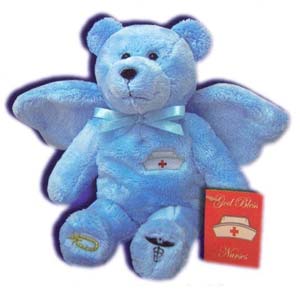
Rather than being perceived as cherubic angels and childlike creatures, this writer feels that being perceived as the valuable and skilled professionals who we truly are would allow the public to have a much more accurate perception of what we do, and our importance to the care of millions.
The Clothes on Our Back
Nurses' uniforms have certainly changed over the years, and as scrubs have become the norm for nurses in most clinical settings, many companies have capitalized on the popularity of such utilitarian clothing. Now, designer scrubs covered with angels, teddy-bears (there they are again!), and any number of cartoon-like images adorn the hard-working bodies of nurses around the world. If nurses want to be taken seriously by the public---and by doctors and other professionals---how does the wearing of such (in my opinion) unprofessional clothing help our cause?
Picture this: a team meeting occurs midday to discuss a patient on the adult oncology floor. Present at the meeting: a medical resident, a medical student, the attending doctor, the oncologist, two unit nurses, a social worker and a respiratory therapist. Of all of the professionals in the room, who would possibly be wearing pink scrubs covered with teddy-bears and hearts, and a pin on her chest saying "Doctors Cure, Nurses Care"? And what message does this convey about the nurse's self-image and how the other professionals present in the meeting should perceive him or her?
What's in a Name?
In From Silence to Voice, Buresh and Gordon make their case that nurses being addressed by first name only is also a major image problem when it comes to the public's perception of us a collective whole.
When doctors introduce themselves to patients or other professionals, they always do so by using the title "Doctor" before their name. This practice immediately creates an impression that the doctor is a professional, that he or she has a name that should be remembered, and a hierarchy of power and authority is clearly established from the start.
Conversely, we nurses almost ubiquitously introduce ourselves by first name only, ostensibly to break down the barriers between patients and nurses, assisting the patient in overcoming fears and anxieties related to their treatment. While this tactic may have some limited benefit, Buresh and Gordon argue that "if nurses introduce themselves by their first names only, they are asking to be regarded as nonprofessionals because that is the conventional way that nonprofessionals present themselves."
The "first-name only convention", as the authors have named it, makes it significantly more difficult for individual nurses to receive recognition for their work when only their first names are known. It also creates a hierarchical structure in which the doctor stands alone as a figure of authority, towering above the patient and nurse with (patriarchal or matriarchal) power and authority.
Interestingly, many nurses will argue that introducing ourselves as "Nurse Smith" or "Nurse Cadmus" is awkward at best, but also brings to mind the infamous "Nurse Ratched" from "One Flew Over the Cuckoo's Nest". Granted, Nurse Ratched is a mythic and hated figure in the pantheon of film and modern literature, yet do we see doctors eschewing their well-earned title due to historical figures such as Dr. Kevorkian or Dr. Mengele (of Auschwitz fame)? Absolutely not. Doctors use their title so commonly and so frequently that the word "doctor" simply holds too much cultural power to be diminished by one literary (or real-life) character who used that title for ill.
As for "naming practices" between doctors and nurses themselves, further examples of an unequal playing field emerge, with nurses almost continually subjugated to a diminished status by always being addressed by first name by both patients and doctors, whereas doctors maintain their professionalism and authority through the use of their title and last name.
Taking Credit Where Credit is Due
All too often, the work of nurses is diminished by nurses themselves. When thanked for their work, nurses will frequently say, "Oh, I didn't do much. The doctors really did the hard part." Or when a nurse is asked what he or she does, the answer will often be, "I'm just a nurse." This diminution of nurses' worth does little to cement in the public's collective mind the utter importance---the crucial presence---of nurses in the healthcare system. The "just a nurse" phrase---used all too painfully often---hurts nurses' cultural standing and diminishes the profession in the public's eye.
Nurses need to stand up and take credit for the work that they do. Buresh and Gordon urge nurses to say "You're welcome" when they are thanked. "I am so glad that I could assist you in learning so much about your diabetes, Mr. Smith" or "It was my pleasure to provide your post-operative nursing care, Mrs. Jones"---these are statements that take credit for nurses' actions, acknowledge patients' gratitude, and accept responsibility for providing crucial nursing care that directly impacts patients' recovery and health.
Nurses' Agency
Buresh and Gordon recommend that nurses discover their "voice of agency". According the authors, "the voice of agency is the voice that says: 'I helped the patient to walk after surgery so that she wouldn't get blood clots in her legs' or 'I taught the patient how to take his medications so that they would be effective and produce fewer side effects.' The authors further illustrate their point by reminding us that "the voice of agency is the voice that conveys the message, 'I'm here. I am doing something important.' "
For nurses to develop their own agency---their own power---nurses must first claim and recognize the importance of what they do. As Buresh and Gordon elucidate so clearly in their book, patients do not learn self-care skills in a vacuum. Someone must teach them those skills, and it is nurses who bring their knowledge and education directly to patient care. When recovering from surgery, it isn't doctors who monitor patients every fifteen minutes, using a lifetime's worth of learning to perform important expert assessments. Nurses use a wide variety of skills---often on an autonomous basis---to provide patients with the care and attention they need for optimal health.
While nurses are indeed held in very high esteem by the general public in surveys and polls, most members of that adoring public would be hard pressed to actually describe what it is that nurses do. As Bernice Buresh and Suzanne Gordon make so abundantly clear, it is up to nurses to claim their rightful place of importance in the care provided to patients in a variety of settings. Nurses need to proudly speak of their work with a voice of agency and power, and communicate clearly---to the public, the media, their families, their friends, and their colleagues---that nursing is important, that it is meaningful, and that what nurses do contributes to successful patient care and positive outcomes. We must forgo the teddy-bears, the hearts, the flowers, the useless diminutive statements and self-deprecation, and claim our professionalism for our own.
Nursing's voice must be heard, and Buresh and Gordon feel that the time for that voice to be clearly heard is now.
Thursday, February 17, 2011
The Fresh Air Fund NYC Half-Marathon
On March 20th, 2o11, The Fresh Air Fund is once again hosting its annual Half-Marathon, an amazing 13.1-mile course through beautiful Central Park, continuing on through Times Square and ending with breathtaking finish-line views of the New York City harbor. More than 11,000 runners, of all ages and abilities, finished the NYC Half-Marathon last year, raising over $100,000 for the cause, with almost $400,000 raised in the last four years.
The Fresh Air Fund has been providing free summer vacations for youth from the five boroughs of New York City since 1877. Thousands of children have benefited from the volunteerism and kindness of their host families.
The Fresh Air Fund is looking for runners and sponsors for the upcoming Half-Marathon, as well as host families willing to take a Fresh Air child into their home for two memorable and rewarding summer weeks.
If you'd like to be involved in the Half-Marathon, please click here, and if you'd like to find out more about becoming a host family, click here and read more about the program. If you'd like to find out if your child is eligible to be enrolled in the Fresh Air Fund summer program, click here.
Enjoy this video about the Fresh Air Fund experience!
The Fresh Air Fund has been providing free summer vacations for youth from the five boroughs of New York City since 1877. Thousands of children have benefited from the volunteerism and kindness of their host families.
The Fresh Air Fund is looking for runners and sponsors for the upcoming Half-Marathon, as well as host families willing to take a Fresh Air child into their home for two memorable and rewarding summer weeks.
If you'd like to be involved in the Half-Marathon, please click here, and if you'd like to find out more about becoming a host family, click here and read more about the program. If you'd like to find out if your child is eligible to be enrolled in the Fresh Air Fund summer program, click here.
Enjoy this video about the Fresh Air Fund experience!
Wednesday, February 16, 2011
The Sweetening of America
These days, it seems like sweeteners have made their sneaky way into almost everything. From soup to nuts, it's apparent that there can be no enlightened trip to the grocery store---or even the health food store---without the very careful reading of ingredient labels. Manufacturers are simply practicing the wholesale sweetening of America, and whether we like it or not, our food supply is increasingly infiltrated with useless calories and unnecessary sweeteners.
What's most maddening to me personally is my utter disappointment when shopping at the health food stores where I am dedicated to spending my money. The manufacturers of so-called "health food"---including companies that have always been at the forefront of the healthy eating movement---have jumped on the sweetener bandwagon in recent years, and everything from crackers to canned soups seem to be tainted with evaporated cane juice, and those extra calories are just adding to the American waistline, whether the cane is organic or not. The presence of these sweeteners is often lost on many consumers, who pull items from the shelves without a great deal of thoughtfulness. However, even a savvy health food consumer like myself can erroneously bring home an item that perhaps was previously sugar-free but is now chock full of sugar, much to my dismay and annoyance.
Like salt, one becomes accustomed to sweetened foods over time, and going back, for example, to unsweetened ketchup can be a huge leap after years of consuming ketchup loaded with sugar. It's a matter of taste, of course, but oftentimes the unsweetened versions are just as tasty as their sugary counterparts (with, admittedly, many exceptions---like soy milk, in my humble opinion).
Most recently, I have been trying to avoid dairy in my diet, so I've been looking for an unsweetened non-dairy creamer to use in my green tea, decaf coffee, or hot grain beverage. Sadly, every creamer on the market seems to be sweetened with evaporated cane juice or some other form of sugar, and I simply cannot fulfill this desire no matter how hard I try. (Do I detect a new market niche and business opportunity for an enterprising soul?)
With a personal goal of losing a few pounds this spring and a general desire to keep my diet as clean as possible, fishing for unsweetened forms of many common foods is a continuous exercise in patience and conscious shopping. Luckily, there are many products that I can count on to remain unsweetened, healthy and as unprocessed as possible. Sadly however, I am consistently dumbfounded as heretofore reliable companies decide to dump truckloads of organic evaporated cane juice into their manufacturing processes. Cane producers (both organic and conventional) must be rubbing their hands together with glee as their factories pump out more tons of their products each year. Want a good stock option? Try sugar futures---it's the future of America.
What's most maddening to me personally is my utter disappointment when shopping at the health food stores where I am dedicated to spending my money. The manufacturers of so-called "health food"---including companies that have always been at the forefront of the healthy eating movement---have jumped on the sweetener bandwagon in recent years, and everything from crackers to canned soups seem to be tainted with evaporated cane juice, and those extra calories are just adding to the American waistline, whether the cane is organic or not. The presence of these sweeteners is often lost on many consumers, who pull items from the shelves without a great deal of thoughtfulness. However, even a savvy health food consumer like myself can erroneously bring home an item that perhaps was previously sugar-free but is now chock full of sugar, much to my dismay and annoyance.
Like salt, one becomes accustomed to sweetened foods over time, and going back, for example, to unsweetened ketchup can be a huge leap after years of consuming ketchup loaded with sugar. It's a matter of taste, of course, but oftentimes the unsweetened versions are just as tasty as their sugary counterparts (with, admittedly, many exceptions---like soy milk, in my humble opinion).
Most recently, I have been trying to avoid dairy in my diet, so I've been looking for an unsweetened non-dairy creamer to use in my green tea, decaf coffee, or hot grain beverage. Sadly, every creamer on the market seems to be sweetened with evaporated cane juice or some other form of sugar, and I simply cannot fulfill this desire no matter how hard I try. (Do I detect a new market niche and business opportunity for an enterprising soul?)
With a personal goal of losing a few pounds this spring and a general desire to keep my diet as clean as possible, fishing for unsweetened forms of many common foods is a continuous exercise in patience and conscious shopping. Luckily, there are many products that I can count on to remain unsweetened, healthy and as unprocessed as possible. Sadly however, I am consistently dumbfounded as heretofore reliable companies decide to dump truckloads of organic evaporated cane juice into their manufacturing processes. Cane producers (both organic and conventional) must be rubbing their hands together with glee as their factories pump out more tons of their products each year. Want a good stock option? Try sugar futures---it's the future of America.
Tuesday, February 15, 2011
Online Nursing Degrees
I just took part in writing a short article for BestNursingDegree.com regarding the benefits and challenges of online nursing degree programs as opposed to traditional "brick and mortar" programs. Please click here if you'd like to peruse this brief article.
Wednesday, December 29, 2010
A Red Scarf and a Cup of Tea
"I know we've met before but I actually don't remember you," she says.
"That's OK. I remember you, and that's what matters. Nice to see you." I sit down at the table after she shakes my hand.
"I'm sorry I don't remember you, but you are very tall and handsome. Are you married?" She gives her ubiquitously flirtatious octogenarian smile.
"Yes, I've been married for 21 years." I take out my notebook and her client folder.
"Oh, too bad. I was hoping you'd stay with me." She sips some tea and folds her hands neatly in her lap again.
"Well, I don't think my wife or my boss would approve," I say, winking at her and getting out my blood pressure cuff and stethoscope.
"Did you have a nice Christmas?" I ask as I wrap the cuff around her arm.
"Oh, was it just Christmas? Oh, yes! I did," she says tentatively. "Thank you for asking." She looks confused.
As I inflate the blood pressure cuff, I watch her closely. Her respirations are normal---about 16 breaths per minute---and she seems at peace, but her mouth is quivering a little at the corner.
"Are you upset about something?" I ask, putting my supplies back in my bag.
"No, I feel fine," she says.
"Are you sure?" I ask again.
"Yes, I think so. I was upset about something this morning, but you know what?" She looks at me sharply.
"What?"
"I forgot what it was!" She laughs and drinks another sip of tea.
"Well," I say, "if you're ever upset about something, you can always talk to me."
"And what would I talk to you about?"
"Anything you like, my dear."
"Well, that's nice." She hesitates. "Are you going to stay with me?"
"No, I can't. But I'll be back next month, OK?"
"OK. Do you know what I forgot?"
"No, tell me."
"I forgot that Christmas is coming, and I didn't get my daughter anything." She begins to cry.
I hold her hand, and contemplate what to say. At this moment, the home health aide comes in, and intercedes on my behalf.
"You didn't forget your daughter, Mrs. ______. Don't you remember that we went shopping last week and bought her the red scarf? You told me she loved it."
My patient lets go of my hand, wipes her eyes, and looks up at the home health aide.
"A red scarf? You're sure?" She attempts a smile.
"Oh yes, I'm sure," the home health aide says. "You can ask your daughter about it later when she comes home. I think she's wearing it today."
"Oh, good. I thought I had completely forgotten. When is Christmas again?"
"It was last week, dear," I say, and the home health aide nods.
"Oh yes. That's right. Thank you." She sips her tea, wipes her eyes one more time, and it seems we've averted a crisis and an unnecessary dementia-related upset.
"Well, have a happy New Year, and I'll see you at the end of January." I take her hand and squeeze it gently.
"Thank you. I'm sorry you won't be staying with me. Are you sure you can't?"
I stand up and take my coat of off the chair. "No, I really can't. I have to get home to my wife. It's a holiday week and we have a lot to do. I'll be back to see you, though. I promise." I bend down to give her a hug, and she grabs the lapels of my coat.
"You're so handsome. Will you come back and see me on Christmas?"
"No dear, not on Christmas, but I'll be back soon. Happy New Year."
She smiles again, sips her tea, and picks up the paper. It's as if I've already left and she's forgotten that I was ever there.
I give the home health aide a hug and slip quietly out the door. Snow is falling again, and I look back at the house. My patient is sitting in the window, the picture of winter tranquility and coziness.
A red scarf, falling snow, a cup of tea, and the promise of a new year.
"That's OK. I remember you, and that's what matters. Nice to see you." I sit down at the table after she shakes my hand.
"I'm sorry I don't remember you, but you are very tall and handsome. Are you married?" She gives her ubiquitously flirtatious octogenarian smile.
"Yes, I've been married for 21 years." I take out my notebook and her client folder.
"Oh, too bad. I was hoping you'd stay with me." She sips some tea and folds her hands neatly in her lap again.
"Well, I don't think my wife or my boss would approve," I say, winking at her and getting out my blood pressure cuff and stethoscope.
"Did you have a nice Christmas?" I ask as I wrap the cuff around her arm.
"Oh, was it just Christmas? Oh, yes! I did," she says tentatively. "Thank you for asking." She looks confused.
As I inflate the blood pressure cuff, I watch her closely. Her respirations are normal---about 16 breaths per minute---and she seems at peace, but her mouth is quivering a little at the corner.
"Are you upset about something?" I ask, putting my supplies back in my bag.
"No, I feel fine," she says.
"Are you sure?" I ask again.
"Yes, I think so. I was upset about something this morning, but you know what?" She looks at me sharply.
"What?"
"I forgot what it was!" She laughs and drinks another sip of tea.
"Well," I say, "if you're ever upset about something, you can always talk to me."
"And what would I talk to you about?"
"Anything you like, my dear."
"Well, that's nice." She hesitates. "Are you going to stay with me?"
"No, I can't. But I'll be back next month, OK?"
"OK. Do you know what I forgot?"
"No, tell me."
"I forgot that Christmas is coming, and I didn't get my daughter anything." She begins to cry.
I hold her hand, and contemplate what to say. At this moment, the home health aide comes in, and intercedes on my behalf.
"You didn't forget your daughter, Mrs. ______. Don't you remember that we went shopping last week and bought her the red scarf? You told me she loved it."
My patient lets go of my hand, wipes her eyes, and looks up at the home health aide.
"A red scarf? You're sure?" She attempts a smile.
"Oh yes, I'm sure," the home health aide says. "You can ask your daughter about it later when she comes home. I think she's wearing it today."
"Oh, good. I thought I had completely forgotten. When is Christmas again?"
"It was last week, dear," I say, and the home health aide nods.
"Oh yes. That's right. Thank you." She sips her tea, wipes her eyes one more time, and it seems we've averted a crisis and an unnecessary dementia-related upset.
"Well, have a happy New Year, and I'll see you at the end of January." I take her hand and squeeze it gently.
"Thank you. I'm sorry you won't be staying with me. Are you sure you can't?"
I stand up and take my coat of off the chair. "No, I really can't. I have to get home to my wife. It's a holiday week and we have a lot to do. I'll be back to see you, though. I promise." I bend down to give her a hug, and she grabs the lapels of my coat.
"You're so handsome. Will you come back and see me on Christmas?"
"No dear, not on Christmas, but I'll be back soon. Happy New Year."
She smiles again, sips her tea, and picks up the paper. It's as if I've already left and she's forgotten that I was ever there.
I give the home health aide a hug and slip quietly out the door. Snow is falling again, and I look back at the house. My patient is sitting in the window, the picture of winter tranquility and coziness.
A red scarf, falling snow, a cup of tea, and the promise of a new year.
Monday, December 27, 2010
One Year Wanes, and Another Dawns
Well, dear Readers, yet another year in our lives has slipped through the fingers of time, and we pause to consider our blessings, count our lucky stars, and plan for the New Year ahead.
For me, this has been a year of great and momentous change. As most of you know, in October of 2009, my wife Mary and I sold our house and most of our possessions, left our beloved New England, and hit the open road in a 29-foot mobile home in search of intentional community. We chronicled that journey on our travel blog, Mary and Keith's Excellent Adventure, and in the course of our travels we visited more than 30 intentional communities in seven months.
Since June, we are settled---at least for now---in a lovely cohousing community in Santa Fe, New Mexico. Looking back, we readily acknowledge that everything we set out to accomplish has been realized: we live in a multigenerational intentional community with many like-minded souls, we are nearby to our son and daughter-in-law, our financial lives are more secure, we work less, we play more, and our quality of life is vastly increased. Speaking of counting one's blessings!
While we are uncertain of what the future holds, we currently have good health, a sense of belonging, a new coaching business, and there is a renewed sense in our lives that just about anything is possible.
As a nurse, I have two part-time jobs that are relatively non-stressful, allowing me more time to develop myself as a coach and as a professional writer. The nursing profession has been kind to me, and I relish being able to pick and choose the positions that are most suitable for me.
For this New Year, I wish all of you much success, health, abundance, love, prosperity, and a sense of peace in your hearts. Thank you for making Digital Doorway what it is, and I look forward to celebrating this blog's sixth anniversary with you next month.
Happy Holidays, Happy New Year, and my blessings to you and yours, now and always.
NurseKeith
For me, this has been a year of great and momentous change. As most of you know, in October of 2009, my wife Mary and I sold our house and most of our possessions, left our beloved New England, and hit the open road in a 29-foot mobile home in search of intentional community. We chronicled that journey on our travel blog, Mary and Keith's Excellent Adventure, and in the course of our travels we visited more than 30 intentional communities in seven months.
Since June, we are settled---at least for now---in a lovely cohousing community in Santa Fe, New Mexico. Looking back, we readily acknowledge that everything we set out to accomplish has been realized: we live in a multigenerational intentional community with many like-minded souls, we are nearby to our son and daughter-in-law, our financial lives are more secure, we work less, we play more, and our quality of life is vastly increased. Speaking of counting one's blessings!
While we are uncertain of what the future holds, we currently have good health, a sense of belonging, a new coaching business, and there is a renewed sense in our lives that just about anything is possible.
As a nurse, I have two part-time jobs that are relatively non-stressful, allowing me more time to develop myself as a coach and as a professional writer. The nursing profession has been kind to me, and I relish being able to pick and choose the positions that are most suitable for me.
For this New Year, I wish all of you much success, health, abundance, love, prosperity, and a sense of peace in your hearts. Thank you for making Digital Doorway what it is, and I look forward to celebrating this blog's sixth anniversary with you next month.
Happy Holidays, Happy New Year, and my blessings to you and yours, now and always.
NurseKeith
Subscribe to:
Posts (Atom)