My niece, a newly minted college student somewhere in New England, referred a friend to me for advice on exploring the joys and vicissitudes of nursing as a career. This thoughtful young woman who is entering her senior year in high school is filled with questions which I most readily and joyfully answer. This is affording me a golden opportunity to examine my motives for being a nurse, my reasons for remaining a nurse, and why and how I would ever consider encouraging anyone else to enter this profession.
Yes, nurses may still sometimes "eat their young", and hospitals may still use mandatory overtime to heartlessly over-utilize their nurses, while some of us struggle with caseloads which burst our brains' ability to provide what we feel is the most thoughtful, thorough care possible.
Still, I see a noble and genuine love of people driving many individuals to enter the nursing milieu, and a career which, historically, is portrayed as one which is grounded in compassion and caring. Nurses have made great strides (alongside some misguided backwards motion at times), and I still feel enormous pride vis-a-vis my chosen vocation/profession.
This correspondence, which I hope to integrate and share here on Digital Doorway, may open for me some more doorways to explore, and I'll be sure to share them here so that you can experience them with me. Stay tuned.
Wednesday, August 30, 2006


Saturday, August 26, 2006
Turning Corners, Connecting Dots
Recovery, healing, and a new life reality are always around the corner. In healthcare, watching someone make that shift is incredibly gratifying.
Two of my current patients are both making great strides in their recovery, accepting help and attempting to make positive choices. One's drug of choice is alcohol. The other has a predilection for cocaine and heroin. Each one has other health problems which only magnify the urgency of making better choices: cirrhosis, hypertension, diabetes, neuropathy, depression, anxiety. No matter the constellation of comorbidities, the potential outcome---disability and death---is certain.
I try to offer a clean slate with each visit. My role, while multifaceted, is also quite simple. I provide guidance, compassion, tough love when needed, and a steady hand through the rough patches. I tell them: when the cravings come, call me. When the pain is too much, call me. When you feel like you're so afraid you want to die, call me. When you need a pep talk, call me. And these two people really do call---as do some others---and now it's paying dividends.
One of the secrets to guiding our patients towards health is getting them to pay attention. If they don't focus on the fact that their liver is affected directly by every drink, every drug, every decision, they just don't connect the dots. If they forget how important it is to tightly control their blood sugars, they lose sight of the prize. If they can't connect their current symptoms with their lifestyle choices, they're lost. Health is a complex entity, and seeing the lightbulb go off in their head is a gratifying moment in itself. Watching them use that lightbulb to illuminate their darkest corners of pain and regret is pure magic.
When it all comes down to it, it is compassion which drives the vehicle. Even when they come in, sit down in the exam room, and say "I fucked up. I used again this weekend. My life is over," I try to keep my expression neutral, my voice calm. "OK. You made a poor choice. But today you're here. Let's talk about today and tomorrow. What next? What's the next step?" I maintain my equilibrium, look them in the eye, hand reasurringly on their arm, my gaze steady but soft, open and inviting of confidence.
One man has been clean of alcohol since January of 2005 and has turned his life around. He is still struggling with the fact that he can't hang out with his old friends anymore and feels isolated. "I don't have much fun since I quit drinking. Everyone else seems to be having such a good time. It's lonely." But he keeps on the straight and narrow, and though his liver is riddled with cirrhosis, it seems we caught it just in time. While he may not be agood candidate for a transplant, he's a good candidate for a paradigm shift. He's living and eating well and trying his best. He turned a corner and never looked back. That liver will eventually kill him, but we don't focus there, turning our gaze forever on the present.
Another patient relapses again and again but now may be on the right road. I finally got him into an outpatient addictions treatment program and he's doing the work, plus going to meetings every day. Frightened of death and disability, knowing that his liver is damaged (but not yet beyond repair like the gentleman in the previous paragraph), he wants to do it all. He sees the cardiologist, shows up for appointments, sees our psychologist, and continues to make the right choices. We treat him like the respectable human being he is, with dignity and respect. He responds by coming back again and again, ready for more. I cant promise him he'll live forever, but I can promise him improved health and quality of life if he pays attention. And his attention is currently riveted----eyes on the prize.
For each patient who I cannot reach, who is lost to their own devices, there are several who respond to the call and step up to the proverbial plate. Their stellar performance, their willingess to engage again and again, that can keep me going. The others? I keep sending out the bait and trying to reel them in. Some respond from time to time, some crash and burn, many die. The hand is always there if they want it----if they can even see it. One such gentleman is now institutionalized forever, having ruptured his esophagus from intractable vomiting. He admits that he should have listened, that he should have known this day would come. Regretful and sad, his body filled with tubes, unable to ever eat or drink again, he is a living example of what happens when one fails to pay attention and falls into the abyss again. It's dark in there, and he was saved only by a miracle. He's a living example, a sad reminder to many. I feel such compassion for him, such sadness.
Back to the present, there are many more willing to take the leap of faith, and we're ready for them every day. What a treat to watch as a person turns that corner, beaming a smile of pride, and seems to finally "get it" in a way that is irreversibly joyful. The dark moments still come, the corners in need of illumination still harboring silent watchful demons, but there's still room for recovery and growth, the light filling the room with hope. That light is what we try to point out, and many thankfully refuse to shade their eyes and step over that threshold. It is a wonder to behold.
Two of my current patients are both making great strides in their recovery, accepting help and attempting to make positive choices. One's drug of choice is alcohol. The other has a predilection for cocaine and heroin. Each one has other health problems which only magnify the urgency of making better choices: cirrhosis, hypertension, diabetes, neuropathy, depression, anxiety. No matter the constellation of comorbidities, the potential outcome---disability and death---is certain.
I try to offer a clean slate with each visit. My role, while multifaceted, is also quite simple. I provide guidance, compassion, tough love when needed, and a steady hand through the rough patches. I tell them: when the cravings come, call me. When the pain is too much, call me. When you feel like you're so afraid you want to die, call me. When you need a pep talk, call me. And these two people really do call---as do some others---and now it's paying dividends.
One of the secrets to guiding our patients towards health is getting them to pay attention. If they don't focus on the fact that their liver is affected directly by every drink, every drug, every decision, they just don't connect the dots. If they forget how important it is to tightly control their blood sugars, they lose sight of the prize. If they can't connect their current symptoms with their lifestyle choices, they're lost. Health is a complex entity, and seeing the lightbulb go off in their head is a gratifying moment in itself. Watching them use that lightbulb to illuminate their darkest corners of pain and regret is pure magic.
When it all comes down to it, it is compassion which drives the vehicle. Even when they come in, sit down in the exam room, and say "I fucked up. I used again this weekend. My life is over," I try to keep my expression neutral, my voice calm. "OK. You made a poor choice. But today you're here. Let's talk about today and tomorrow. What next? What's the next step?" I maintain my equilibrium, look them in the eye, hand reasurringly on their arm, my gaze steady but soft, open and inviting of confidence.
One man has been clean of alcohol since January of 2005 and has turned his life around. He is still struggling with the fact that he can't hang out with his old friends anymore and feels isolated. "I don't have much fun since I quit drinking. Everyone else seems to be having such a good time. It's lonely." But he keeps on the straight and narrow, and though his liver is riddled with cirrhosis, it seems we caught it just in time. While he may not be agood candidate for a transplant, he's a good candidate for a paradigm shift. He's living and eating well and trying his best. He turned a corner and never looked back. That liver will eventually kill him, but we don't focus there, turning our gaze forever on the present.
Another patient relapses again and again but now may be on the right road. I finally got him into an outpatient addictions treatment program and he's doing the work, plus going to meetings every day. Frightened of death and disability, knowing that his liver is damaged (but not yet beyond repair like the gentleman in the previous paragraph), he wants to do it all. He sees the cardiologist, shows up for appointments, sees our psychologist, and continues to make the right choices. We treat him like the respectable human being he is, with dignity and respect. He responds by coming back again and again, ready for more. I cant promise him he'll live forever, but I can promise him improved health and quality of life if he pays attention. And his attention is currently riveted----eyes on the prize.
For each patient who I cannot reach, who is lost to their own devices, there are several who respond to the call and step up to the proverbial plate. Their stellar performance, their willingess to engage again and again, that can keep me going. The others? I keep sending out the bait and trying to reel them in. Some respond from time to time, some crash and burn, many die. The hand is always there if they want it----if they can even see it. One such gentleman is now institutionalized forever, having ruptured his esophagus from intractable vomiting. He admits that he should have listened, that he should have known this day would come. Regretful and sad, his body filled with tubes, unable to ever eat or drink again, he is a living example of what happens when one fails to pay attention and falls into the abyss again. It's dark in there, and he was saved only by a miracle. He's a living example, a sad reminder to many. I feel such compassion for him, such sadness.
Back to the present, there are many more willing to take the leap of faith, and we're ready for them every day. What a treat to watch as a person turns that corner, beaming a smile of pride, and seems to finally "get it" in a way that is irreversibly joyful. The dark moments still come, the corners in need of illumination still harboring silent watchful demons, but there's still room for recovery and growth, the light filling the room with hope. That light is what we try to point out, and many thankfully refuse to shade their eyes and step over that threshold. It is a wonder to behold.
Thursday, August 24, 2006
Change of Shift, Vol. I, No. V
Please surf on over to Change of Shift, Volume 5. Change of Shift is a new blog carnival by and about nurses and nurse bloggers. Please show your support by reading this newest edition. No charge!
Wednesday, August 23, 2006
A Question and an Answer
QUESTION: Tired nurse seeking fuel for his train running low on soul coal. Where does one turn? Exercise? Vacation? Gin? Meditation? Sleep? Narcotics? Dear Abbie? Dr. Ruth? Judge Judy? Dr. Phil?
ANSWER: Don't just do something. Sit there.
ANSWER: Don't just do something. Sit there.
Tuesday, August 22, 2006
Mid-Week Fatigue
Mid-week fatigue rolls in on this nurse who just finished a 12-hour day plus time at the gym early this morning. I have that boy-my-feet-and-brain-are-tired feeling. Bone tired. This chronic pain thing is draining. Part of my fatigue is the extra weight of pain and discomfort throughout the day, with lost sleep for extra spice.
Tired or not, the patients keep coming, each with their individual needs. So many interactions fill a day. Hours go by, with myriad details flying around my head like so many swarming flies.
Each interaction, each situation, calls for a certain level of awareness and presence. I try to bring to each patient a sense that I am fully there, fully listening, hearing their complaints and responding to them in a way which helps them to feel heard. Beyond hearing, I look for teaching moments, as well as ways in which my actions will benefit that individual in some way, assuage a pain, relieve a worry, mitigate an annoyance. There is so much to do, so many choices to make.
Sometimes the days are like being in an asteroid belt, dodging and sailing around so many obstacles, potential clashes and frictions always on the verge of manifesting themselves. At other times, it feels like a battlefield, and as the telephone calls and faxes and unannounced patients arrive, the support staff yell "incoming!" like infantry in a foxhole. Then again it can sometimes just feel like an office with alot of hubbub, while I coast atop the crest of the wave, few ruffles of my feathers even noticed as I breeze along. Still other days, it is a nauseating roller-coaster, the carnie on an extended break and the ride set on an endless loop. Then we reach for the barf-bag and pass the Dramamine.
No Dramamine today. Rather, a need for deep sleep uninterrupted by pain, muscles crying out, disturbing my needed rest. Pain can raise one's compassion---for one's self and for others. It can be a very human reminder of the mortal corporeal reality in which we are ensconced, the dangerous pull of gravity which wears down our resistance, pulling us to earth like the proverbial ball and chain.
This physical existence, this dragging around a body---it's enough to make one realize just how much work it takes to propel yourself along through life. As healthcare professionals, we try to remedy that weight as it is experienced by our patients, but we cannot carry their burdens for them. No. We use compassion, skillful listening, and our own life's truth to guide us in our guiding of others along these difficult earthly paths. I feel the weight of gravity today. May tomorrow its pull be less noticeable, the strain of physicality assuaged for all who need that sweet relief.
Tired or not, the patients keep coming, each with their individual needs. So many interactions fill a day. Hours go by, with myriad details flying around my head like so many swarming flies.
Each interaction, each situation, calls for a certain level of awareness and presence. I try to bring to each patient a sense that I am fully there, fully listening, hearing their complaints and responding to them in a way which helps them to feel heard. Beyond hearing, I look for teaching moments, as well as ways in which my actions will benefit that individual in some way, assuage a pain, relieve a worry, mitigate an annoyance. There is so much to do, so many choices to make.
Sometimes the days are like being in an asteroid belt, dodging and sailing around so many obstacles, potential clashes and frictions always on the verge of manifesting themselves. At other times, it feels like a battlefield, and as the telephone calls and faxes and unannounced patients arrive, the support staff yell "incoming!" like infantry in a foxhole. Then again it can sometimes just feel like an office with alot of hubbub, while I coast atop the crest of the wave, few ruffles of my feathers even noticed as I breeze along. Still other days, it is a nauseating roller-coaster, the carnie on an extended break and the ride set on an endless loop. Then we reach for the barf-bag and pass the Dramamine.
No Dramamine today. Rather, a need for deep sleep uninterrupted by pain, muscles crying out, disturbing my needed rest. Pain can raise one's compassion---for one's self and for others. It can be a very human reminder of the mortal corporeal reality in which we are ensconced, the dangerous pull of gravity which wears down our resistance, pulling us to earth like the proverbial ball and chain.
This physical existence, this dragging around a body---it's enough to make one realize just how much work it takes to propel yourself along through life. As healthcare professionals, we try to remedy that weight as it is experienced by our patients, but we cannot carry their burdens for them. No. We use compassion, skillful listening, and our own life's truth to guide us in our guiding of others along these difficult earthly paths. I feel the weight of gravity today. May tomorrow its pull be less noticeable, the strain of physicality assuaged for all who need that sweet relief.
Wednesday, August 16, 2006
Barely Living
Her home feels like a tomb. Her paranoia causes her to barricade the front door with the couch and hide in her room upstairs. She's lost her Personal Care Attendant services, her family have abandoned her, and she spins relentless webs of paranoia as she cowers indoors on even the nicest summer days.
The level of trauma which she has experienced in her life is something which I cannot begin to fathom, and the chaos of her mind is also beyond my ken. I can tell that it's muddy in there, but the muddiness is not within my ability to clarify. What I am able to provide is concrete: an appointment with our psychologist for an assessment, prefilled psychotropic meds in an easy-to-use daily med box, the number for psychiatric emergency services, holding her hand as she cries.
I offer a hug when I get up to leave her barren apartment which once teemed with life---children, teens, neighbors, grandchildren, visitors. The house feels so lonely, there are barely echoes of its former life. I know her husband died in this house and his ghost must haunt her still, not to mention the horror of finding him in their bed, blue and lifeless.
She complains of voices constantly telling her "horrible, horrible things." She peers through the curtains into the bright sunlit street and demonstrates for me how her paranoia manifests in fear-based obsessive-compulsive behavior.
What can I offer? Empathy? Sympathy? Emergency phone numbers? An appointment? Medications? I feel like what's needed here is an all-out exorcism, and I leave the darkened home, sobered and sad.
"Barely living" is what I think as I walk towards the clinic. Can we really prescribe a return to life?
The level of trauma which she has experienced in her life is something which I cannot begin to fathom, and the chaos of her mind is also beyond my ken. I can tell that it's muddy in there, but the muddiness is not within my ability to clarify. What I am able to provide is concrete: an appointment with our psychologist for an assessment, prefilled psychotropic meds in an easy-to-use daily med box, the number for psychiatric emergency services, holding her hand as she cries.
I offer a hug when I get up to leave her barren apartment which once teemed with life---children, teens, neighbors, grandchildren, visitors. The house feels so lonely, there are barely echoes of its former life. I know her husband died in this house and his ghost must haunt her still, not to mention the horror of finding him in their bed, blue and lifeless.
She complains of voices constantly telling her "horrible, horrible things." She peers through the curtains into the bright sunlit street and demonstrates for me how her paranoia manifests in fear-based obsessive-compulsive behavior.
What can I offer? Empathy? Sympathy? Emergency phone numbers? An appointment? Medications? I feel like what's needed here is an all-out exorcism, and I leave the darkened home, sobered and sad.
"Barely living" is what I think as I walk towards the clinic. Can we really prescribe a return to life?
Monday, August 14, 2006
On Blogging and Connectivity
I realize that I spend a great deal of my time either thinking about blogging, talking about blogging, or actually writing on my blogs. I am a great proponent of the medium, have now appeared in at least one article about nurse bloggers, and participate in two ongoing and regular blog carnivals which gather together the "best" of the bloggers in the medical, nursing, and allied health fields.
In the mainstream media, "blogger" or "bloggers" are generally lumped into one category---the political blogger---that pesky nuisance (or brilliant iconoclast, depending upon your opinion on the matter, of course) who breaks a story faster than ABC and makes Dan Rather look like a dinosaur (an easy task, I know, but still laudable, in essence).
Aside from the political pundits who inhabit the blogsophere, there are countless categories of bloggers filling the Web with what some might call drivel, but which I consider a portal into the lives, loves, longings and interests of millions of souls staring at a screen, fingers typing with intention. While some blogs which detail the ins and outs of rechargeable batteries may not be my cup of tea, the fact that an individual feels strongly enough about those batteries to publish his or her thoughts about them and share them with the world is, by nature (at least in my mind) a worthwhile task. Whereas some might postulate that the "battery blogger" needs to get a life, perhaps his life includes time devoted to filling one small mini-hectare of cyberspace with his opinion on the merits of various batteries. Is this in itself bad or good, productive or not? The person shopping for the ultimate rechargeable battery would certainly be grateful for the information on offer.
Strolling through any blog search engine will reveal that there are many, many people with something to say. The worth of those words and pictures are completely subjective, but the sense of connection and community which these communications can foster is certainly worthy of exploration. I'm interested to see what scholarly and popular tomes are written (on real paper) in the near future, examining the effect of blogs on culture, social connectivity, and the dissemination of information and opinion on a global basis, be it about batteries or Babar.
To some, sitting in front of a computer to "connect"with others might seem somewhat of a conundrum. Why not meet like-minded others in a cafe? A bar? A local gym? A meeting or club? Yes, all of the these are distinct possibilities, yet meeting people these days and forming friendships can be a slow and painstaking process, especially as life has taken on a propulsive velocity that precludes the practice of sitting in the town square and watching the people go by as we chat with neighbors and friends, making new friends and acquaintances in the process. The fact of the matter is that meeting for lunch, then going out for drinks, then getting one's families together to meet one another, is often a prohibitive experience for many new friends. If one is a parent, the taxiing and ferrying of children to and fro---and the complicated social lives of children---make it even more difficult for working adults to simply spend time over coffee, chatting and deepening friendships the old-fashioned way. For better or for worse (probably for worse), our culture has changed, and this type of easy social discourse is much more difficult to achieve, perhaps even in smaller towns previously untouched by the speed of life in the 21st century.
With blogs can come community, connectivity, and a sense of belonging. Nurse bloggers "meet" on-line and form strong professional and personal bonds. Posting comments on one another's blogs leads to personal email transactions, then telephone conversations, even face-to-face meetings. After a year of blog and email communications, my wife and I actually visited a blog-friend of mine in her hometown and we have begun a friendship built upon the foundation of the multitudinous and deep sharing we have done in the digital realms. The friendship moved from the virtual to the physical plane, and we are richer for it.
Beyond blogs, on-line social networking communities have created even more cohesive groups where individuals find like-minded people and congregate to discuss topics or issues of interest. often leading to "real-time" meetings, even international conferences and the like. Tribe, MySpace, Zaadz, Care2---these sites all carry the promise of connectivity, community, a sense of belonging, and a way to find those who share your interests without standing at a bar, ordering a beer, and asking the person next to you if they happen to like Jean Paul Sartre and would be interested in discussing Nausea with you for an hour or so. Zaadz is where I put my attention, a place dedicated to bringing together people who want to change the world. I also concentrate on the relationships fostered between myself and other bloggers, and the sense of true connection is something only the initiated can truly understand and appreciate.
I am by no means covering all of the aspects of blogging and social connectivity which could be put forth in such a missive. These are simply the late-night ramblings of a dedicated blogger and admitted email addict who sees that much good can come of such predilections, as long as one maintains normal real-world social discourse, takes time to read real paper books, drink coffee unhurriedly with friends at outdoor cafes in dappled sunlight, and delight in the scampering of a puppy pursuing a stick thrown by its owner in the neighborhood park. There is room for connectivity of all kinds in this world, and we all know that too much of any good thing---blogging included---can only myopia make.
So now I will peel my eyes from the screen, pick up my book, pour some tea, and connect with myself through the magic of literature and the fire it lights in my imagination. Meanwhile, millions of bloggers fill the ethers as they share their lives and loves and inspirations, digital tendrils snaking around the world, connections made, severed, reconnected and strengthened. What a tangled web we weave......
In the mainstream media, "blogger" or "bloggers" are generally lumped into one category---the political blogger---that pesky nuisance (or brilliant iconoclast, depending upon your opinion on the matter, of course) who breaks a story faster than ABC and makes Dan Rather look like a dinosaur (an easy task, I know, but still laudable, in essence).
Aside from the political pundits who inhabit the blogsophere, there are countless categories of bloggers filling the Web with what some might call drivel, but which I consider a portal into the lives, loves, longings and interests of millions of souls staring at a screen, fingers typing with intention. While some blogs which detail the ins and outs of rechargeable batteries may not be my cup of tea, the fact that an individual feels strongly enough about those batteries to publish his or her thoughts about them and share them with the world is, by nature (at least in my mind) a worthwhile task. Whereas some might postulate that the "battery blogger" needs to get a life, perhaps his life includes time devoted to filling one small mini-hectare of cyberspace with his opinion on the merits of various batteries. Is this in itself bad or good, productive or not? The person shopping for the ultimate rechargeable battery would certainly be grateful for the information on offer.
Strolling through any blog search engine will reveal that there are many, many people with something to say. The worth of those words and pictures are completely subjective, but the sense of connection and community which these communications can foster is certainly worthy of exploration. I'm interested to see what scholarly and popular tomes are written (on real paper) in the near future, examining the effect of blogs on culture, social connectivity, and the dissemination of information and opinion on a global basis, be it about batteries or Babar.
To some, sitting in front of a computer to "connect"with others might seem somewhat of a conundrum. Why not meet like-minded others in a cafe? A bar? A local gym? A meeting or club? Yes, all of the these are distinct possibilities, yet meeting people these days and forming friendships can be a slow and painstaking process, especially as life has taken on a propulsive velocity that precludes the practice of sitting in the town square and watching the people go by as we chat with neighbors and friends, making new friends and acquaintances in the process. The fact of the matter is that meeting for lunch, then going out for drinks, then getting one's families together to meet one another, is often a prohibitive experience for many new friends. If one is a parent, the taxiing and ferrying of children to and fro---and the complicated social lives of children---make it even more difficult for working adults to simply spend time over coffee, chatting and deepening friendships the old-fashioned way. For better or for worse (probably for worse), our culture has changed, and this type of easy social discourse is much more difficult to achieve, perhaps even in smaller towns previously untouched by the speed of life in the 21st century.
With blogs can come community, connectivity, and a sense of belonging. Nurse bloggers "meet" on-line and form strong professional and personal bonds. Posting comments on one another's blogs leads to personal email transactions, then telephone conversations, even face-to-face meetings. After a year of blog and email communications, my wife and I actually visited a blog-friend of mine in her hometown and we have begun a friendship built upon the foundation of the multitudinous and deep sharing we have done in the digital realms. The friendship moved from the virtual to the physical plane, and we are richer for it.
Beyond blogs, on-line social networking communities have created even more cohesive groups where individuals find like-minded people and congregate to discuss topics or issues of interest. often leading to "real-time" meetings, even international conferences and the like. Tribe, MySpace, Zaadz, Care2---these sites all carry the promise of connectivity, community, a sense of belonging, and a way to find those who share your interests without standing at a bar, ordering a beer, and asking the person next to you if they happen to like Jean Paul Sartre and would be interested in discussing Nausea with you for an hour or so. Zaadz is where I put my attention, a place dedicated to bringing together people who want to change the world. I also concentrate on the relationships fostered between myself and other bloggers, and the sense of true connection is something only the initiated can truly understand and appreciate.
I am by no means covering all of the aspects of blogging and social connectivity which could be put forth in such a missive. These are simply the late-night ramblings of a dedicated blogger and admitted email addict who sees that much good can come of such predilections, as long as one maintains normal real-world social discourse, takes time to read real paper books, drink coffee unhurriedly with friends at outdoor cafes in dappled sunlight, and delight in the scampering of a puppy pursuing a stick thrown by its owner in the neighborhood park. There is room for connectivity of all kinds in this world, and we all know that too much of any good thing---blogging included---can only myopia make.
So now I will peel my eyes from the screen, pick up my book, pour some tea, and connect with myself through the magic of literature and the fire it lights in my imagination. Meanwhile, millions of bloggers fill the ethers as they share their lives and loves and inspirations, digital tendrils snaking around the world, connections made, severed, reconnected and strengthened. What a tangled web we weave......
Monday, August 07, 2006
Moonlightin' Nurse
Now that my teaching days at the community college are done, I'm stepping up my moonlighting at two other per diem gigs. This nurse and his blushing bride don't seem able to earn quite enough from 9 to 5, so some evening shifts are de rigeur in terms of financial survival and debt relief, at least for now.
This evening was four home visits for a local visiting nurse agency which had woo'ed me for more than a year to take a full time position. I've refused their offers time and again---including a managerial position---but have taken on the mantle of "Evening Per Diem Nurse" simply to increase deposits to my checking account.
Interestingly, both of my per diem gigs reflect the nature of two previously held jobs during my early career as a nurse. My current work as a per diem visiting nurse harkens back to my previous employment at a locally-owned visiting nurse association which afforded me the opportunity to work somewhat autonomously, visiting 8 homebound patients per day, but bound and gagged by the specific orders signed by the supervising physician. I found that role stifling and clinically limited and lasted only a few years before being swept off my feet to the job which I now hold.
My second per diem position is within the community health center where my full-time care management program is housed as a contracting agency. I primarily chose to work per diem at the clinic so that I could gain access to various employee benefits at the hospital of which the clinic is a part, namely the employee gym where I work out several times per week for $20 per month. Aside from that, it gives me an insider's view of the health center and some measure of an edge when it comes to facilitating care for the 80 patients on my roster during my day job.
Wearing several different hats as a nurse can be confusing at times if one loses sight of what the particular scope of practice is for the position of the moment. While I may occasionally experience "role confusion" (ie: wanting to make an autonomous decision in my clinic role as Pod Nurse before realizing that this autonomy belongs to my full-time job), I'm relatively capable of maintaining my differentiation depending upon the role in which I am presently embodied.
Examining my three distinct clinical roles and their defined scopes of practice, I am immeasurably grateful for the breadth and depth of the autonomy which is the cornerstone of my full-time job, a reason why I remain in such a stressful and demanding professional position. Overseeing and managing the care of 80 people whose clinical disposition, comorbidities and occasionally chaotic lives can be an enormous challenge, but the freedom of practice which is the central aspect of my role more than makes up for the frustrations and vicissitudes of the job.
As much as it's difficult to work in two other positions which place me in a more, shall we say, "subservient" nursing role (ie: simply carrying out doctor's orders with relatively little room for personal initiative), spending time in those other "hats" gives me time to pause and reflect on the singular nature of what I do from 9 to 5, the authority and trust placed in me by my bosses and the doctors with whom I co-manage patients, and the ability which I regularly exercise of making clinical judgments and enacting plans of action vis-a-vis those judgments.
All this is to simply say that my "other jobs" can often serve to reinvigorate my 9 to 5 experience rather than just exhaust me due to the extra hours of labor after the 5 o'clock whistle blows. Would I rather not feel the need to work more than just my full-time job? Sure. But when push comes to shove, the Man Who Would be Nurse does what he must do, and then comes home to reap the rewards of a day's work well done.
This evening was four home visits for a local visiting nurse agency which had woo'ed me for more than a year to take a full time position. I've refused their offers time and again---including a managerial position---but have taken on the mantle of "Evening Per Diem Nurse" simply to increase deposits to my checking account.
Interestingly, both of my per diem gigs reflect the nature of two previously held jobs during my early career as a nurse. My current work as a per diem visiting nurse harkens back to my previous employment at a locally-owned visiting nurse association which afforded me the opportunity to work somewhat autonomously, visiting 8 homebound patients per day, but bound and gagged by the specific orders signed by the supervising physician. I found that role stifling and clinically limited and lasted only a few years before being swept off my feet to the job which I now hold.
My second per diem position is within the community health center where my full-time care management program is housed as a contracting agency. I primarily chose to work per diem at the clinic so that I could gain access to various employee benefits at the hospital of which the clinic is a part, namely the employee gym where I work out several times per week for $20 per month. Aside from that, it gives me an insider's view of the health center and some measure of an edge when it comes to facilitating care for the 80 patients on my roster during my day job.
Wearing several different hats as a nurse can be confusing at times if one loses sight of what the particular scope of practice is for the position of the moment. While I may occasionally experience "role confusion" (ie: wanting to make an autonomous decision in my clinic role as Pod Nurse before realizing that this autonomy belongs to my full-time job), I'm relatively capable of maintaining my differentiation depending upon the role in which I am presently embodied.
Examining my three distinct clinical roles and their defined scopes of practice, I am immeasurably grateful for the breadth and depth of the autonomy which is the cornerstone of my full-time job, a reason why I remain in such a stressful and demanding professional position. Overseeing and managing the care of 80 people whose clinical disposition, comorbidities and occasionally chaotic lives can be an enormous challenge, but the freedom of practice which is the central aspect of my role more than makes up for the frustrations and vicissitudes of the job.
As much as it's difficult to work in two other positions which place me in a more, shall we say, "subservient" nursing role (ie: simply carrying out doctor's orders with relatively little room for personal initiative), spending time in those other "hats" gives me time to pause and reflect on the singular nature of what I do from 9 to 5, the authority and trust placed in me by my bosses and the doctors with whom I co-manage patients, and the ability which I regularly exercise of making clinical judgments and enacting plans of action vis-a-vis those judgments.
All this is to simply say that my "other jobs" can often serve to reinvigorate my 9 to 5 experience rather than just exhaust me due to the extra hours of labor after the 5 o'clock whistle blows. Would I rather not feel the need to work more than just my full-time job? Sure. But when push comes to shove, the Man Who Would be Nurse does what he must do, and then comes home to reap the rewards of a day's work well done.
Friday, August 04, 2006
Eavesdropping
You are a fly on the wall of an exam room today, and I'm facing a patient whose choices are not always the best, but she shows great promise.....
"I'm so worried about my liver, I've been thinking of killing myself."
"Well, your liver really isn't that bad."
"Are you sure? I'm so nervous. I took one of my mother's Ativans this morning. I just couldn't take it. I'm gonna die."
"We're all gonna die someday. I could die when I leave work tonight. You may outlive me by thirty years. But here we are right now."
"I don't wanna die. I'm shittin' myself."
"Look at the computer screen with me for a second. Do you see those lab values compared with two years ago? That indicates inflammation and damage to the liver. You were much worse off at that time. We're making progress."
"But I just did crack recently and was in detox for days! I keep telling myself that I don't really drink, but I have this whole box full of nip bottles. I just guzzled one after another."
"Look, everybody makes mistakes. The fact is, you went to detox, now you're clean. You've got a fresh start, a chance to begin again. Every day you're clean is a victory. Every hour you're clean is a victory. Don't look at the bigger picture---it's too overwhelming. You can say to yourself, 'Wow, I didn't use today. I didn't have any cravings. That's great! I went an hour without thinking about drugs. Wow!' "
"But I'm so worried. I went to the methadone clinic today, and somebody said, 'Hey, you look all stressed out. Want some Xanax? I've got some rock [cocaine] you could have.' Jesus, don't these people get it? I just got out of detox and they're offering me rock! Shit!"
"Part of recovery is changing the people you hang out with. Seeing those same old people every day just triggers you to use, or at least to crave it."
"But that's the thing----the methadone clinic is crawling with druggies. And the staff don't want me to get off of methadone---they don't want to lose clients. I need to get off of that stuff and away from those assholes."
"There is a place where you can be detoxed off of methadone safely, but you have to go every day for at least a month and really get with the program. There's counseling, nurses, a doctor to oversee your care, and they'll communicate closely with me. We also need to get you into therapy and to see a psychiatrist. If we don't deal with the depression and anxiety, we're missing a big piece."
"I wanna do it all! I'm ready. You've been so good to me, all I want to do is get it together. I don't wanna die, not any time soon. Do you think I have a chance?"
"You have all the chances you need right here in front of you. Let's go one step at a time. You look good, your labs aren't that bad, and you're ready to roll. Let's get you referred to those programs, and then for a liver biopsy so we know exactly what we're working with, OK?"
"All right. I'm ready. I'm gonna take good care of myself this weekend, go to meetings every day, and come see you Monday."
"Great plan. I really think you can do this, and we're here to help you make the right choices. Call me Monday."
"OK. It's a deal."
And with a handshake, she's gone, swallowed by the world, and the streets that tempt her at every turn. May every force for good in the universe be with her........
"I'm so worried about my liver, I've been thinking of killing myself."
"Well, your liver really isn't that bad."
"Are you sure? I'm so nervous. I took one of my mother's Ativans this morning. I just couldn't take it. I'm gonna die."
"We're all gonna die someday. I could die when I leave work tonight. You may outlive me by thirty years. But here we are right now."
"I don't wanna die. I'm shittin' myself."
"Look at the computer screen with me for a second. Do you see those lab values compared with two years ago? That indicates inflammation and damage to the liver. You were much worse off at that time. We're making progress."
"But I just did crack recently and was in detox for days! I keep telling myself that I don't really drink, but I have this whole box full of nip bottles. I just guzzled one after another."
"Look, everybody makes mistakes. The fact is, you went to detox, now you're clean. You've got a fresh start, a chance to begin again. Every day you're clean is a victory. Every hour you're clean is a victory. Don't look at the bigger picture---it's too overwhelming. You can say to yourself, 'Wow, I didn't use today. I didn't have any cravings. That's great! I went an hour without thinking about drugs. Wow!' "
"But I'm so worried. I went to the methadone clinic today, and somebody said, 'Hey, you look all stressed out. Want some Xanax? I've got some rock [cocaine] you could have.' Jesus, don't these people get it? I just got out of detox and they're offering me rock! Shit!"
"Part of recovery is changing the people you hang out with. Seeing those same old people every day just triggers you to use, or at least to crave it."
"But that's the thing----the methadone clinic is crawling with druggies. And the staff don't want me to get off of methadone---they don't want to lose clients. I need to get off of that stuff and away from those assholes."
"There is a place where you can be detoxed off of methadone safely, but you have to go every day for at least a month and really get with the program. There's counseling, nurses, a doctor to oversee your care, and they'll communicate closely with me. We also need to get you into therapy and to see a psychiatrist. If we don't deal with the depression and anxiety, we're missing a big piece."
"I wanna do it all! I'm ready. You've been so good to me, all I want to do is get it together. I don't wanna die, not any time soon. Do you think I have a chance?"
"You have all the chances you need right here in front of you. Let's go one step at a time. You look good, your labs aren't that bad, and you're ready to roll. Let's get you referred to those programs, and then for a liver biopsy so we know exactly what we're working with, OK?"
"All right. I'm ready. I'm gonna take good care of myself this weekend, go to meetings every day, and come see you Monday."
"Great plan. I really think you can do this, and we're here to help you make the right choices. Call me Monday."
"OK. It's a deal."
And with a handshake, she's gone, swallowed by the world, and the streets that tempt her at every turn. May every force for good in the universe be with her........
Thursday, August 03, 2006
Prima Facie
prima facie \PRY-muh-FAY-shee; -shuh\, adverb:
1. At first view; on the first appearance.
adjective:
1. True, valid, or adequate at first sight; as it seems at first sight; ostensible.
2. Self-evident; obvious.
3. (Law) Sufficient to establish a fact or a case unless disproved.
To many of us, the desire for healing, for health and wholeness is prima facie, or obvious, a self-evident goal and marker of life's quality. From our priviledged middle-class vantage point, we go to the dentist for prophylactic cleanings, make sure we see our doctor, read labels on the foods we buy, make informed decisions about our healthcare and diet, and see this as a responsibility and a wise decision.
As healthcare providers, we are often faced with individuals who don't seem to make the same choices, who appear to behave in ways which would lead some observers to decide that our patients don't really care about themselves and have blatant disregard for the tenuousess and preciousness of life. But this is never truly as it seems.
What does one say to the middle-aged man whose father lashed out in blind drunken rages and threatened to kill the child who next spoke a word? How do you help him to see past his own addiction, his predilection for the numbing qualities of cocaine and alcohol?
How do I impress upon the thirty-year-old with AIDS that this current regimen of antiretrovirals is his final chance, that if he blows this one by not taking his meds correctly and religiously, the virus will mutate in ways which will preclude any futher successful treatment, pending the invention of new drugs which he could tolerate?
What do I say to the woman whose history of trauma leads her to acts of desperation, to somatic complaints for which we have no remedy, to blind rages that no counseling can relieve?
When patients' state insurance cuts all dental care for four years, ceases to pay for eye glasses, and does not cover $50 pairs of compression stockings for peripheral vascular disease, how does one convince a patient that they are valued and should value themselves? Patients have said, "The government doesn't value my dental health, why should I?"
How does a citizenry feel valued when their taxes increase, their benefits shrink, and the government appears to consistently abandon its neediest members while pursuing questionable policies which only enrich the wealthy and well-connected?
So, prima facie, at first appearance, it is easy---too easy---to impose our own middle-class standards of self-care and conscientiousness on our patients. We see their plight through eyes which have never been denied glasses. We speak through mouths which have received the dental care which they needed. We leave for work, bellies filled with nutritious food which fuels our morning, an equally nutritious lunch packed in our bag or awaiting us at a local restaurant of our choosing. As tax-paying working citizens, we feel validated, our education and relative luxuries cushioning and softening our days and nights.
Sure, it's easy to be self-righteous, to preach the gospel of the priviledged. It's another to see the plight of the disadvantaged and forgotten, and see clearly with eyes stripped of their middle-class blinders. Can I always do it? Not a chance. I'm as guilty as the rest.
We must all be reminded time and again, and we healthcare providers must also remind ourselves that there is only so much we can say, so much begging we can do, so much pleading we can verbalize. There are those whose psychic spines seem to have been broken beyond repair. It's hard to not be discouraged, not to feel angry, to blame the patient, their families, the government, the world, "the system". Our perceived powerlessness can be maddening to the point of tears.
At first appearance, there is so much we just cannot fix. But in the end, we fix that which is fixable and we move on, letting compassion guide our steps and hearts, and allowing realism to remind us that we can only do so much, and even we must sometimes let go.
Prima facie.
Tuesday, August 01, 2006
Eskimolitos and The Economics of Poverty
The heat gripped the city tightly today. The children pranced in the sprinkler park, and the elders sat in the shade of the trees playing Bingo and dominos. The youth played basketball, oblivious to the heat and the dire warnings of poor air quality and smoggy humidity. I don't know how many times I warned people to be careful in the heat today, sounding like a broken sweaty record.
At my wife's senior center, popsicles from the Department of Elder Affairs made the rounds---the Puerto Ricans call them "Eskimolitos".
All of our patients receive checks from Social Security on the first of each month, making that a relatively quiet day for the medical providers. Unfortunately, today---the hottest day of the year---was "Check Day", and hundreds of our clients and patients rushed around the city to cash checks, pay bills, shop, and otherwise hurriedly rid themselves of the small amounts of money with which they subsist on a monthly basis. I spent some time today worrying about the many people in compromised health who, out of force of habit, spent the hottest part of the day on the simmering streets.
This line of thought led me to consider the economics of poverty and how our patients do---and don't---manage their funds. In previous posts, I've described the extortionate prices that our patients pay for leased household furnishings and the money that's squandered on such high interest rates and fees. Similarly, our clients generally do not have bank accounts, choosing simply to cash their checks at a check-cashing facility (which takes a cut, of course) and subsequently paying their bills from the same store (with additional fees paid for each money order written). Add to this the extraordinary amounts which people pay for premium cable television service, and it's no wonder that when push comes to shove, there's precious little money left for such things as prescription co-payments and extra fluids and popsicles for hot weather. It's enough to make a nurse steam with incomprehension.
So, there they all ran, the macadam soft under their shoes, their monthly stipend from the federal government dwindling at each stop. Some walk, some take the bus, some get rides from neighbors, friends, and family members. Their children hopefully learn to use banks, checks, debit cards, and on-line bill-paying, leaving the old-fashioned money orders and fees to the elders. Check Day is a monthly phenomenon, an orgy of consumption, a rush to fill the cabinets and stock the fridge, pay the rent, and flatten the bills. With poor planning, the final week of the month then becomes a time to scour the cabinets for that last can of beans, visit the free lunch program, or find a ride to the food pantry.
Today, the heat be damned, they criss-crossed the city in a mad dash of accomplishment and consumption (not to mention responsible bill-paying, a praiseworthy practice). One diabetic and asthmatic patient of mine arrived to the senior center sweaty and dizzy, with a blood sugar of 59 and a roaring headache, but it was nothing that a little Eskimolito couldn't cure.
And the temperatures will only rise tomorrow.
At my wife's senior center, popsicles from the Department of Elder Affairs made the rounds---the Puerto Ricans call them "Eskimolitos".
All of our patients receive checks from Social Security on the first of each month, making that a relatively quiet day for the medical providers. Unfortunately, today---the hottest day of the year---was "Check Day", and hundreds of our clients and patients rushed around the city to cash checks, pay bills, shop, and otherwise hurriedly rid themselves of the small amounts of money with which they subsist on a monthly basis. I spent some time today worrying about the many people in compromised health who, out of force of habit, spent the hottest part of the day on the simmering streets.
This line of thought led me to consider the economics of poverty and how our patients do---and don't---manage their funds. In previous posts, I've described the extortionate prices that our patients pay for leased household furnishings and the money that's squandered on such high interest rates and fees. Similarly, our clients generally do not have bank accounts, choosing simply to cash their checks at a check-cashing facility (which takes a cut, of course) and subsequently paying their bills from the same store (with additional fees paid for each money order written). Add to this the extraordinary amounts which people pay for premium cable television service, and it's no wonder that when push comes to shove, there's precious little money left for such things as prescription co-payments and extra fluids and popsicles for hot weather. It's enough to make a nurse steam with incomprehension.
So, there they all ran, the macadam soft under their shoes, their monthly stipend from the federal government dwindling at each stop. Some walk, some take the bus, some get rides from neighbors, friends, and family members. Their children hopefully learn to use banks, checks, debit cards, and on-line bill-paying, leaving the old-fashioned money orders and fees to the elders. Check Day is a monthly phenomenon, an orgy of consumption, a rush to fill the cabinets and stock the fridge, pay the rent, and flatten the bills. With poor planning, the final week of the month then becomes a time to scour the cabinets for that last can of beans, visit the free lunch program, or find a ride to the food pantry.
Today, the heat be damned, they criss-crossed the city in a mad dash of accomplishment and consumption (not to mention responsible bill-paying, a praiseworthy practice). One diabetic and asthmatic patient of mine arrived to the senior center sweaty and dizzy, with a blood sugar of 59 and a roaring headache, but it was nothing that a little Eskimolito couldn't cure.
And the temperatures will only rise tomorrow.
Monday, July 31, 2006
Monday Evening Nurse Syndrome
Symptoms: fatigue, with a modicum of feeling wired and drained at the same time; feelings that the week will be endlessly long; profuse diaphoresis from summer heat; muscular soreness from nerve root cyst and bulging lumbar discs; moderate thirst without compromised skin turgor or change in urinary output; did I say fatigue?
Symptom management: swim at creek with dogs; relaxing computer time, blogging and emailing; fruit smoothie for dinner (frozen banana, blueberry-pomegranate juice, soy milk, watermelon); 15-minute sunset bike ride; gin and tonic with organic lime juice while sitting on screened-in porch listening to crickets and locusts; looking at the face of my love; cool shower; 7 or 8 hours of sleep in air-conditioned room after gin and tonic settles nicely; toothbrushing mandatory, flossing is elective procedure.
Diagnosis: Monday Evening Nurse Syndrome; alteration in weekend relaxation.
Prognosis: good, as long as the swims, gin and tonics, and air-conditioned sleeps are adhered to as rx'd.
Treatment Goal: happy nurse, without burnout or compassion fatigue, ready for the world tomorrow.
Likelihood of successful treatment: high.
Likelihood of similar symptoms in future: also high.
Likelihood of ability to cope with said symptoms in future: unquestionably high.
Overall prognosis: positive, with proper maintenance and adherence to treatment.
Additional rx: gin and tonics, ad lib. Adhere to Prozac rx. Add ice cream or chocolate prn.
Symptom management: swim at creek with dogs; relaxing computer time, blogging and emailing; fruit smoothie for dinner (frozen banana, blueberry-pomegranate juice, soy milk, watermelon); 15-minute sunset bike ride; gin and tonic with organic lime juice while sitting on screened-in porch listening to crickets and locusts; looking at the face of my love; cool shower; 7 or 8 hours of sleep in air-conditioned room after gin and tonic settles nicely; toothbrushing mandatory, flossing is elective procedure.
Diagnosis: Monday Evening Nurse Syndrome; alteration in weekend relaxation.
Prognosis: good, as long as the swims, gin and tonics, and air-conditioned sleeps are adhered to as rx'd.
Treatment Goal: happy nurse, without burnout or compassion fatigue, ready for the world tomorrow.
Likelihood of successful treatment: high.
Likelihood of similar symptoms in future: also high.
Likelihood of ability to cope with said symptoms in future: unquestionably high.
Overall prognosis: positive, with proper maintenance and adherence to treatment.
Additional rx: gin and tonics, ad lib. Adhere to Prozac rx. Add ice cream or chocolate prn.
Saturday, July 29, 2006
Hoping for a Miracle
"I relapsed," he said over the phone. "I was shooting cocaine diluted in vinegar. Plus I was drinkin' a whole lot. I almost died in detox."
His liver is almost gone, and he just keeps pouring gasoline on the fire. We'll meet on Wednesday with my psychologist colleague and try to come up with a plan.
Another patient who I've been trying to find for six months also finally surfaced. His liver is also mostly shot, and he hasn't had a drink or used drugs in three months, or so he reports.
"Can't I have just a few beers a day?"
"Well, that's asking for trouble, really. We need to keep you clean. Plus, your diabetes is way out of control."
He regards me dubiously, then talks about liver functions, bilirubin, hepatitis viral load. Very impressive grasp of the issues, but still not sold on the sobriety part. Denial, I guess.
Some of our success stories are walking the streets today, while those who were not so successful (in our terms, anyway) are in the next world, hopefully learning some of the lessons they missed down here.
We all carry our pains and losses and traumas, and we all have deep-seated reasons for why we are who and what we are. It's hard to not judge another for how they choose to cope, but we might find their moccasins pretty damn uncomfortable if we tried them on for a day.
For every patient who manipulates us and pulls the wool over our eyes (or tries really hard to do so), there's another who's forthright, honest, authentic, and easy to read. The very sweet gentleman who I mentioned at the beginning of this missive is a troubled soul with a trauma history to which I am not yet privy. If I actually heard his story, his recidivism vis-a-vis drug use would make even more sense, but I can hear the plaintive note in his voice which calls desperately out for help, and we'll keep extending a compassionate hand. Whether he takes that hand remains to be seen, but for now we hope that our presence in his life can cause some small shift, some minor changes that could lead to major decisions about improved life and health.
We've seen some miracles, and I have no doubt that there are more to come. If he shows up to our appointment on Wednesday, that will be the first. If he comes to the next one, even better. If he goes on the wagon, gets with the program, stays clean, turns himself around and begins to help others do the same, then that's a miracle of the highest order (and we know several who have done just that), and I'll be the first to congratulate him on his recovery. Until then, that hand is extended, and the rest is up for grabs.
His liver is almost gone, and he just keeps pouring gasoline on the fire. We'll meet on Wednesday with my psychologist colleague and try to come up with a plan.
Another patient who I've been trying to find for six months also finally surfaced. His liver is also mostly shot, and he hasn't had a drink or used drugs in three months, or so he reports.
"Can't I have just a few beers a day?"
"Well, that's asking for trouble, really. We need to keep you clean. Plus, your diabetes is way out of control."
He regards me dubiously, then talks about liver functions, bilirubin, hepatitis viral load. Very impressive grasp of the issues, but still not sold on the sobriety part. Denial, I guess.
Some of our success stories are walking the streets today, while those who were not so successful (in our terms, anyway) are in the next world, hopefully learning some of the lessons they missed down here.
We all carry our pains and losses and traumas, and we all have deep-seated reasons for why we are who and what we are. It's hard to not judge another for how they choose to cope, but we might find their moccasins pretty damn uncomfortable if we tried them on for a day.
For every patient who manipulates us and pulls the wool over our eyes (or tries really hard to do so), there's another who's forthright, honest, authentic, and easy to read. The very sweet gentleman who I mentioned at the beginning of this missive is a troubled soul with a trauma history to which I am not yet privy. If I actually heard his story, his recidivism vis-a-vis drug use would make even more sense, but I can hear the plaintive note in his voice which calls desperately out for help, and we'll keep extending a compassionate hand. Whether he takes that hand remains to be seen, but for now we hope that our presence in his life can cause some small shift, some minor changes that could lead to major decisions about improved life and health.
We've seen some miracles, and I have no doubt that there are more to come. If he shows up to our appointment on Wednesday, that will be the first. If he comes to the next one, even better. If he goes on the wagon, gets with the program, stays clean, turns himself around and begins to help others do the same, then that's a miracle of the highest order (and we know several who have done just that), and I'll be the first to congratulate him on his recovery. Until then, that hand is extended, and the rest is up for grabs.
Friday, July 28, 2006
The Nurse as Vet
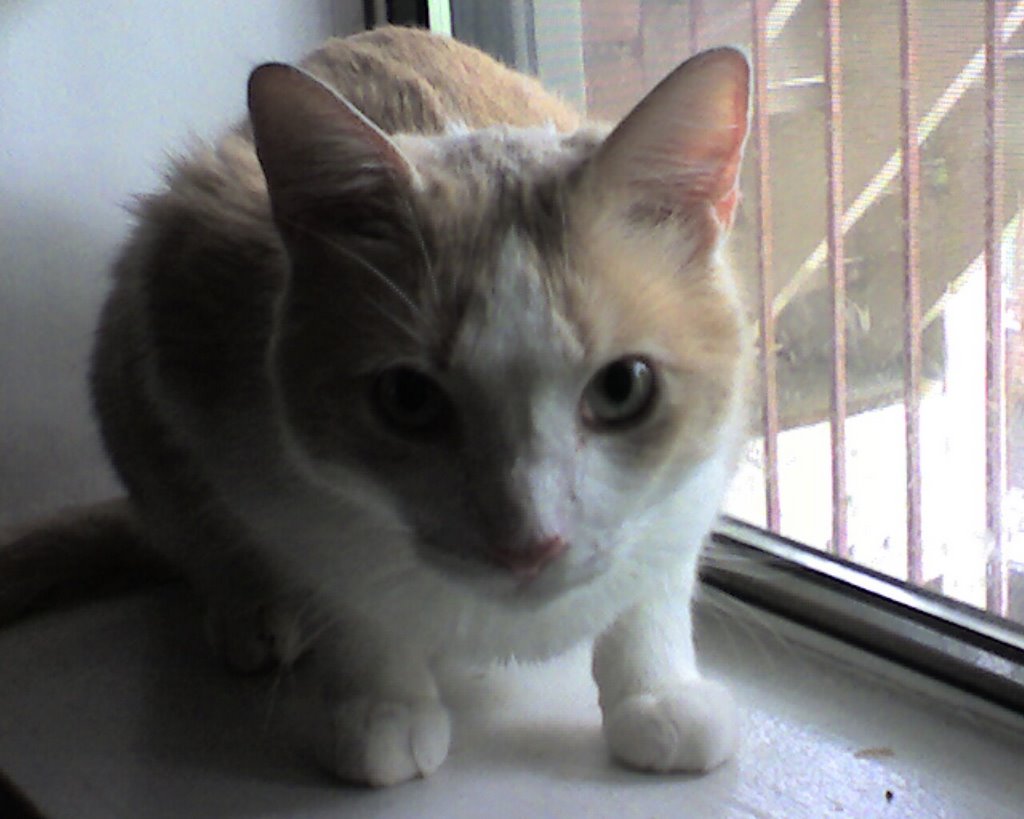 I was visiting a patient today to follow up on a finger lesion that we biospied in the office on Wednesday. Although my patient was moderately concerned with her finger---which, by the way, looked considerably better---her main concerns rested with her cat (pictured here) who apparently has a upper respiratory infection.
Said cat---"Timmy"---has been sneezing and anorexic for days, and only today began taking azithromycin. My patient was mostly concerned with ongoing anorexia on Timmy's part.
Being a nurse who likes to please, I performed a cursory exam of the surprisingly cooperative feline, felt his belly, palpated his nose and throat and sinuses, checked out his nose and mouth and ears, and concluded that he had no acute GI symptoms and was most likely not eating due to a combination of the antibiotics and a cold. I urged my patient to relax, keep plenty of fluids and cat food available to him at all times, and recommended she follow up with her vet if Tommy isn't better by Monday.
As for the finger, the wound culture has so far grown out gram-negative rods and we're waiting to see if the herpes culture is positive or negative. While my patient has already had one lung removed due to adenocarcinoma, I don't think the finger will be killing her any time soon. (Interestingly, she reports having had a colonoscopy recently and thinks that the finger with the lesion was the one that they had in a pulse oximeter. Could she have picked up an infection from poorly cleaned medical equipment? It wouldn't be the first time.)


As for Timmy, I expect a full recovery and give him a prognosis of a very long and happy life, along with the occasional URI.
Tuesday, July 25, 2006
Grand Rounds as Garden
A lovely and visually pleasing edition of Grand Rounds is now up at Medical Humanities. Well worth a gander, I dare say.
Article on Nurse Bloggers Featuring Yours Truly
A very positive and informative article on nurses of the blogosphere is now up on the Advance for Nurses website. Written by Teri Polick, the article features Digital Doorway, Death Maiden, and Emergiblog, with quotes from each blogger interspersed with descriptions of blogs, as well as the nuts and bolts of blogging. Please surf on over.
Monday, July 24, 2006
A Little Shell Shock
After such a balanced and blissful weekend, the reality of Monday morning was difficult to digest. As the morning wore on, my internal mantra of "maintain the relaxation of the weekend within" lost its power and I was then lost to the stress of the day.
I occasionally came up for air, especially when Mary arrived just before noon, knocking on the window behind my desk. I opened the office door to see her, a vision in a lovely summer dress, saying "Can you come out to play?" Smiling, she held our lunch in her hand for us to enjoy by the sprinkler park as children frolicked in the splashing water, some of which misted us as we ate watermelon and organic pistachios. I walked her halfway across the park back towards her sweet Senior Center and we kissed goodbye. She didn't know it, but I looked back three or four times to watch her cross the expanse of grass towards her workplace. I just couldn't stop watching her. It was like my soul was crossing that field. Then I headed to the office and plunged back into the melee, the simplicity of lunch in the park with my love giving way to the complexity of the endless needs of my patients.
It was uphill from there.
I occasionally came up for air, especially when Mary arrived just before noon, knocking on the window behind my desk. I opened the office door to see her, a vision in a lovely summer dress, saying "Can you come out to play?" Smiling, she held our lunch in her hand for us to enjoy by the sprinkler park as children frolicked in the splashing water, some of which misted us as we ate watermelon and organic pistachios. I walked her halfway across the park back towards her sweet Senior Center and we kissed goodbye. She didn't know it, but I looked back three or four times to watch her cross the expanse of grass towards her workplace. I just couldn't stop watching her. It was like my soul was crossing that field. Then I headed to the office and plunged back into the melee, the simplicity of lunch in the park with my love giving way to the complexity of the endless needs of my patients.
It was uphill from there.
Saturday, July 22, 2006
Perseverance
Imagine that you had gone all your life without ever washing, and then one day you decide to take a shower. You start scrubbing away, but then watch in horror as the dirt begins to ooze out of the pores of your skin and stream down your body. Something must be wrong: You were supposed to be getting cleaner and all you can see is grime. You panic and fling yourself out of the shower, convinced that you should never have begun. But you only end up even more dirty than before. You have no way of knowing that the wisest thing to do is to be patient and to finish the shower. It may look for a while as if you are getting even dirtier, but if you keep on washing, you will emerge fresh and clean. It’s all a process, the process of purification.
Whenever doubt arises, see it simply as an obstacle, recognize it as an understanding that is calling out to be clarified or unblocked, and know that it is not a fundamental problem but simply a stage in the process of purification and learning. Allow the process to continue and complete itself, and never lose your trust or resolve. This is the way followed by all the great practitioners of the past, who used to say: “There is no armor like perseverance.”
---Sogyal Rinpoche, from the website Rigpa
You can have daily meditations on living and dying emailed to you from this page.
Friday, July 21, 2006
A Summer Friday in the City
As the temperature peaked around 93 or so today, the "11th Annual Summer Party for Kids" roared its way through the sun-soaked afternoon in the park adjacent to our office and clinic. My wife's senior center for low-income Latinos is on the other side of the park, and people of all ages came to the information tables and the newly-refurbished sprinkler park. Snacks, a DJ, tents for shade, and gifts for the children completed the picture, along with a fire-truck and a police K-9 unit demonstration. Bike helmet and other safety demonstrations were key aspects of the displays. At lunchtime, I took some time out of my day to wander around the celebration with Mary and a coworker.
For all the troubles in this very troubled town, there are still good people making good things happen. Our health center, for example, hosts a Christmas party for the neighborhood children every year, complete with Santa, elves, a very impressive Santa's workshop, substantive gifts for every---and I mean every---child who shows up, free Polaroids of each kid with Santa, music, free food, and the promise of a very good time. The amount of hours put into this undertaking are astronomical and the planning and gift-gathering begin each summer.
All of the numerous social service agencies in our end of the city---serving an 83% Latino community---have banded together to form a committee to oversee and guide the overarching plans for knitting this community together and providing comprehensive services to families and individuals, taking into consideration health, healthcare, economics, elders, children, teens, families, addicts, sex workers, IV drug users, and newborns. The vision is astounding---the implementation will be a challenge. Nonetheless, a well-meaning and ethnically diverse team has assembled itself to transform and restore this community, and there are times when I feel that I could not work anywhere else. Even as the city collapses upon itself---or threatens to---the movers and shakers continue to plow ahead to bring their visions to fruition. To wit, my program of care management for the most vulnerable members of the community was born---and is sustained---by such tenacity of will and desire to serve. That underpinning of heart is what keeps me where I am.
As I watched the children frolic in the sprinkler park and the people chat under the trees, it became easy to overlook the trash, the violence, the corruption, the homelessness, the desperation that walks these streets. Even for a moment, frozen for a summertime pause of sun and water and laughter, the promise of community unfolded and placed a gently soft hand upon the faces of those gathered in such innocent joy and celebration of life. These are instants that cannot, and should not, be taken for granted, and they are truly miracles, conscious manifestations of the power of positive energy, the will to serve, and the desire for togetherness that I feel lives in us all.
For all the troubles in this very troubled town, there are still good people making good things happen. Our health center, for example, hosts a Christmas party for the neighborhood children every year, complete with Santa, elves, a very impressive Santa's workshop, substantive gifts for every---and I mean every---child who shows up, free Polaroids of each kid with Santa, music, free food, and the promise of a very good time. The amount of hours put into this undertaking are astronomical and the planning and gift-gathering begin each summer.
All of the numerous social service agencies in our end of the city---serving an 83% Latino community---have banded together to form a committee to oversee and guide the overarching plans for knitting this community together and providing comprehensive services to families and individuals, taking into consideration health, healthcare, economics, elders, children, teens, families, addicts, sex workers, IV drug users, and newborns. The vision is astounding---the implementation will be a challenge. Nonetheless, a well-meaning and ethnically diverse team has assembled itself to transform and restore this community, and there are times when I feel that I could not work anywhere else. Even as the city collapses upon itself---or threatens to---the movers and shakers continue to plow ahead to bring their visions to fruition. To wit, my program of care management for the most vulnerable members of the community was born---and is sustained---by such tenacity of will and desire to serve. That underpinning of heart is what keeps me where I am.
As I watched the children frolic in the sprinkler park and the people chat under the trees, it became easy to overlook the trash, the violence, the corruption, the homelessness, the desperation that walks these streets. Even for a moment, frozen for a summertime pause of sun and water and laughter, the promise of community unfolded and placed a gently soft hand upon the faces of those gathered in such innocent joy and celebration of life. These are instants that cannot, and should not, be taken for granted, and they are truly miracles, conscious manifestations of the power of positive energy, the will to serve, and the desire for togetherness that I feel lives in us all.
Thursday, July 20, 2006
Burns, Recovery, and Compassion
On my way home from work today, I tuned into NPR and heard a very intense and moving story about military burn victims from the Iraq War being treated for their injuries. Several of the soldiers featured in the story were burned on more than 90% of their bodies, and contrary to expectations, several of those have actually survived. No matter how negatively I feel about the war and its humanitarian (and geopolitical) consequences, these stories of human suffering bring tears to my eyes and occasionally a knot to my stomach, like they did today. Since it would be easy for the reader to click on the link to read and/or listen to the actual story, I don't choose to encapsulate its contents here in this forum.
Aside from the accounts of the soldiers' misfortunes and incredibly painful treatment---some extensive burns require debridement of the charred skin down to a subterranean layer of viable and healthy tissue, exposing thousands of screaming nerve endings---I was extremely touched by the nurses and doctors who were interviewed. One must consider the fact that the staff are working with individuals who are horribly disfigured, often lacking recognizable faces and features. It was explained that pictures of the soldiers before their burns are always hung on the walls around their beds---posing with families and loved ones---to remind the burn unit staff that these are real people with real families, who used to have features that distinguished them and identified them. The supervisors want the staff to know what these men and women really look like, and to treat them from that perspective of wholeness and the recognition of their complete selves.
One nurse described how he has a place along the highway on the way home where he stops to cry, meditate, or scream, so that he can arrive home having released some of the emotions which were generated during the workday. Another describes "cramming" emotions away---a sure recipe for burnout and substance abuse, in my book. Coping mechanisms can sometimes be overwhelmed when such trauma is witnessed, and I can only imagine how a nurse or doctor must feel as he or she debrides an extensive burn, exposing raw nerve endings and tissue. The screams and tears and curses must be powerful and strong. (This is why I hate clinic evenings when I have to give three, four or even five vaccinations to a one-year-old child all at once. The terror and pain in that child's eyes---and the caterwauling screams---are enough to put me over the edge with guilt.)
Such suffering is witnessed by so many around the world---whether parents, children, soldiers, nurses, or the infirm themselves---and I sometimes wonder how we---humanity---carry the weight of such suffering on our collective conscience. Aside from the right or wrong of war, the good and bad things inflicted upon human beings by other humans beings, there are stories of heroism, compassion, and incredible kindness around every corner. This story which beamed to my car across the airwaves today was just one small reminder of one small corner of the drama experienced by a relatively tiny portion of this multicellular organism we call humanity.
Even as I write, at this moment, those burned soldiers dream morphine dreams of blissful forgetfulness while a mother in Beirut mourns her three-year-old killed by a bomb, or an Israeli settler bemoans the ruins of his home, or a homeless man in the city where I work drops his bottle of beer, clutching his chest as a heart attack commences to extinguish his unsung life. And at that same moment, hundreds---perhaps thousands---of children are born into this world as new parents weep with happiness despite the pain which they know their children may endure in the course of a lifetime on this spinning globe.
Those stories opened something in my heart today, and I'm grateful for the moment of reflection and connection to others. These are the moments when one can sometimes get in touch with that collective unconscious of which Carl Jung spoke, that undercurrent of connectivity which binds us all in our shared humanity. Perhaps this story opened my heart as I thought of an old friend undergoing surgery for cancer today, or another friend recently hospitalized with a dangerously high fever induced by a tick-bite, or the daughter of a former boss who suddenly died this week at 33. The drama is multifaceted, and I can choose to send all beings a wish for happiness and wholeness, recovery and hope. Stories can do this to us, and that ability to listen and recognize the suffering and tribulations of others may be the key to cultivating more compassion each day. Compassion for others---an important lesson worth learning again and again.
Aside from the accounts of the soldiers' misfortunes and incredibly painful treatment---some extensive burns require debridement of the charred skin down to a subterranean layer of viable and healthy tissue, exposing thousands of screaming nerve endings---I was extremely touched by the nurses and doctors who were interviewed. One must consider the fact that the staff are working with individuals who are horribly disfigured, often lacking recognizable faces and features. It was explained that pictures of the soldiers before their burns are always hung on the walls around their beds---posing with families and loved ones---to remind the burn unit staff that these are real people with real families, who used to have features that distinguished them and identified them. The supervisors want the staff to know what these men and women really look like, and to treat them from that perspective of wholeness and the recognition of their complete selves.
One nurse described how he has a place along the highway on the way home where he stops to cry, meditate, or scream, so that he can arrive home having released some of the emotions which were generated during the workday. Another describes "cramming" emotions away---a sure recipe for burnout and substance abuse, in my book. Coping mechanisms can sometimes be overwhelmed when such trauma is witnessed, and I can only imagine how a nurse or doctor must feel as he or she debrides an extensive burn, exposing raw nerve endings and tissue. The screams and tears and curses must be powerful and strong. (This is why I hate clinic evenings when I have to give three, four or even five vaccinations to a one-year-old child all at once. The terror and pain in that child's eyes---and the caterwauling screams---are enough to put me over the edge with guilt.)
Such suffering is witnessed by so many around the world---whether parents, children, soldiers, nurses, or the infirm themselves---and I sometimes wonder how we---humanity---carry the weight of such suffering on our collective conscience. Aside from the right or wrong of war, the good and bad things inflicted upon human beings by other humans beings, there are stories of heroism, compassion, and incredible kindness around every corner. This story which beamed to my car across the airwaves today was just one small reminder of one small corner of the drama experienced by a relatively tiny portion of this multicellular organism we call humanity.
Even as I write, at this moment, those burned soldiers dream morphine dreams of blissful forgetfulness while a mother in Beirut mourns her three-year-old killed by a bomb, or an Israeli settler bemoans the ruins of his home, or a homeless man in the city where I work drops his bottle of beer, clutching his chest as a heart attack commences to extinguish his unsung life. And at that same moment, hundreds---perhaps thousands---of children are born into this world as new parents weep with happiness despite the pain which they know their children may endure in the course of a lifetime on this spinning globe.
Those stories opened something in my heart today, and I'm grateful for the moment of reflection and connection to others. These are the moments when one can sometimes get in touch with that collective unconscious of which Carl Jung spoke, that undercurrent of connectivity which binds us all in our shared humanity. Perhaps this story opened my heart as I thought of an old friend undergoing surgery for cancer today, or another friend recently hospitalized with a dangerously high fever induced by a tick-bite, or the daughter of a former boss who suddenly died this week at 33. The drama is multifaceted, and I can choose to send all beings a wish for happiness and wholeness, recovery and hope. Stories can do this to us, and that ability to listen and recognize the suffering and tribulations of others may be the key to cultivating more compassion each day. Compassion for others---an important lesson worth learning again and again.
Wednesday, July 19, 2006
The Probation Tax
We have a patient whose age, race and other identifiers are inconsequential. Suffice it to say that this client is physically disabled in a major way and has managed to remain substantially independent despite his disability, living on his own, maintaining an apartment,with frequent visits with his children by several different women. This very kind gentleman was on the wrong side of the law as a young adult, was convicted of some small-time non-violent drug offenses, and has been on probation for some time. His Probation Officer seems to be one of those individuals in law enforcement who goes out of their way to make others' lives miserable, and we have gone to bat for this most exemplary of clients several times. Anyone on our team who gets to know this individual cannot help but be fond of him. He's a very magnetic and genuine personality.
Our client has expressed determination and a fierce desire to pursue an education, overcome his disability, and enter the workforce. Eager to help others, he has grand plans for how he would actualize himself and bring his many gifts to others. Through many applications and beaureaucratic processes, my coworker enabled this gentleman to be approved for classes, training, and a free home computer to facilitate his academic success. Our pleasure at seeing his face light up when talking about his future is beyond measure, and his plans for the future only seem to expand.
This week, a huge monkey wrench was thrown into the works in the guise of The War on Drugs. It appears that, due to misdemeanor drug possession charges and mandatory minimum sentencing laws with prolonged probation, this gentleman---who is eager to make something of himself, give back to the world, and contribute to society---is thwarted in his desire by the fact that his past convictions and current probation preclude his ability to receive even one dollar in financial aid. With classes ready to be registered for, a computer ready for delivery, and training all set to commence, his dreams and aspirations are now dashed against the rocks of misguided government action.
While white collar criminals bilk retirees of millions, slum-lords charge outrageous rents for substandard housing, the Big Dig in Boston collapses under its own weight, and members of law enforcement (including the CIA and FBI) appear to profit from involvement in the international drug trade, this promising young man with so much to give cannot receive the education he needs to remove himself from the rolls of Social Security Disability and create a new life. For all the talk of the "rehabilitation" of criminals, the government's denial of financial aid for the education of those on probation for minor non-violent crimes flies in the face of all logic and ethics. If this society was to put into words its goals for the future of non-violent offenders, those words would certainly reflect a desire for such individuals to receive education and training which would make them productive, peaceful, tax-paying citizens contributing to the welfare of the larger society while simultaneously pursuing self-mastery and personal fulfillment.
So, in light of this maddeningly Kafkaesque outcome, our protagonist cannot pursue his dreams, better himself, or otherwise lift himself from poverty and economic reliance upon the state, because his previous actions preclude his receiving financial assistance for training and education. Rather, he should languish in uneducated disability, unable to obtain the skills training needed for advancement and gainful, tax-paying employment. It's just another great example which proves that the War on Drugs is really just a War on the Poor; and the war, my friends, is simply never over.
Our client has expressed determination and a fierce desire to pursue an education, overcome his disability, and enter the workforce. Eager to help others, he has grand plans for how he would actualize himself and bring his many gifts to others. Through many applications and beaureaucratic processes, my coworker enabled this gentleman to be approved for classes, training, and a free home computer to facilitate his academic success. Our pleasure at seeing his face light up when talking about his future is beyond measure, and his plans for the future only seem to expand.
This week, a huge monkey wrench was thrown into the works in the guise of The War on Drugs. It appears that, due to misdemeanor drug possession charges and mandatory minimum sentencing laws with prolonged probation, this gentleman---who is eager to make something of himself, give back to the world, and contribute to society---is thwarted in his desire by the fact that his past convictions and current probation preclude his ability to receive even one dollar in financial aid. With classes ready to be registered for, a computer ready for delivery, and training all set to commence, his dreams and aspirations are now dashed against the rocks of misguided government action.
While white collar criminals bilk retirees of millions, slum-lords charge outrageous rents for substandard housing, the Big Dig in Boston collapses under its own weight, and members of law enforcement (including the CIA and FBI) appear to profit from involvement in the international drug trade, this promising young man with so much to give cannot receive the education he needs to remove himself from the rolls of Social Security Disability and create a new life. For all the talk of the "rehabilitation" of criminals, the government's denial of financial aid for the education of those on probation for minor non-violent crimes flies in the face of all logic and ethics. If this society was to put into words its goals for the future of non-violent offenders, those words would certainly reflect a desire for such individuals to receive education and training which would make them productive, peaceful, tax-paying citizens contributing to the welfare of the larger society while simultaneously pursuing self-mastery and personal fulfillment.
So, in light of this maddeningly Kafkaesque outcome, our protagonist cannot pursue his dreams, better himself, or otherwise lift himself from poverty and economic reliance upon the state, because his previous actions preclude his receiving financial assistance for training and education. Rather, he should languish in uneducated disability, unable to obtain the skills training needed for advancement and gainful, tax-paying employment. It's just another great example which proves that the War on Drugs is really just a War on the Poor; and the war, my friends, is simply never over.
Tuesday, July 18, 2006
Poverty, Consumption and the Pursuit of Happiness
The other day, while helping a patient put together an application for a social service program, we went over some monthly bills which she had brought to my office to include as documentation of her expenses. Other than her subsidized rent, her monthly bills included a cell phone, a land-line, cable TV, and monthly payments on leased furniture. She has no credit cards (and those who do pay extortionate interest rates!), but the interest and fees she pays for her leased furniture more than makes up for her lack of a Visa or MasterCard.
I often forget that many of my patients actually lease their furniture and large-screen TVs from local leasing companies. I'm genuinely shocked at the size of some of my patients' television screens and the excessively massive furniture (all black with fake gold and chrome plating) which crowds their apartments and homes. I was also shocked a few years ago when I realized the enormous amounts of money which is spent on the leasing of such home furnishings.
While perusing my patient's lease agreement, I could see that a mediocre dining-room set with four chairs, retailing at around $600, was going to cost this woman on a fixed income more than $1300 by the time she finished the payments over several years. Add to this mix the great risk which she runs of having the items reposessed if she happens to become ill, get hospitalized, or otherwise miss a monthly payment, thus forfeiting all of the money which she has already paid on said furnishings. This type of exploitation (and poor judgement) makes my blood boil.
After she left my office, I spent some time pondering the reasons behind such behavior and consumption. I had asked her why she leased under such horrible and exploitative terms rather than simply saving up money and purchasing a dining room set outright for much less money, and she could not necessarily answer me in a way that explained her actions. What I surmised from her answer is that "this is what is done" and she didn't necessarily have the skills to do anything differently. I was perplexed, but was (and am) undaunted in my determination to more fully understand.
From my solid middle-class perspective, it's relatively easy to not see the other side, to turn a blind eye to the eagerness of those less fortunate to rise up, or to at least have surroundings which make one feel more comfortable and on a par with others. Don't so many of us strive for more? I told myself to look deeply at the circumstance of a disabled person with multiple illnesses, perhaps a history of emotional trauma, and generations of poverty and struggle. That person watches TV, takes in thousands of commercials and advertisements enticing him or her towards a better life of conspicuous consumption, and numerous television shows and movies portray beautiful people in beautiful surroundings enjoying comfortable furniture, the latest technology, the most chic of homes, and the latest and greatest gadgets and toys. Cinderella stories---in the form of "American Idol" and "The Apprentice", for example---demonstrate that ordinary people can transform their lives and reap the benefits of fame and wealth almost overnight. The economically disadvantaged watch these shows with zeal, look around at their homes, and are determined to bring some semblance of that wealth into their own living rooms and bedrooms.
Is this a fair theory? Are they victims of the free market and the media's relentless presentation of the contentment which consumption might deliver? Do they, in their desire for a more comfortable life, miss an opportunity to reexamine how they wish to spend the little money with which they manage their lives? And when they complain that they don't have the $1 co-payment for their antihypertensive medication (and believe that they should not have a government-mandated co-payment in the first place), is it fair to remind them how much they pay for cable and their dining room set? Is it really my place to use that moment to instill a new way of looking at consumption, economics, and priorities? Am I right to suggest that they downgrade their cable to the $60 package so that they have $15 for medication co-pays each month? My jury is out.
Reflecting on these questions, I examine my own life and financial state and the choices which I make. Do these choices point towards a desire to have more, to live in a way which my income and level of education do not necessarily reflect? Do I also make choices which some would find suspect vis-a-vis the realities of my situation? Do I even have the right to question others' motivations in this regard?
We all strive for happiness and comfort, and in a consumer culture that happiness and comfort is often reflected in our purchasing habits. I feel strongly that I cannot properly address this issue with any substantive acumen in this post, as it would take a great deal of research, reading, and contemplation to get to the heart of this very complicated socioeconomic issue. The bottom line is that I see individuals with whom I interact on a regular basis make choices which may be deleterious to them economically, and which, in my opinion, are based on artificial desires created by suits on Wall Street who decide in boardrooms what the next gimmick may be which they will peddle to the poor masses as those mega-corporations behind these "objects of desire" seek ever-expanding profitability and market control.
Although this may seem far from healthcare-related, economic health and savvy financial planning are actually integrally entwined with health, healthcare, and self-care. An individual's priorities might dictate how often an individual refills prescriptions, how important they feel it is to spend a dollar on the bus ride to a doctor's appointment, or whether they choose between a cable upgrade or fresh vegetables. Consumerism drives our culture and economy (and our healthcare system), and our patients are often pawns in a game which they perhaps are unware even exists. Or perhaps they willingly play that game, openly acknowledging that they desperately want what the purveyors of consumer goods offer so willingly. It is a conundrum of a dizzying order, one with which I struggle, and one which certainly impacts my patients' health---and my sanity.
The next time a patient tells me that they can't afford a dollar for a medication prescribed by their doctor, my response will be colored by these thoughts which I have pondered here, unfortunately never having reached a satisfactory conclusion from which to draw a pearl of wisdom and insight.
The pursuit of happiness, did you say? Yes, and that pursuit may very well take some to Wal-Mart to buy cheap goods made in sweatshops, whether I like it or not. It may also make a woman who can barely afford her rent choose to lease a dining room set for $1000 which she does not have.
This is an exercise in tolerance, in understanding, of confronting internalized classism, and of coming to terms with aspects of our society which drive me to the brink.
May all beings be happy. May all beings be free from suffering. May I be more understanding and compassionate. And while we're at it, may all beings in need find an extra thousand dollars in their bank account on the day they need it most.
I often forget that many of my patients actually lease their furniture and large-screen TVs from local leasing companies. I'm genuinely shocked at the size of some of my patients' television screens and the excessively massive furniture (all black with fake gold and chrome plating) which crowds their apartments and homes. I was also shocked a few years ago when I realized the enormous amounts of money which is spent on the leasing of such home furnishings.
While perusing my patient's lease agreement, I could see that a mediocre dining-room set with four chairs, retailing at around $600, was going to cost this woman on a fixed income more than $1300 by the time she finished the payments over several years. Add to this mix the great risk which she runs of having the items reposessed if she happens to become ill, get hospitalized, or otherwise miss a monthly payment, thus forfeiting all of the money which she has already paid on said furnishings. This type of exploitation (and poor judgement) makes my blood boil.
After she left my office, I spent some time pondering the reasons behind such behavior and consumption. I had asked her why she leased under such horrible and exploitative terms rather than simply saving up money and purchasing a dining room set outright for much less money, and she could not necessarily answer me in a way that explained her actions. What I surmised from her answer is that "this is what is done" and she didn't necessarily have the skills to do anything differently. I was perplexed, but was (and am) undaunted in my determination to more fully understand.
From my solid middle-class perspective, it's relatively easy to not see the other side, to turn a blind eye to the eagerness of those less fortunate to rise up, or to at least have surroundings which make one feel more comfortable and on a par with others. Don't so many of us strive for more? I told myself to look deeply at the circumstance of a disabled person with multiple illnesses, perhaps a history of emotional trauma, and generations of poverty and struggle. That person watches TV, takes in thousands of commercials and advertisements enticing him or her towards a better life of conspicuous consumption, and numerous television shows and movies portray beautiful people in beautiful surroundings enjoying comfortable furniture, the latest technology, the most chic of homes, and the latest and greatest gadgets and toys. Cinderella stories---in the form of "American Idol" and "The Apprentice", for example---demonstrate that ordinary people can transform their lives and reap the benefits of fame and wealth almost overnight. The economically disadvantaged watch these shows with zeal, look around at their homes, and are determined to bring some semblance of that wealth into their own living rooms and bedrooms.
Is this a fair theory? Are they victims of the free market and the media's relentless presentation of the contentment which consumption might deliver? Do they, in their desire for a more comfortable life, miss an opportunity to reexamine how they wish to spend the little money with which they manage their lives? And when they complain that they don't have the $1 co-payment for their antihypertensive medication (and believe that they should not have a government-mandated co-payment in the first place), is it fair to remind them how much they pay for cable and their dining room set? Is it really my place to use that moment to instill a new way of looking at consumption, economics, and priorities? Am I right to suggest that they downgrade their cable to the $60 package so that they have $15 for medication co-pays each month? My jury is out.
Reflecting on these questions, I examine my own life and financial state and the choices which I make. Do these choices point towards a desire to have more, to live in a way which my income and level of education do not necessarily reflect? Do I also make choices which some would find suspect vis-a-vis the realities of my situation? Do I even have the right to question others' motivations in this regard?
We all strive for happiness and comfort, and in a consumer culture that happiness and comfort is often reflected in our purchasing habits. I feel strongly that I cannot properly address this issue with any substantive acumen in this post, as it would take a great deal of research, reading, and contemplation to get to the heart of this very complicated socioeconomic issue. The bottom line is that I see individuals with whom I interact on a regular basis make choices which may be deleterious to them economically, and which, in my opinion, are based on artificial desires created by suits on Wall Street who decide in boardrooms what the next gimmick may be which they will peddle to the poor masses as those mega-corporations behind these "objects of desire" seek ever-expanding profitability and market control.
Although this may seem far from healthcare-related, economic health and savvy financial planning are actually integrally entwined with health, healthcare, and self-care. An individual's priorities might dictate how often an individual refills prescriptions, how important they feel it is to spend a dollar on the bus ride to a doctor's appointment, or whether they choose between a cable upgrade or fresh vegetables. Consumerism drives our culture and economy (and our healthcare system), and our patients are often pawns in a game which they perhaps are unware even exists. Or perhaps they willingly play that game, openly acknowledging that they desperately want what the purveyors of consumer goods offer so willingly. It is a conundrum of a dizzying order, one with which I struggle, and one which certainly impacts my patients' health---and my sanity.
The next time a patient tells me that they can't afford a dollar for a medication prescribed by their doctor, my response will be colored by these thoughts which I have pondered here, unfortunately never having reached a satisfactory conclusion from which to draw a pearl of wisdom and insight.
The pursuit of happiness, did you say? Yes, and that pursuit may very well take some to Wal-Mart to buy cheap goods made in sweatshops, whether I like it or not. It may also make a woman who can barely afford her rent choose to lease a dining room set for $1000 which she does not have.
This is an exercise in tolerance, in understanding, of confronting internalized classism, and of coming to terms with aspects of our society which drive me to the brink.
May all beings be happy. May all beings be free from suffering. May I be more understanding and compassionate. And while we're at it, may all beings in need find an extra thousand dollars in their bank account on the day they need it most.
Friday, July 14, 2006
Execution and the Medical Professional
Having just watched Now on PBS with David Brancaccio, I was moved to write about tonight's story which discussed the role of doctors and nurses in the executions of condemned prisoners. The Now reporter presented what I felt was a relatively dispassionate airing of the various sides of this very controversial issue, the website providing further facts and figures for the curious.
Whether one opposes or supports capital punishment, the myriad questions raised in its discussion are thought-provoking and quite worthy of consideration. The media has recently focused a fair amount of attention on the various court decisions which have ruled lethal injection as a flawed form of execution which is in dire need of readdressing. Many opponents have stated that the cocktails used for the euthanization of animals in the United States are far more effective in producing a soporific effect with no apparent experience of pain than those used in our prison system today. Horrific stories have been published of condemned prisoners complaining of pain while undergoing injection, one particularly gruesome account detailing that technicians needed 90 minutes to complete the execution of a man who kept raising his head from the gurney to say "It ain't workin'!" These stories send chills down my spine and underscore the next questions that I will raise.
In these times, we have come to understand that execution has become "medicalized", in that it no longer involves a firing squad or hangman---it now involves IV access, the administration of sedatives and narcotics, and the need for medical oversight of such an undertaking (no pun intended). During tonight's show on PBS, a nurse from Georgia who participates in executions was interviewed about her experience. In her descriptions of the executions in which she takes part, she carefully stated that she does not see herself---nor the anesthesiologists who actually push the plungers---as executioners. She sees the execution team as a group of professionals carrying out orders, the "executioner" actually being "The State". This Kafkaesque denial of responsibility was difficult for me to swallow, as was a doctor's statement that by solely overseeing the heart monitor and vitals of the "patient", he was not actually participating in the execution, rather, he was advocating for the prisoner and assuring that no undue suffering was occuring.
To wit, the AMA states clearly that a doctor "should not be a participant in a legally authorized execution. Physician participation in execution is defined generally as actions which would fall into one or more of the following categories: (1) an action which would directly cause the death of the condemned; (2) an action which would assist, supervise, or contribute to the ability of another individual to directly cause the death of the condemned; (3) an action which could automatically cause an execution to be carried out on a condemned prisoner." Additionally, the American Nurses Association states that "participation in executions is considered contrary to the fundamental goals and ethical traditions of the [nursing] profession."
Taking into consideration the Hippocratic Oath of "do no harm", as well as the many pledges taken by (and professional standards imposed upon) nurses, takng active part in the carrying out of executions seems to be a contradiction of any medical code of ethics with which I am even vaguely familiar. Reading the AMA position statement, even consulting with the administering personnel would be a violation of the physician's role as healer. That said, some doctors' defense of the practice---and continued participation in such---has led to proceedings and investigations, although whether licenses have actually been revoked is unknown to this writer.
This article by Atul Gawande, MD, is certainly worthy of perusal. Dr. Gawande is firmly against the participation of any medical professionals in state-sanctioned executions of any kind, and his article was published in the March 23rd edition of NEJM earlier this year.
When considering "non-traditional" roles for doctors and nurses and other medical professionals---whether it be participation and medical oversight of interrogations at Guantanamo Bay, oversight of medical experiments on those unable to defend themselves (remember the institutions for the mentally retarded in the 20th century?), or the doctors who colluded in the Nazi experiments in the 1940s---one must bear in mind the ethical and moral issues underscored when such acts are committed by said indivduals. While there are some stellar prison healthcare facilities which offer state of the art compassionate care to the incarcerated, there are those in the shadows who, rather than contributing to the health and recuperation of the imprisoned, actually are complicit in the extinguishing of those lives.
Whether we can truthfully say that "The State"---a faceless entity---is the true executioner or not, many of our brethren and colleagues are taking part in the ending of life for reasons other than the relieving of suffering. One might argue that execution provides "closure" and relief from suffering for the loved ones of the victims of violent crime. That said, it is still a stretch---in my mind---that there is any precedent for a medical professional to take part in such an act and still truly call him- or herself a healer.
Whether one opposes or supports capital punishment, the myriad questions raised in its discussion are thought-provoking and quite worthy of consideration. The media has recently focused a fair amount of attention on the various court decisions which have ruled lethal injection as a flawed form of execution which is in dire need of readdressing. Many opponents have stated that the cocktails used for the euthanization of animals in the United States are far more effective in producing a soporific effect with no apparent experience of pain than those used in our prison system today. Horrific stories have been published of condemned prisoners complaining of pain while undergoing injection, one particularly gruesome account detailing that technicians needed 90 minutes to complete the execution of a man who kept raising his head from the gurney to say "It ain't workin'!" These stories send chills down my spine and underscore the next questions that I will raise.
In these times, we have come to understand that execution has become "medicalized", in that it no longer involves a firing squad or hangman---it now involves IV access, the administration of sedatives and narcotics, and the need for medical oversight of such an undertaking (no pun intended). During tonight's show on PBS, a nurse from Georgia who participates in executions was interviewed about her experience. In her descriptions of the executions in which she takes part, she carefully stated that she does not see herself---nor the anesthesiologists who actually push the plungers---as executioners. She sees the execution team as a group of professionals carrying out orders, the "executioner" actually being "The State". This Kafkaesque denial of responsibility was difficult for me to swallow, as was a doctor's statement that by solely overseeing the heart monitor and vitals of the "patient", he was not actually participating in the execution, rather, he was advocating for the prisoner and assuring that no undue suffering was occuring.
To wit, the AMA states clearly that a doctor "should not be a participant in a legally authorized execution. Physician participation in execution is defined generally as actions which would fall into one or more of the following categories: (1) an action which would directly cause the death of the condemned; (2) an action which would assist, supervise, or contribute to the ability of another individual to directly cause the death of the condemned; (3) an action which could automatically cause an execution to be carried out on a condemned prisoner." Additionally, the American Nurses Association states that "participation in executions is considered contrary to the fundamental goals and ethical traditions of the [nursing] profession."
Taking into consideration the Hippocratic Oath of "do no harm", as well as the many pledges taken by (and professional standards imposed upon) nurses, takng active part in the carrying out of executions seems to be a contradiction of any medical code of ethics with which I am even vaguely familiar. Reading the AMA position statement, even consulting with the administering personnel would be a violation of the physician's role as healer. That said, some doctors' defense of the practice---and continued participation in such---has led to proceedings and investigations, although whether licenses have actually been revoked is unknown to this writer.
This article by Atul Gawande, MD, is certainly worthy of perusal. Dr. Gawande is firmly against the participation of any medical professionals in state-sanctioned executions of any kind, and his article was published in the March 23rd edition of NEJM earlier this year.
When considering "non-traditional" roles for doctors and nurses and other medical professionals---whether it be participation and medical oversight of interrogations at Guantanamo Bay, oversight of medical experiments on those unable to defend themselves (remember the institutions for the mentally retarded in the 20th century?), or the doctors who colluded in the Nazi experiments in the 1940s---one must bear in mind the ethical and moral issues underscored when such acts are committed by said indivduals. While there are some stellar prison healthcare facilities which offer state of the art compassionate care to the incarcerated, there are those in the shadows who, rather than contributing to the health and recuperation of the imprisoned, actually are complicit in the extinguishing of those lives.
Whether we can truthfully say that "The State"---a faceless entity---is the true executioner or not, many of our brethren and colleagues are taking part in the ending of life for reasons other than the relieving of suffering. One might argue that execution provides "closure" and relief from suffering for the loved ones of the victims of violent crime. That said, it is still a stretch---in my mind---that there is any precedent for a medical professional to take part in such an act and still truly call him- or herself a healer.
Thursday, July 13, 2006
Change of Shift, Vol. I, No. II
The second edition of Change of Shift, a blog carnival for and about nurses and nursing, can be viewed by clicking here. Please pay a visit if you are so inclined.
Tuesday, July 11, 2006
Of Vacation's End and The Sisyphus Syndrome
I knew that vacation was over when I walked into the office and a patient's boyfriend was waiting for me. My patient gets a narcotic prescription every Tuesday and I guess I had failed to make sure the script got written on Monday before my return to work. Oh well. I found a sympathetic doc who didn't mind penning the script and sent the boyfriend on his merry way.
Next came the mailbox filled with papers to review, the email inbox to slog through, and the new technology in the form of a Treo smartphone which needed a great deal of attention and detail management. Juggling my old Palm Pilot, old pager, new Treo, old cell-phone (with all the numbers I need and no way to transfer them to the new phone)---it was a post-modern mess. See this post for the recent history of our office's techno-struggle.
I jokingly asked the administrative staff if they had sent out a notice to all of my patients that I would be back at 9am today because the phone began to ring and didn't really stop all day for the most part. Aside from the few prescriptions I called in and fax'd, my day did not feel very "nurse-like"---more administrative and desk-based. What is "nurse-like" really like, anyway? Probably however I feel at any point of the day is nurse-like enough, dammit.
As a "wellness and health broker"---a term (that I think I made up) which I have come to see as indicative of some aspects of my work---I felt today like there were so many threads which I again needed to find and pursue. My brain's problem was the fact that remembering the details of what comes next for approximately 80 people is a Herculean task (or is it more Sisyphean? You be the judge!) Who was it who needed a follow-up visit this week? Whose blood sugar is most uncontrolled? Who died? Who's in the hospital? Whose med box needed filling today? What about those narcotics? Did that patient I love really go to Puerto Rico to die? Sisyphus would surely let this rock go a-tumblin'.
The devil is certainly in the details, as the saying goes, and the devil of details is certainly the devil I know intimately. Does one become a nurse because one enjoys the micro-management of endless minutiae? Do all nurses make those little boxes next to the items on their t0-do lists and then garner a perverse pleasure from checking those boxes off? Again, you be the judge, folks, but my obsessive-compulsive side sure likes being a nurse.
So, as Zen Mind, Vacationer's Mind gives way to Worker-Bee Mind, I'll do my damndest to make the evenings and weekends their own little vacations, while still being the (watered down) productive-obsessive which I am to my core.
The circus-tent of work as a nurse never ceases to entertain, even if that entertainment sometimes carries a certain sadomasochistic aura. I re-enter the fray, rested and vacated, but still sadly longing for the briefly carefree days of vacation. Head down, nose already sharpening on grindstone, can that softening and loosening of the tightened mind which occurs on holiday still retain its afterglow? Stay tuned......
Next came the mailbox filled with papers to review, the email inbox to slog through, and the new technology in the form of a Treo smartphone which needed a great deal of attention and detail management. Juggling my old Palm Pilot, old pager, new Treo, old cell-phone (with all the numbers I need and no way to transfer them to the new phone)---it was a post-modern mess. See this post for the recent history of our office's techno-struggle.
I jokingly asked the administrative staff if they had sent out a notice to all of my patients that I would be back at 9am today because the phone began to ring and didn't really stop all day for the most part. Aside from the few prescriptions I called in and fax'd, my day did not feel very "nurse-like"---more administrative and desk-based. What is "nurse-like" really like, anyway? Probably however I feel at any point of the day is nurse-like enough, dammit.
As a "wellness and health broker"---a term (that I think I made up) which I have come to see as indicative of some aspects of my work---I felt today like there were so many threads which I again needed to find and pursue. My brain's problem was the fact that remembering the details of what comes next for approximately 80 people is a Herculean task (or is it more Sisyphean? You be the judge!) Who was it who needed a follow-up visit this week? Whose blood sugar is most uncontrolled? Who died? Who's in the hospital? Whose med box needed filling today? What about those narcotics? Did that patient I love really go to Puerto Rico to die? Sisyphus would surely let this rock go a-tumblin'.
The devil is certainly in the details, as the saying goes, and the devil of details is certainly the devil I know intimately. Does one become a nurse because one enjoys the micro-management of endless minutiae? Do all nurses make those little boxes next to the items on their t0-do lists and then garner a perverse pleasure from checking those boxes off? Again, you be the judge, folks, but my obsessive-compulsive side sure likes being a nurse.
So, as Zen Mind, Vacationer's Mind gives way to Worker-Bee Mind, I'll do my damndest to make the evenings and weekends their own little vacations, while still being the (watered down) productive-obsessive which I am to my core.
The circus-tent of work as a nurse never ceases to entertain, even if that entertainment sometimes carries a certain sadomasochistic aura. I re-enter the fray, rested and vacated, but still sadly longing for the briefly carefree days of vacation. Head down, nose already sharpening on grindstone, can that softening and loosening of the tightened mind which occurs on holiday still retain its afterglow? Stay tuned......
Subscribe to:
Posts (Atom)